Feature

The Nomad is Home to Milwaukee’s Second On-Street Bike Corral
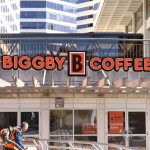
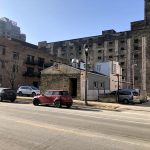
Portland has 67 on-street bike corrals while Milwaukee now has just two. With the latest being installed this past week at the Nomad on the Lower East Side. The Nomad's new bike corral is located in an used space along Warren St., and just as Alterra's on-street bike corral removed no regular automobile parking spots, none were removed to install these racks.
Jul 18th, 2011 by Dave Reid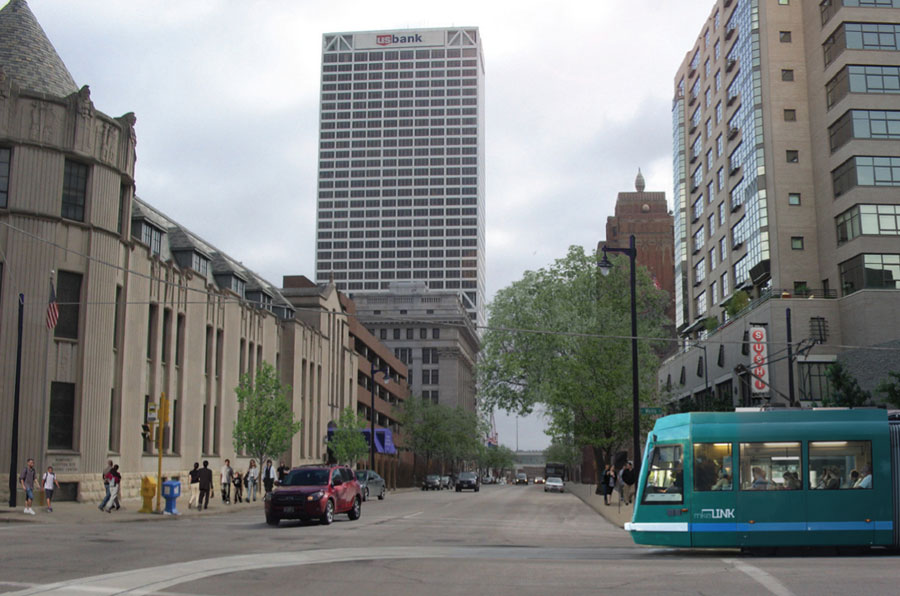
Milwaukee Moves Forward!
Council committee moves forward with the streetcar.
Jul 15th, 2011 by Dave Reid
Brighten The Passage
Walking from downtown to the Historic Third Ward can be an uncomfortable experience. I-794 and the sea of surface parking lots on Water St., Broadway, and Milwaukee St. create an isolated and intimidating dead spot that deters pedestrians from walking between the two districts.
Jul 13th, 2011 by Dave Reid
Keep the Milwaukee Streetcar Moving Forward
The Milwaukee Streetcar is projected to go before the Steering & Rules Committee of the Milwaukee Common Council next week. If the project is able to pass the Steering & Rules Committee it is widely believed that it will pass the Common Council as a whole. However, passage by the Steering & Rules Committee is far from a sure thing, and now is a critical time to make your voice heard so that the project can move forward.
Jul 8th, 2011 by Jeramey Jannene
Building an Aerotropolis in Milwaukee
What would an aerotropolis bring to Milwaukee? What does Milwaukee need to do to get there? Better yet, what is an aerotropolis? I recently completed reading Aerotropolis: The Way We'll Live Next by Greg Lindsay and John Kasarda, and couldn't help but continually think about how the idea of an aerotropolis fits with Milwaukee.
Jun 28th, 2011 by Jeramey Jannene
SITE Artists in the Community
Over the past couple of years, there have been a number of public art crises in Milwaukee. This has included the city removing a TRUE Skool mural, the arts community coming forward to save the Janet Zweig project for Wisconsin Avenue, and County Executive Chris Abele recently pulling the funding for a Milwaukee County Public Art Committee percent for art sculpture.
Jun 24th, 2011 by Pegi Christiansen
Wells St. Two-way Street Conversion is Long Overdue
At Thursday’s Public Safety Committee meeting a file will be voted on that would authorize the conversion of Wells St. to two-way operation from 6th St. to Prospect Ave. According to the Journal Sentinel, the Wisconsin Center District Board voted to oppose part of this conversion, in particular from 4th Street to 6th Street, due to “safety” concerns. These concerns miss the big picture and can be handled while bringing the benefits of making Wells St. two-ways in downtown Milwaukee. Well Street’s one-way configuration brings an assortment of issues that negatively impact the neighborhood it passes through. In particular it is common to see cars continuously circling the block, because a parking spot is not easily accessible without circling the neighborhood. Another direct result of Wells St. being a one-way street, with little congestion, and having multiple travel lanes is that people speed excessively. This is an all too frequent occurrence. Additionally, crashes occur when drivers attempt to turn left from the center lane, because the nature of the street doesn’t fit with the location, causing an accident. Finally, it is all to common to see are drivers heading in the wrong direction along Wells St. A two-way street conversion would alleviate these issues while bringing benefits to the city. A benefit is that a two-way conversion will make Wells St. more pedestrian friendly, as no longer will one need to cross a “freeway” to get across the street. It will bring enhanced visibility to retail establishments, drawing in more of the infrequent drivers passing through the neighborhood. Additionally, for automobile drivers it will actually enhance connectivity by reducing the need to loop around to find a parking spot or a missed intersection. Finally, it will reduce traffic speeds along Wells St., improving safety for both the pedestrian and the automobile driver. This change is long overdue and hopefully this is just another step toward a more connected, accessible, and safe built environment in downtown Milwaukee.
Jun 22nd, 2011 by Dave Reid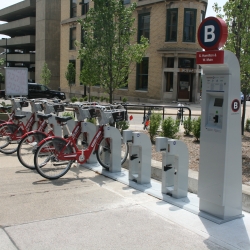
Bike-sharing is coming to Milwaukee!
Bike-sharing is coming to Milwaukee, or at least to Discovery World for a limited time. On Thursday June 23rd, from 11am-2pm, B-cycle, a partnership between Humana, Trek Bicycle and Crispin Porter + Bogusky, will be bringing their 5-bike, demonstration station to Discovery World.
Jun 21st, 2011 by Dave Reid
Milwaukee Streetcar at Apex
The Milwaukee Streetcar is finally poised to move forward. Following last May's approval of a preliminary engineering study by the Milwaukee Connector Study Group, the Milwaukee Streetcar project has progressed to the next step in its development. In late June the Public Works Committee and Steering and Rules Committee will take up the project on subsequent days, followed by the full Milwaukee Common Council in early July.
Jun 16th, 2011 by Jeramey Jannene
MSOE Parking Garage Proposal Needs Work
Talks between M&I, MSOE, and Milwaukee County regarding MSOE's proposed parking garage in the Park East have dragged on for months, and it is likely because of a new detail that makes a marginal project into a bad project.
Jun 14th, 2011 by Dave Reid
Growing Local – Recap
UrbanMilwaukee.com spent June 1st through June 4th in Madison live blogging CNU 19. The Congress for New Urbanism brings together architects, urban planners, government officials, and interested citizens to learn about topic related to the New Urbanism. We took part in sessions covering topics such as transit, incremental urbanism, bikeability, economic development, tactical urbanism, stormwater management, and urban design. Take a minute to see for yourself what CNU 19 was all about.
Jun 13th, 2011 by Dave Reid
Triumph of the City
Released February 10th, 2011, Trimuph of the City is the latest book to examine the value of cities. Written by Ed Glaseser, an economist at Harvard, the book explores "How Our Greatest Invention Makes Us Richer, Smarter, Greener, Healthier, and Happier." Dwelling largely on the social aspects of cities, Glaeser walks through the various aspects of city life that enable cities to succeed or fail including public health, public education, and transportation. He walks through evidence-based examples of why cities work to increase their residents wealth and health, examining the spread of ideas and disease as well.
Jun 8th, 2011 by Jeramey Jannene