Council Says Mayor’s Flock Changes Don’t Settle Debate
Plus: The county is addressing its own use, and Tom Tiffany tries to make it an issue in the gubernatorial race.
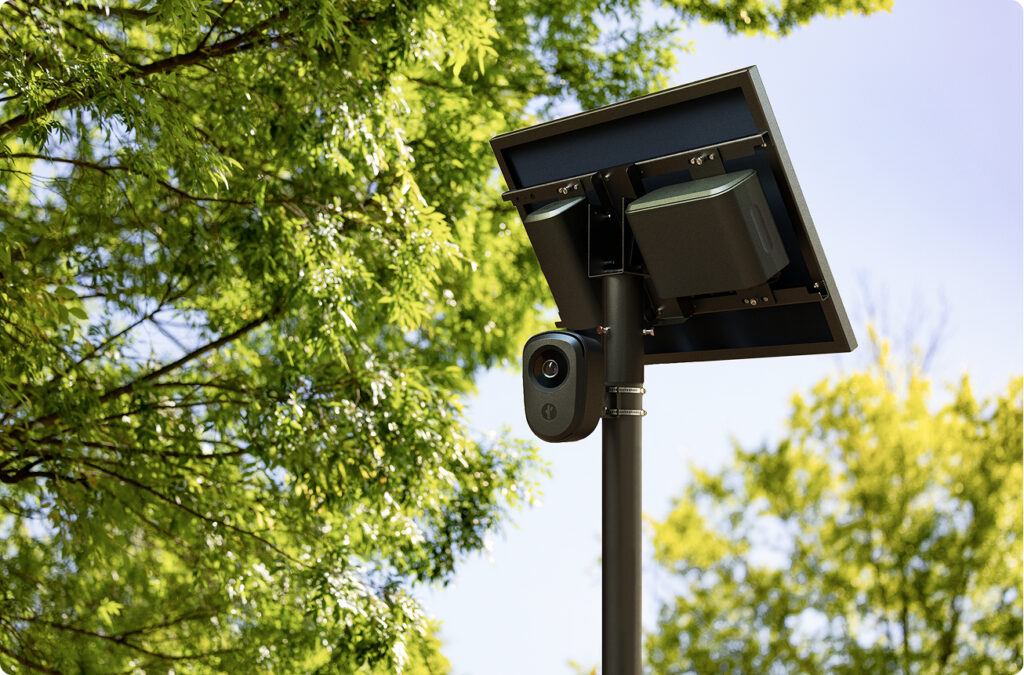
Flock Safety license plate readers are typically mounted on tall poles, with a camera and solar panel on top. The company says its technology is used in more than 6,000 communities across 49 states in partnership with thousands of law enforcement agencies nationwide. (Photo courtesy of Flock Safety)
Mayor Cavalier Johnson and Police Chief Jeffrey Norman announced sweeping new restrictions on Milwaukee’s use of Flock cameras this week, but members of the Common Council who forced the issue say the announcement does not settle the debate.
For Alderwoman Marina Dimitrijevic, who led 12 of the council’s 15 members in demanding changes to the Milwaukee Police Department’s use of the automated license plate-reading system, there are concerns both about what Johnson left out and how he went about announcing the changes.
“I don’t legislate via letter,” Dimitrijevic told Urban Milwaukee in an interview.
The distinction is particularly important because, despite Johnson’s unusually forceful declaration that he was “insisting on significant policy adjustments,” the mayor does not formally control MPD’s standard operating procedures.
Under changes imposed by 2023 Wisconsin Act 12, the police chief controls departmental policy. The Fire & Police Commission (FPC) can study policies and recommend changes, while the Common Council can modify a chief’s policy with a two-thirds vote, or 10 of its 15 members.
Several City Hall sources, including those in support of the mayor’s actions, separately expressed surprise that Johnson inserted himself so directly into a process in which he has no formal policymaking role.
Dimitrijevic said the council deliberately directed its Aug. 25 letter to Norman and the FPC, not Johnson.
“I’m not really sure how much of a direct role the mayor has here,” she said.
The council members had called for the FPC to undertake a public review, hear from MPD and the public and recommend changes by Sept. 30. If the chief declined to make sufficient changes, the council could then use its statutory authority.
Instead, Johnson announced an agreement with Norman and FPC Executive Director Leon W. Todd III six days after the council letter became public.
MPD has now confirmed to Urban Milwaukee that it is working to turn the agreement with Johnson into changes to its standard operating procedures.
That could address one of Dimitrijevic’s central concerns: whether restrictions announced in a press release will become enforceable rules that survive changes in mayors, police chiefs or other city officials.
“Where there is alignment, which I do think there’s some alignment … that should be codified in an SOP,” she said.
The Flock camera issue has become a hotbutton issue following two MPD officers being criminally charged for abusing the system and several Wisconsin communities canceling their contracts with Flock Safety.
First FPC Meeting Is Thursday
The Fire & Police Commission will hold its first meeting since Johnson and Norman’s announcement Thursday evening.
The 6:30 p.m. Sept. 3 agenda includes a broad MPD communication concerning “recent changes to MPD Standard Operating Procedures and/or Standard Operating Instructions.” The item does not specifically mention Flock.
Whether commissioners use the meeting to begin the broader public discussion sought by the council remains to be seen, but a public comment period is certain to include feedback on the issue.
Dimitrijevic said that public process was a central reason the council’s letter asked the FPC to act first.
The commission, she said, offers a venue for research, testimony and discussion over whether the city should tighten restrictions, maintain the cameras under new safeguards or potentially abandon the technology entirely.
“The letter, for me, it doesn’t go far enough and the process should be a public process with FPC, which is a very critical component of this,” she said.
The council’s Aug. 25 letter was signed by Dimitrijevic, Common Council President José G. Pérez, Alex Brower, Sharlen P. Moore, Andrea Pratt, Mark Chambers, Jr., Robert Bauman, Lamont Westmoreland, Milele A. Coggs, DiAndre Jackson, JoCasta Zamarripa and Scott Spiker.
The unusually broad coalition is significant because 10 votes are necessary for the council to impose policy changes over the chief.
Dimitrijevic said she also introduced an entitled-only council file Tuesday to preserve the council’s ability to pursue its own Flock-related SOP changes after the FPC completes its work.
What Is Still Missing?
Johnson’s announcement embraces several of the council’s requests.
Rank-and-file officers and detectives will lose access to Flock, at least for now. Searches will be restricted to Part I crimes, critical missing persons, abductions and drug trafficking organizations. MPD will stop allowing outside agencies to directly search data collected by the city’s 31 cameras, establish a public dashboard and undergo independent audits every six months.
But the council requested a substantially longer list of safeguards.
Members called for a seven-day retention period for routine license plate data, case or computer-aided dispatch numbers and specific justifications for searches, automated misuse detection, restrictions on federal access, protections against use for civil immigration enforcement, limits on use from non-department devices and immediate suspension of Flock access when credible evidence of intentional misuse exists.
Dimitrijevic said Wednesday that the seven-day retention period and a fully external audit remain among her concerns.
Flock itself has recommended a seven-day retention period as part of changes the company announced in August.
Dimitrijevic also said cancellation or non-renewal of Milwaukee’s relationship with Flock remains an option she is willing to consider.
“I guess you could say that it’s on the table for me,” she said.
That would represent a substantial evolution. Dimitrijevic and Spiker were among council members who in April 2025 encouraged MPD to explore expanding Flock partnerships with business improvement districts and neighborhood groups. But since then, two MPD members have been criminally charged with abusing the system and a third is under investigation.
The council’s ability to cancel any agreements with Flock Safety remains an open question. Under state law, the chief has almost complete control over how MPD spends the funding it is allocated. It has recently approved the agreements with Flock using a waiver process for commodity products, sidestepping a council review. The 2027 budget debate is scheduled to begin later this month.
County Also Tightens Flock Rules
A parallel debate is unfolding at Milwaukee County.
County Executive David Crowley issued a directive Tuesday calling for limits on Flock use across county government and asking Sheriff Denita Ball to establish additional restrictions.
Like Johnson, Crowley does not have the authority to order the independently elected sheriff to change law enforcement policy.
But Ball responded with a series of changes that, in several respects, go further than those announced by the city.
The Milwaukee County Sheriff’s Office is reducing its data retention period from 30 days to seven days, limiting access to MCSO personnel, prohibiting data sharing with law enforcement agencies outside Wisconsin and preventing searches of statewide or nationwide data.
Searches must include a case number, offense type and credible justification. Searches relating to immigration status or reproductive health are prohibited. Automated alerts are being limited to stolen vehicles and license plates, violent crimes and missing or endangered people.
MCSO also plans to use Flock’s audit-assistance system to flag questionable searches and automatically lock accounts, and to launch a public transparency portal.
Those restrictions still do not satisfy everyone at the county level. Supervisor Justin Bielinski, chair of the County Board’s Judiciary, Law Enforcement and General Services Committee, is pursuing a resolution that would ban Flock cameras from Milwaukee County Parks entirely.
There are 42 Flock cameras permitted on county parkland, while six additional cameras are located on county roads or equipment for use by municipal police departments.
Flock Enters Governor’s Race
The controversy is also rapidly becoming an issue in the race for governor.
Republican nominee U.S. Rep. Tom Tiffany issued a campaign proposal Wednesday attacking Crowley’s record and promising to halt the use of state funding for Flock cameras while creating a task force to recommend statewide restrictions.
“When it comes to Flock, personal privacy needs to come first,” Tiffany said. “Government should not be building an AI surveillance network that tracks law-abiding Wisconsinites everywhere they drive.”
Tiffany said his task force would consider privacy protections, penalties for misuse, limits on data retention and sharing and protections against foreign adversaries.
But the proposal provides few details about who would serve on the task force, how long its work would take or what restrictions Tiffany himself believes should ultimately become law.
He also said he would prevent shared revenue dollars from being used to purchase Flock cameras until the review is finished.
It is unclear what practical effect that restriction would have in Milwaukee.
Wisconsin shared revenue is unrestricted aid that flows into local government budgets rather than being attached to individual expenditures. But law enforcement agencies can simultaneously receive funding from property taxes, sales taxes, federal grants, forfeiture proceeds and other sources.
It is therefore not clear whether Milwaukee currently pays any Flock expense specifically with shared revenue, or how a Tiffany administration would determine which revenue source ultimately paid for an individual camera.
Tiffany’s criticism also combines several different technologies. His campaign attacks Crowley, the Democratic nomineee, for supporting automated speed and red-light enforcement cameras while serving in the Legislature and for approving county budgets that funded automated license plate readers and Flock cameras.
Crowley, like the mayor, supported automated traffic enforcement and signed budgets that funded license plate-reading technology. His latest position is to retain Flock under significantly tighter restrictions, not eliminate it.
But Tiffany’s attempt to cast himself as a check on AI surveillance also comes after he voted in Congress for legislation that would have sharply limited state-level regulation of artificial intelligence.
In May 2025, Tiffany voted for the House version of President Donald Trump’s sweeping budget reconciliation bill, which passed 215-214. The legislation included a proposed 10-year moratorium on states enforcing laws regulating artificial intelligence systems. The provision drew bipartisan opposition and was ultimately stripped from the bill by the U.S. Senate on a 99-1 vote.
The federal proposal was broader than the specific question of police surveillance and Flock, but Tiffany’s vote complicates his new campaign argument that state government should lead in imposing AI-related guardrails.
Meanwhile, in Milwaukee, officials are moving considerably faster than any proposed gubernatorial task force, but only after the issue has become a national talking point.
Other communities must also grapple with their use of the camera system, including an alleged abuse in Waukesha County where an individual was surveilled after reporting misconduct in the sheriff’s department.
If you think stories like this are important, become a member of Urban Milwaukee and help support real, independent journalism. Plus you get some cool added benefits.
More about the Use of Flock Cameras
- Council Says Mayor’s Flock Changes Don’t Settle Debate - Jeramey Jannene - Sep 3rd, 2026
- MKE County: Crowley Calls for Restrictions on Sheriff’s Flock Cameras - Graham Kilmer - Sep 1st, 2026
- Mayor Demands Restrictions on Milwaukee’s Flock Cameras - Jeramey Jannene - Aug 31st, 2026
- City Hall: Led By Dimitrijevic, Council Demands More Control Over Flock - Jeramey Jannene - Aug 26th, 2026
- Investigator In Flock Stalking Case Now Charged With Felony Misuse of System - Jeramey Jannene - Jul 9th, 2026
- Milwaukee Police Records Show a Growing Surveillance Infrastructure - Devin Blake - Jun 9th, 2026
- Some Wisconsin Communities Dropping Flock Surveillance - Isiah Holmes - Jun 4th, 2026
- Second Milwaukee Police Employee Probed Over Flock Camera Misuse - Jeramey Jannene - May 28th, 2026
- Police Misuse of Flock Surveillance Becoming Statewide Issue - Isiah Holmes - Mar 15th, 2026
- Milwaukee Cop Used Flock Cameras to Track Romantic Partner - Graham Kilmer - Feb 25th, 2026
Read more about Use of Flock Cameras here
Political Contributions Tracker
Displaying political contributions between people mentioned in this story. Learn more.
- October 23, 2024 - DiAndre Jackson received $75 from Sharlen P. Moore
- March 4, 2016 - Cavalier Johnson received $35 from Sharlen P. Moore
- February 20, 2016 - Cavalier Johnson received $250 from Robert Bauman
- December 17, 2015 - David Crowley received $25 from Sharlen P. Moore
- September 11, 2015 - David Crowley received $25 from Sharlen P. Moore
- August 13, 2015 - Cavalier Johnson received $25 from David Crowley
- July 22, 2015 - David Crowley received $50 from Sharlen P. Moore
- May 5, 2015 - José G. Pérez received $10 from Cavalier Johnson
- May 5, 2015 - José G. Pérez received $100 from JoCasta Zamarripa