

UWM Removing Its Flock Cameras
More than 30 cities and law enforcement agencies have now bailed.
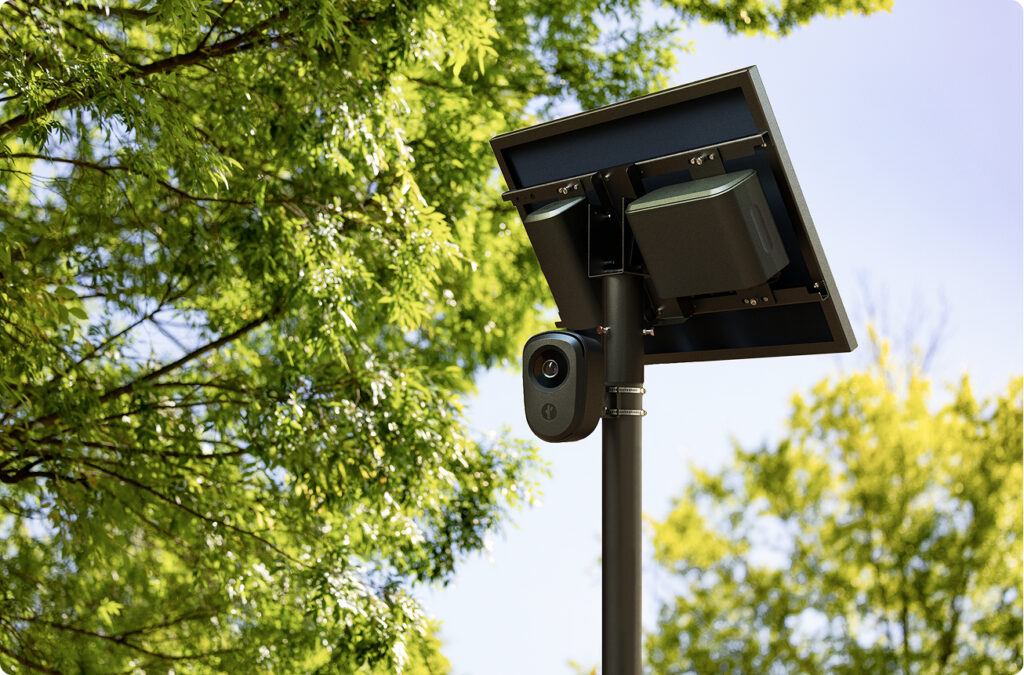
Flock Safety license plate readers are typically mounted on tall poles, with a camera and solar panel on top. The company says its technology is used in more than 6,000 communities across 49 states in partnership with thousands of law enforcement agencies nationwide. (Photo courtesy of Flock Safety)
The University of Wisconsin-Milwaukee is ending its use of Flock Safety cameras and has ordered the company to remove the controversial license plate readers from campus.
“The UWM Police Department is discontinuing its use of Flock Safety cameras,” the university announced Thursday. “UWM has directed Flock Safety to remove the cameras. In the interim, the university has taken steps to ensure the cameras are not operational.”
The university did not provide a reason for the decision.
UWM is the latest in a rapidly growing group of Wisconsin law enforcement agencies to stop or suspend use of the automated license plate reader system. At least 31 other Wisconsin agencies have ended, suspended or announced plans to terminate or not renew their use of Flock.
The decision does not affect license plate readers used to manage UWM parking facilities.
“UWM parking garage license plate readers are not connected to any internal or external systems outside of UWM Transportation Services,” said the university. “Their sole purpose is to read license plates at designated parking facility entrances and exits.”
Until announcing the change, UWM had publicly defended its use of Flock.
The university’s website described the UWM Police Department as using a “limited number” of automated license plate readers to help identify vehicles connected to stolen vehicles, Amber Alerts, violent offenses, missing-person cases and other serious incidents.
UWM said the cameras captured still images of vehicles and vehicle characteristics but did not use facial recognition or collect personal information about drivers or passengers. The university also said the technology was not used to randomly monitor people or conduct continuous surveillance.
The DeFlock mapping service shows 18 cameras clustered on the university’s East Side campus. Two more can be seen in its parking lot north of E. Capitol Drive.
UWM is at least the third University of Wisconsin campus police department to take action against Flock. The UW-Madison Police Department ended its use, while UW-Oshkosh suspended its program.
The university’s reversal comes amid a dramatic collapse in support for Flock among Wisconsin law enforcement agencies.
A new wave of suspensions and cancellations began earlier this month after agencies learned Flock was using information generated from its cameras for a separate traffic analytics product. In Sheboygan, officials said a Flock representative offered to sell the city several years of anonymized traffic information generated from cameras already being operated by the city. The traffic data covered a longer period of time than Flock previously said it was retaining data for.
Flock says its traffic product uses aggregate, de-identified information and does not retain license plate information or individual vehicle records. But several Wisconsin agencies said they had not understood that information derived from their cameras would be retained and marketed separately.
Concerns also emerged after information connected to an active Fond du Lac County investigation was released by an out-of-state law enforcement agency in response to an open records request.
Those revelations added to existing concerns about privacy and the ability of law enforcement agencies to search a nationwide network of Flock cameras.
Among the Wisconsin agencies that have ended or are moving to end their relationships with Flock are police departments in Appleton, Altoona, Grand Chute, Kaukauna, Kenosha, Monona, Oshkosh, Stoughton, Sturgeon Bay and Verona, as well as the Dane County and Racine County sheriff’s offices. More than a dozen others have suspended use or are winding down their use of the system.
Milwaukee’s two largest local law enforcement agencies have so far taken a different approach.
The Milwaukee Police Department continues to use Flock, but Mayor Cavalier Johnson and Police Chief Jeffrey Norman announced significant restrictions in late August. Access is now limited to supervisors, searches are restricted to specified categories of investigations and MPD has stopped sharing access to its own cameras with outside agencies.
Milwaukee County also imposed new restrictions on its system, but County Executive David Crowley said Wednesday he does not currently plan to include money to renew the county’s Flock contract when it expires at the end of 2026.
The controversy is also moving into the courts.
The Wisconsin Institute for Law & Liberty filed a lawsuit Thursday against Waukesha County and 11 municipalities in the county, arguing that police searches of Flock’s database without a warrant violate the Fourth Amendment. WILL is not asking that the cameras be removed, but is seeking a court ruling requiring law enforcement officers to obtain a warrant before searching the database, absent an applicable exception.
Meanwhile, both candidates for Wisconsin attorney general have called for changes. Attorney General Josh Kaul has urged the Legislature to establish statewide rules governing automated license plate readers, including limits on data sharing and access and requirements for regular auditing. His Republican challenger, Fond du Lac County District Attorney Eric Toney, has also called for legislative action and supported decisions by law enforcement agencies in his county to discontinue their use of Flock.
Flock is not the only manufacturer of automated license plate readers, with MPD and other departments using mobile units mounted to vehicles, but Flock’s technology has engendered the greatest criticism for its network data sharing and the recent revelation that it is selling the data for non-public-safety purposes.
If you think stories like this are important, become a member of Urban Milwaukee and help support real, independent journalism. Plus you get some cool added benefits.
More about the Use of Flock Cameras
- MKE County: Sheriff Will Replace Flock With Other Cameras - Graham Kilmer - Oct 15th, 2026
- MKE County: Supervisors Pass Flock Ban - Graham Kilmer - Oct 3rd, 2026
- UWM Removing Its Flock Cameras - Jeramey Jannene - Sep 11th, 2026
- WILL Sues 11 Waukesha County Communities Over Flock Cameras - Evan Casey - Sep 10th, 2026
- MKE County: Crowley May Kill Funding for Flock Cameras - Graham Kilmer - Sep 9th, 2026
- Both Attorney General Candidates Dump on Flock - Jeramey Jannene - Sep 8th, 2026
- Council Says Mayor’s Flock Changes Don’t Settle Debate - Jeramey Jannene - Sep 3rd, 2026
- MKE County: Crowley Calls for Restrictions on Sheriff’s Flock Cameras - Graham Kilmer - Sep 1st, 2026
- Mayor Demands Restrictions on Milwaukee’s Flock Cameras - Jeramey Jannene - Aug 31st, 2026
Read more about Use of Flock Cameras here
Political Contributions Tracker
Displaying political contributions between people mentioned in this story. Learn more.
- August 13, 2015 - Cavalier Johnson received $25 from David Crowley






















Sad. . . I would think UWM would be concerned about protecting students.
Flock License Plate Readers take a photo of a license plate and add location and date/time.
If there is an active search for that plate . . . for example, the plate belongs to a car registered to a person who was arrested for Domestic Violence (beating wife), he was taken to jail, and made bail with instructions not to contact the victim. (He did contactact the victom demanding that she somehow makes all of this go away – there is a reason the police actually arrested him and took him to jail – they saw the woman and what had been done to her.) Trial date 10 September and he doesn’t show up. The judge revokes bail and issues an arrest warrant. The German Town Police put his license plate number into the Flock hotlist. Blue Ford Mustang License Plate WI A81-K71. He is not happy.
The Plate WI A81-K71 drives into the UWM parking garage. It may be the person with an arrest warrant for bail jumping in a domestic violence case. Maybe someone stole his car. Perhaps he took his car to his son’s house and traded it. Maybe the number was entered wrong, and it was really “WI A81-K7I.” People do make mistakes.
What if it was the man, and he is hunting for his wife? The UWM Police would know that perhaps there is a problem?
If the system only reported wanted vehicles, UWM would know when that bail jumper’s car was on campus or . . .
If a student is injured – something happens to a student – UWM should be concerned that there would be significantly more liability.
The University had the ability to provide some protection – know that the car that just went into the garage was reported stolen, or was reported involved in . . . , or was owned by someone wanted for rape, murder, selling drugs, . . .
Here, UWM has decided to remove Flock and, with it, the notification system and that layer of protection. UWM has knowingly reduced the protection provided for their students.
I would want the reason for removing the camera, and if a student is hurt, raped, assaulted, . . . and the person who committed the crime drove into the parking garage at UWM with a plate number that would have alerted the Flock System . . . .
What amazes me is how leadership and those making more than $200,000 a year can sleep at night knowing that they are putting others at risk.
Good to know we’ve got the AI-written comments to back the technofeudalist argument.