

Supervisors Pass Flock Ban
Supervisors order removal of 42 Flock cameras from county parkland.
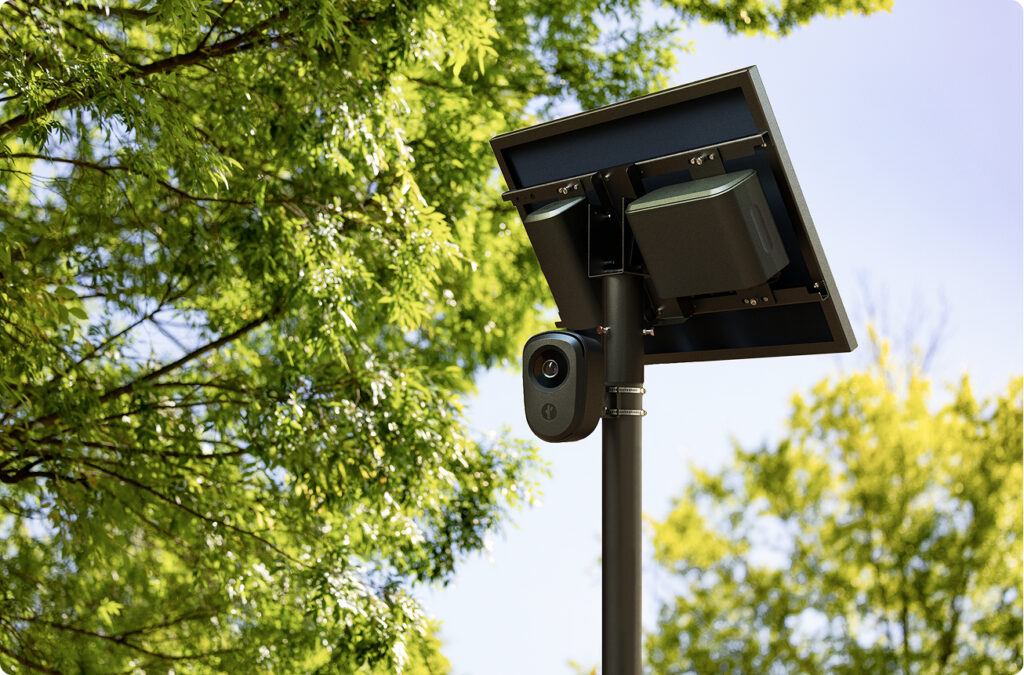
Flock Safety license plate readers are typically mounted on tall poles, with a camera and solar panel on top. The company says its technology is used in more than 6,000 communities across 49 states in partnership with thousands of law enforcement agencies nationwide. (Photo courtesy of Flock Safety)
Milwaukee County supervisors voted Thursday to remove controversial Flock surveillance cameras from Milwaukee County parkland.
The resolution directs Milwaukee County Parks to remove all Flock Safety cameras from county parkland, including both regular video surveillance cameras and the controversial automated license plate reader (ALPR) cameras.
There are currently 42 Flock cameras located in 11 county parks. The Milwaukee County Sheriff’s Office (MCSO) operates most of them, with 25 Flock ALPR cameras and six Flock Condor cameras, which do not have ALPR capabilities but can be controlled by MCSO personnel to track people or objects. There are also six other Flock cameras on county roads and equipment operated by municipal police departments.
County supervisors have little authority over MCSO policy, but do control county parkland. The resolution was authored by Sup. Justin Bielinski. It passed unanimously by the board on a vote of 16-0. Supervisors Juan Miguel Martinez and Felesia Martin were not in attendance.
“I want to thank all the colleagues in the parks committee who were able to come together in agreement to get something unanimous that could have been very controversial,” Bielinski said after the resolution passed the board.
Flock cameras passively capture license plates of all passing vehicles, as well as vehicle make, model and aftermarket modifications, all of which can be searched by law enforcement in the Flock database. Until recently, the MCSO maintained photos in the searchable database for other law enforcement agencies to access. As public opposition to Flock grew, the MCSO lowered data retention to seven days.
MCSO opposed the resolution, arguing Flock cameras have proven a useful tool for investigating crime in the county parks system. Chief Deputy Brian Barkow told supervisors the cameras have been used to investigate violent crimes, including homicides, and other serious offenses.
Before it was passed by the board, Bielinski’s colleagues on the Committee on Parks and Culture amended the resolution to include language authorizing the MCSO to replace the cameras with conventional video surveillance cameras operating on the county’s network. The amendment, drafted by Sup. Sheldon Wasserman, outlines the board’s opposition to Flock but not ALPR in general.
The board opposes ALPR when the “breadth of data” allows the tracking and reconstruction of an individual’s movements, and when the technology lacks “appropriate safeguards, including strict limits on data retention, access, sharing, auditing, and permissible uses.”
Milwaukee County Executive David Crowley did not include funding for Flock in his 2027 budget proposal, instead moving the money to a program providing legal aid for people facing eviction.
“I recognize the value this technology can offer our public safety partners, but the concerns for residents’ constitutional rights must take precedence,” Crowley said during his budget address Thursday.
Supervisors, activists and members of the public have expressed concern about the county’s continued use of Flock Safety. Law enforcement officers in Milwaukee, and across the country, have been caught using the Flock system to stalk ex-girlfriends and lovers. Three Milwaukee Police Department (MPD) officers have been investigated for improper use of Flock. One of them, Josue Ayala, pleaded guilty to misconduct in public office for using the Flock system to track his ex-girlfriend.
Flock runs a program that allows law enforcement to share and search data collected by Flock cameras across the country, including law enforcement agencies that collaborate with U.S. Immigration and Customs Enforcement (ICE) on immigration enforcement. Agencies can opt in or out of this program, as MCSO now reports doing.
Municipal leaders and law enforcement officials have started canceling contracts with Flock over concerns about data sharing and Flock potentially violating contracts. In Sheboygan, Mayor Ryan Sorenson canceled a contract with Flock after the company allegedly violated terms of its agreement. Racine County Sheriff Christopher Schmaling recently ordered the removal of all Flock cameras used by the department, “after learning that Flock appears to have been collecting and retaining information beyond what the Sheriff’s Office understood or agreed to,” according to the Racine County Sheriff’s Office.
If you think stories like this are important, become a member of Urban Milwaukee and help support real, independent journalism. Plus you get some cool added benefits.
More about the Use of Flock Cameras
- MKE County: Sheriff Will Replace Flock With Other Cameras - Graham Kilmer - Oct 15th, 2026
- MKE County: Supervisors Pass Flock Ban - Graham Kilmer - Oct 3rd, 2026
- UWM Removing Its Flock Cameras - Jeramey Jannene - Sep 11th, 2026
- WILL Sues 11 Waukesha County Communities Over Flock Cameras - Evan Casey - Sep 10th, 2026
- MKE County: Crowley May Kill Funding for Flock Cameras - Graham Kilmer - Sep 9th, 2026
- Both Attorney General Candidates Dump on Flock - Jeramey Jannene - Sep 8th, 2026
- Council Says Mayor’s Flock Changes Don’t Settle Debate - Jeramey Jannene - Sep 3rd, 2026
- MKE County: Crowley Calls for Restrictions on Sheriff’s Flock Cameras - Graham Kilmer - Sep 1st, 2026
- Mayor Demands Restrictions on Milwaukee’s Flock Cameras - Jeramey Jannene - Aug 31st, 2026
Read more about Use of Flock Cameras here
Political Contributions Tracker
Displaying political contributions between people mentioned in this story. Learn more.
- December 17, 2015 - David Crowley received $50 from Felesia Martin


MKE County
-
Mayor, Congresswoman Moore Stump for Crowley As Early Voting Begins
 Oct 21st, 2026 by Graham Kilmer
-
Republicans Attack Crowley Over Wife’s Nonprofit Work
 Oct 19th, 2026 by Graham Kilmer
-
Zoo’s New Parking System Is a Success
 Oct 17th, 2026 by Graham Kilmer





















This is a mistake. Far too many municipalities and agencies jumped on the bandwagon wagon and eliminated a valuable and successful weapon used to solve crime. Instead of punishing those individuals who broke public trust, we chose to put entire communities at further risk. My bet is we will see a jump in unsolved crimes and then blame our police for poor performance in solving crimes.
This is a good move. Is a surveillance state really what you want, James? The cameras are too easily abused by those using them.
Since these devices have been put into use have clearance rates gone up?