
Master Lock Factory Back Up For Auction, Bidding Starts at $1
First auction deal fell apart, so owner wants no-contingency sale of sprawling industrial campus.

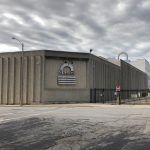
Master Lock campus in May 2020. Photo by Jeramey Jannene.
Want to own a 780,000-square-foot former factory in the middle of Milwaukee? Bidding starts at just $1.
The former Master Lock manufacturing campus, 2600 N. 32nd St., is headed back to auction after a deal to sell the property earlier this year fell apart.
But this time, the seller is taking a different approach. The 26-acre property will be offered through a no-contingency auction, eliminating the conditions that ultimately derailed the first sale.
“If you’re the only bidder and you bid one dollar, you can own it,” said Bill Lange, CEO of FRE Auctions, during a Tuesday afternoon press conference.
The online auction is expected to go live Tuesday afternoon, with an initial bidding deadline of Dec. 10 at 5 p.m.
It’s the latest twist for a property that once employed 1,300 workers and served as a cornerstone of Milwaukee’s north side manufacturing economy.
St. Louis-based Commercial Development Company (CDC) acquired the property from Master Lock parent company Fortune Brands Innovations in May 2025 for $2.6 million. The company initially pledged to reposition the sprawling industrial complex for new manufacturing, warehousing and industrial storage uses.
But rather than pursue a redevelopment itself, CDC put the property up for auction in July.
Lange said that auction generated substantial interest, including a prospective buyer who emerged through the bidding process. But the deal ultimately fell apart over the buyer’s request for additional time.
The first auction used FRE’s “Online Auction Plus” format, which let bidders submit offers with contingencies and provided 30 days to resolve them.
“And then the buyer came back and said we can’t clear what we need to clear in 30 days; we need an extension,” said Lange.
CDC refused.
“They’ve told us to put it back on the market,” Lange said. “This time we’re not going to do Auction Plus.”
The seller, according to Lange, wants a simpler transaction that will result in a completed sale rather than another prolonged negotiation.
The $1 starting bid is intended to draw attention to the massive property and encourage prospective buyers to compete. It does not necessarily mean the campus will sell for anything close to that amount.
“It’s a fun way to sell property and it probably will light it up pretty good,” said Lange.
But interested buyers will need to demonstrate they’re serious. FRE will offer property tours to qualified prospective bidders, who must authorize a $5,000 credit card hold to secure a showing. They must also show proof of capital in the amount of the current bid.
“If they can’t do that, we’re not going to take them seriously,” Lange said.
The auction company is expected to publish bidding increments and additional details Tuesday afternoon.
From Paintball to Battery Storage
One thing the first auction established is that the enormous factory campus could accommodate a wide variety of potential uses.
“We had good interest in it,” said Lange.
He said prospective buyers floated ideas ranging from traditional industrial activities to uses that would represent a substantial departure from the property’s manufacturing history.
“All kinds of interesting uses, including a couple of governmental uses,” said Lange.
Among the proposals were a paintball facility, bulk storage operations, office space and battery storage.
One interested party envisioned what Lange described as a miniature version of Le Mans, the famous French automobile racing event.
Other potential uses include a data center or large-scale battery storage facility. Both could benefit from the property’s proximity to an electrical substation and its substantial power infrastructure.
The property was previously marketed with an electrical supply of four megawatts, though any new high-demand user would need to determine what additional utility infrastructure or upgrades might be necessary. Modern data centers often consume more than four megawatts of electrically, particularly at the size of the Master Lock site. The City of Milwaukee is also in the process of drafting data center zoning regulations and currently has a moratorium in place.
Lange said the party that emerged from the first auction could return as a bidder. He said he was familiar with the proposed use but could not disclose it publicly.
“They’re probably going to be a player for it now,” he said.
The auction includes approximately 26 acres of land and a collection of industrial buildings with about 780,000 square feet of space.
The largest building is a five-story, 413,606-square-foot structure equipped with three 20-ton freight elevators. Other buildings offer large open industrial spaces, loading docks and drive-in doors.
The complex includes approximately seven acres of paved parking, 10 loading docks and 10 drive-in doors.
The campus is zoned IH, the City of Milwaukee’s most intensive industrial zoning classification, which permits a broad range of manufacturing and industrial activities.
Lange said environmental remediation work has been completed at the property, potentially removing a significant obstacle for prospective buyers. Details of that work and any remaining environmental obligations were not immediately available.
A Factory Without a Future?
Master Lock closed the manufacturing operation in March 2024, eliminating approximately 330 union jobs and moving production to other North American facilities.
The closure ended more than eight decades of lock manufacturing at the property.
At its peak, Master Lock employed approximately 1,300 people at the campus. Then-President Barack Obama visited the factory in 2012 to promote domestic manufacturing.
The heavily secured complex stretches from W. Center Street to W. Meinecke Avenue, between the 30th Street Corridor railroad tracks and N. 33rd Street.
The property includes extensive fencing, controlled entrances and a guardhouse. The security measures became controversial in 2019 when city officials allowed Master Lock to close portions of the surrounding street grid and acquire nearby homes to create a buffer around the factory. The Common Council has recently discussed clawing back some of the closings.
Reminders of the company’s legacy remain throughout the property, including lock imagery incorporated into buildings, a giant rooftop padlock and a walking path shaped like a lock.
CDC specializes in acquiring and repositioning obsolete industrial facilities, but its redevelopment track record has drawn scrutiny elsewhere in Wisconsin.
The company previously acquired the former General Motors assembly plant in Janesville, demolished the factory and proposed a new industrial park. After years of disputes over the property’s condition, environmental cleanup and redevelopment prospects, Janesville officials pursued eminent domain and gained control of the property in 2025. The city is now pursuing a data center development at the former GM site.
Existing members must be signed in to see the interactive map. Sign in.
If you think stories like this are important, become a member of Urban Milwaukee and help support real, independent journalism. Plus you get some cool added benefits.