New Plaza Connects Riverwalk, City, Embodies Its Namesake Gary Grunau
Gary P. Grunau Plaza was developed through a complicated and collaborative process, honors civic booster.
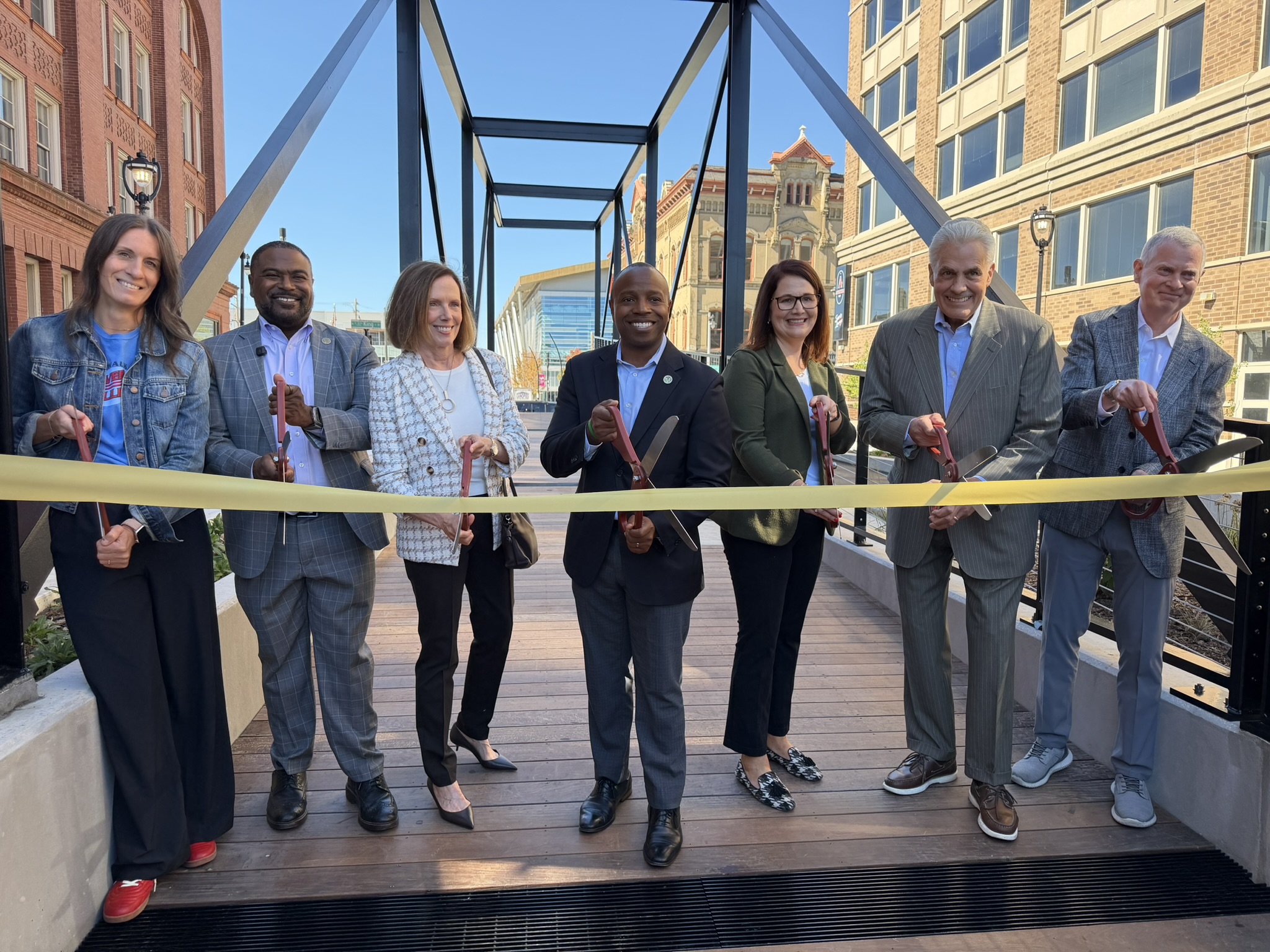
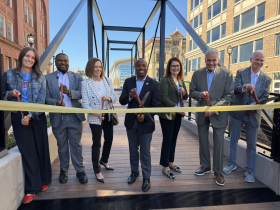
Alyssa Remington, Lafayette Crump, Joanne Grunau, Cavalier Johnson, Stacie Callies, Robert Bauman and Bruce Block cut the ribbon on Gary P. Grunau Memorial Plaza. Photo by Jeramey Jannene.
A large crowd gathered along the Milwaukee River Monday morning to celebrate a new public space — and the man whose fingerprints can be found on projects throughout Milwaukee.
Gary P. Grunau Memorial Plaza is now officially open.
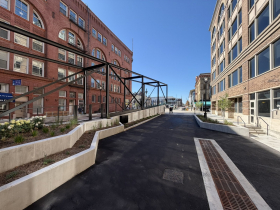
The $4.6 million plaza transforms the stub end of W. Highland Avenue, just east of N. Martin Luther King Jr. Drive, into a new link between Deer District, the Highland Avenue Pedestrian Bridge, Water Street and the Milwaukee RiverWalk. It improves the pedestrian linkage between Westown and East Town.
Monday’s ceremony was as much about Gary Grunau as it was about the new plaza.
Grunau, who died in 2019 at age 80, was a businessman, developer and civic leader who was instrumental in the creation of the RiverWalk, redevelopment of Schlitz Park, development of the Hyatt Regency Hotel and creation of the Wisconsin Center District, among many other initiatives.
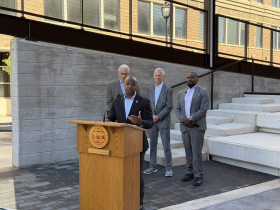
“Gary understood Milwaukee’s potential,” said Mayor Cavalier Johnson. “He believed in the power of investing in our city and notably in downtown.”
Area Alderman Robert Bauman, who said he first met Grunau in the late 1980s, said much of modern Downtown can be linked to Grunau’s efforts.
“Much of the built environment in downtown Milwaukee is directly or indirectly linked to the vision and energy and advocacy of Gary Grunau,” said Bauman.
That included causes that didn’t directly benefit Grunau’s own businesses.
Bauman recalled Grunau’s advocacy for regional public transit and his role in creating the Alliance for Future Transit in the 1980s. He also credited Grunau with helping establish the Milwaukee Downtown, Business Improvement District #21 and developing a nighttime economy at a time when Milwaukee’s central business district emptied out at night.
Attorney Bruce Block, a longtime friend of Grunau’s, went even further in recounting Grunau’s impact.
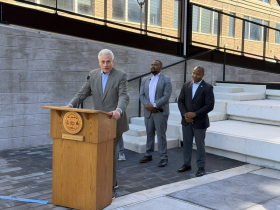
“His DNA is embedded in the tissue of the city to the same degree that Byron Kilbourn, Solomon Juneau and George Walker are,” said Block. “If we can have a Juneau Park, Kilbourn Avenue and a Walker’s Point, then we can certainly have Grunau Plaza.”
He rattled off six projects within walking distance of the new plaza that Grunau played an important role in advancing: Schlitz Park, ManpowerGroup’s riverfront headquarters, the redevelopment of a former power plant for Time Warner Cable, demolition of the Park East Freeway, creation of the Wisconsin Center District and development of the Milwaukee RiverWalk.
And that list didn’t even get to Discovery World, where a statue of Grunau stands outside a building he helped bring to the lakefront.
Block described his friend as “a man with an engineering brain and a liberal arts heart.”
He said Grunau combined five qualities: energy, vision, problem solving, a love of community and a love of people.
“He could look at what was and see what could be,” Block said. “He was always looking for the next catalytic project.”
Grunau took over the family mechanical contracting firm, Grunau Co., in the 1970s and ultimately became involved in an array of businesses and civic causes. He was an early partner in Warner Cable Communications, helped bring Manpower’s headquarters Downtown, was a partner in The Edge condominium development and served on numerous civic boards, including as a trustee at Alverno College.
His influence on the Milwaukee River was particularly substantial.
Grunau and then-Mayor John Norquist helped establish the public-private financing model that enabled the RiverWalk system to grow along private riverfront properties instead of relying on a wholly publicly owned walkway. Grunau served for years as chairman of the RiverWalk Business Improvement District and also helped launch RiverSplash and the Milwaukee River Challenge.
Department of City Development Commissioner Lafayette Crump said the transformation of the riverfront demonstrates what long-term public-private cooperation can accomplish.
“The Milwaukee RiverWalk, of course, is one of our city’s finest man-made assets,” he said. “Where we once had an underutilized riverfront, it’s since become a vibrant public destination and now connects neighborhoods, businesses, restaurants, cultural attractions and people on the Milwaukee River.”
Crump also singled out DCD riverwalk project manager Alyssa Remington for her work, dubbing her “the river queen herself.” Block followed with a joke that Remington, in addition to her many other responsibilities, had also been tasked with delivering good weather for Monday’s ceremony. She succeeded.
Remington, Grunau’s widow Joanne and Westown Association Executive Director Stacie Callies joined the speakers for the ribbon cutting.
The size and makeup of the crowd offered its own testament to Grunau’s reach.
Among those spotted were former mayor Tom Barrett, architect David Uihlein, architect Matt Rinka and business partner Steve Morales, retired Wisconsin Policy Forum leader Rob Henken, architect and longtime friend Marsha Sehler, architecture professor Robert Greenstreet, Bradley Foundation leader Rick Graber, nearby bar owner Jake Dehne, Wisconsin Cheese Mart owner Ken McNulty, retired judge John Franke, former city development commissioner Rocky Marcoux, architect Greg Uhen, Milwaukee Bucks development executive Michael Belot, attorney Deborah Tomczyk, retired Badger Meter CEO Rich Meeusen, UW-Milwaukee architecture professor Carolyn Esswein as well as a large contingent of current and former city officials.

Gary Grunau speaks at a 2009 Milwaukee RiverWalk art unveiling. Photo by Jeramey Jannene.
A New Connection
The plaza itself addresses an awkward gap in the pedestrian network.
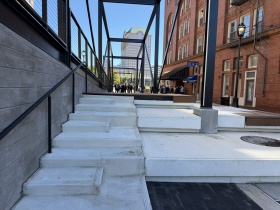
Before construction, W. Highland Avenue effectively ended in an oversized loading area at the west end of a pedestrian bridge. A substantial elevation difference forced pedestrians to divert to a sidewalk rather than continue directly between the bridge and Deer District.
The new design uses that elevation change as an asset.
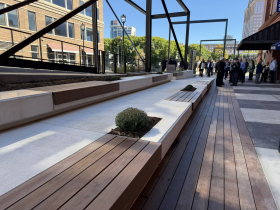
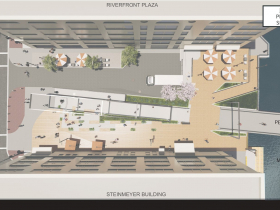
A broad, sloping walkway points toward Fiserv Forum and doubles as a vista through the plaza. A large “social stair” provides seating alongside the path, while benches and other amenities line the sidewalk adjacent to the Steinmeyer Building.
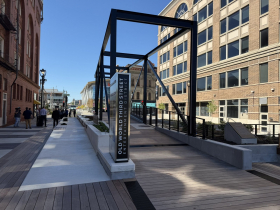
A trestle-like structure extends along the central walkway and onto the existing pedestrian bridge. The design is a nod to the property’s history as part of a rail yard that served Schlitz and Milwaukee’s other breweries.
The plaza and bridge are lined with lighting, making the plaza particularly striking at dusk and after dark. In the coming weeks, a controller will be added to activate the lighting to follow pedestrians as they cross the plaza.
RINKA designed the project, Selzer-Ornst Construction Company served as general contractor and Colliers International served as owner’s representative.
Block said Selzer-Ornst encountered a substantial number of underground complications during construction but managed to keep the project on budget.
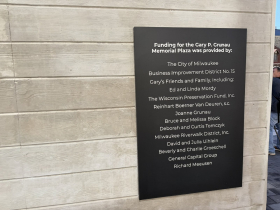
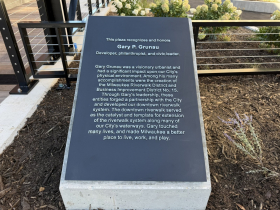
The $4.6 million project was 78% city-funded, with private donations covering the remainder. A plaque on the site honors those who contributed. The public share came through tax incremental financing, including TID #84, the district originally established to support development of Fiserv Forum.
The RiverWalk BID funded $150,000 of preliminary design work and helped coordinate the project, while Milwaukee Downtown and the Deer District BID districts agreed to take on portions of the plaza’s ongoing maintenance.
The mix of city financing, private donations, multiple business improvement districts and other partners was itself something Block thought Grunau would have appreciated.
“Gary would have loved the collaboration and he would have been thrilled by the complexity of putting this together,” Block said.
The space could become more active as nearby storefronts fill.
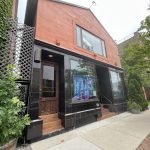
The former S’Lush Daiquiri Lounge & Events space is currently vacant and includes a patio immediately alongside the plaza. Other commercial spaces surround the new public area.
And the plaza could eventually become an even more important pedestrian link if development occurs on the east side of the river.
A complementary public plaza was proposed across the Highland Avenue bridge as part of Neutral Edison, a planned mass-timber apartment tower. That development has stalled and is now the subject of a court fight.
For now, the new Grunau plaza creates a substantially improved western gateway to the bridge and another gathering space along the RiverWalk that Grunau worked decades ago to create.
Johnson noted that subsequent mayors continued expanding the system that Grunau and Norquist helped launch, including new sections added during the Barrett and Johnson administrations.
“We’re still building on Gary’s legacy,” said the mayor.
After hearing Block recount the many nearby projects tied to Grunau, Johnson proposed another way Milwaukee might eventually recognize him.
“It kind of seems as if we should have like a Gary Grunau trail,” Johnson said, “to go to all the places that Gary has touched and helped to improve here in the city of Milwaukee.”
Photos
Press Conference
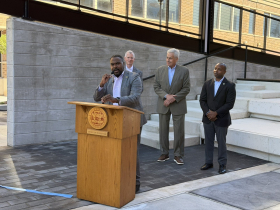
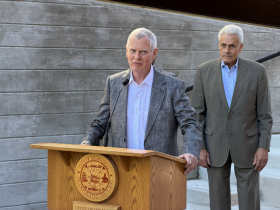
Plaza Renderings
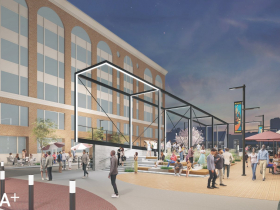
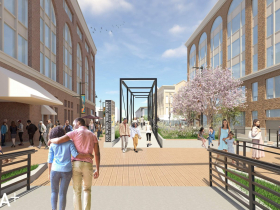
Pre-Construction
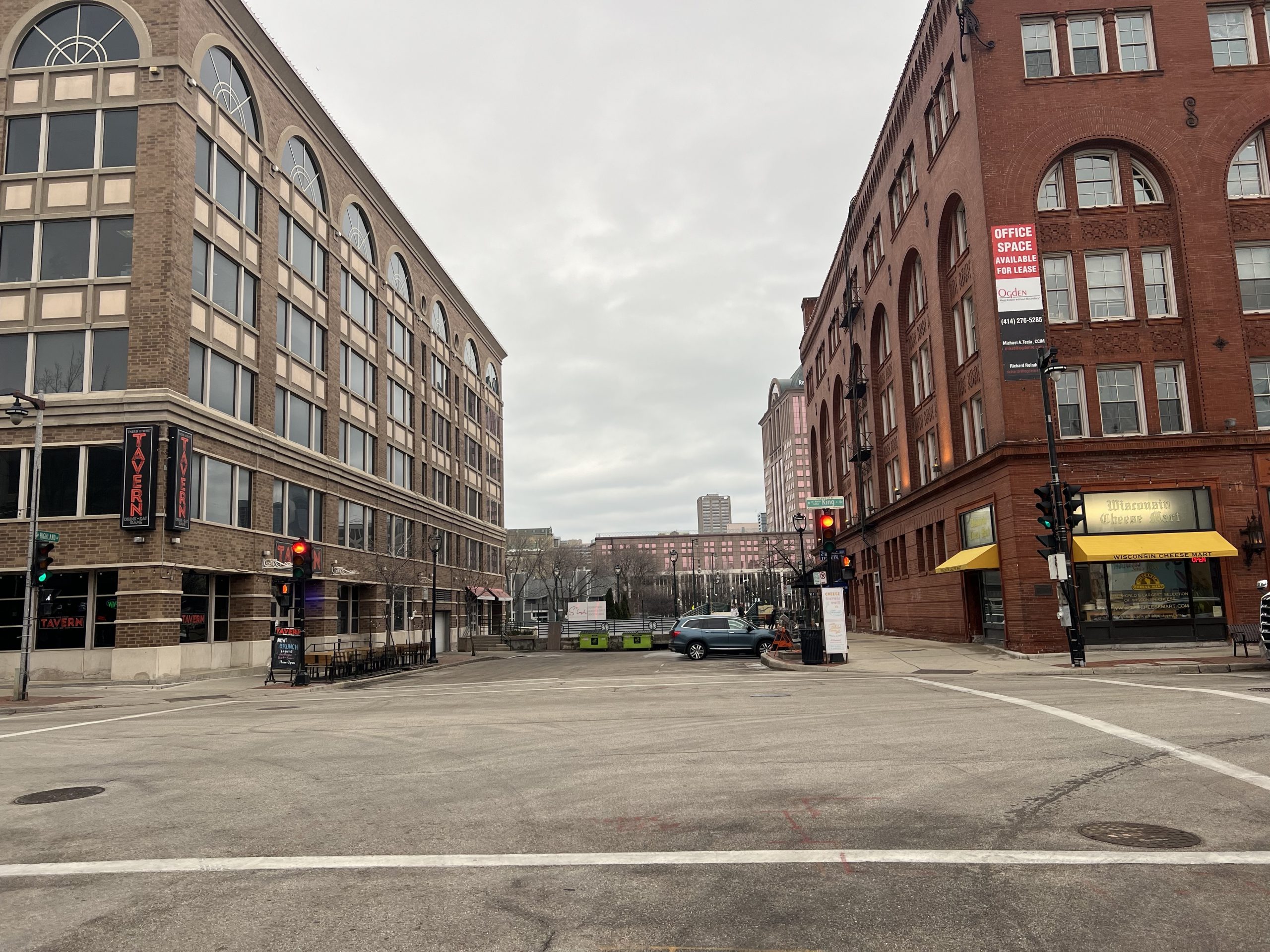
W. Highland Avenue. Future site of Grunau Memorial Plaza. Photo by Jeramey Jannene.
Existing members must be signed in to see the interactive map. Sign in.
If you think stories like this are important, become a member of Urban Milwaukee and help support real, independent journalism. Plus you get some cool added benefits.
Political Contributions Tracker
Displaying political contributions between people mentioned in this story. Learn more.
- September 19, 2025 - Robert Bauman received $100 from Stacie Callies
- September 5, 2025 - Robert Bauman received $250 from David Uihlein
- July 12, 2025 - Cavalier Johnson received $100 from John Franke
- July 9, 2025 - Cavalier Johnson received $500 from Lafayette Crump
- December 10, 2024 - Robert Bauman received $200 from Jake Dehne
- December 31, 2023 - Cavalier Johnson received $100 from Rocky Marcoux
- December 8, 2023 - Cavalier Johnson received $500 from Rich Meeusen
- December 1, 2023 - Cavalier Johnson received $500 from Lafayette Crump
- December 23, 2020 - Tom Barrett received $500 from Rocky Marcoux
- October 23, 2019 - Robert Bauman received $250 from Jake Dehne
- October 12, 2019 - Robert Bauman received $150 from David Uihlein
- April 22, 2019 - Cavalier Johnson received $50 from Lafayette Crump
- December 22, 2018 - Tom Barrett received $500 from Rocky Marcoux
- December 22, 2018 - Tom Barrett received $2,000 from David Uihlein
- December 10, 2018 - Tom Barrett received $100 from Deborah Tomczyk
- November 12, 2018 - Tom Barrett received $100 from Marsha Sehler
- June 23, 2018 - Tom Barrett received $1,000 from Bruce Block
- June 22, 2018 - Tom Barrett received $400 from Lafayette Crump
- December 29, 2017 - Tom Barrett received $500 from Rocky Marcoux
- November 13, 2017 - Tom Barrett received $1,000 from David Uihlein
- March 23, 2017 - Robert Bauman received $100 from Deborah Tomczyk
- March 20, 2017 - Robert Bauman received $250 from David Uihlein
- March 7, 2017 - Cavalier Johnson received $100 from Deborah Tomczyk
- March 1, 2017 - Tom Barrett received $400 from Rocky Marcoux
- February 23, 2017 - Tom Barrett received $400 from Lafayette Crump
- May 20, 2016 - Robert Bauman received $100 from Ken McNulty
- May 9, 2016 - Cavalier Johnson received $100 from Gary Grunau
- March 30, 2016 - Tom Barrett received $1,000 from David Uihlein
- March 28, 2016 - Tom Barrett received $200 from Bruce Block
- March 25, 2016 - Tom Barrett received $100 from Marsha Sehler
- March 22, 2016 - Cavalier Johnson received $100 from Joanne Grunau
- March 20, 2016 - Tom Barrett received $250 from Ken McNulty
- March 9, 2016 - Tom Barrett received $50 from Lafayette Crump
- February 20, 2016 - Cavalier Johnson received $250 from Robert Bauman
- February 17, 2016 - Robert Bauman received $500 from Greg Uhen
- February 13, 2016 - Robert Bauman received $100 from Jake Dehne
- February 11, 2016 - Robert Bauman received $50 from Stacie Callies
- February 10, 2016 - Robert Bauman received $200 from David Uihlein
- February 2, 2016 - Tom Barrett received $100 from Lafayette Crump
- December 21, 2015 - Tom Barrett received $500 from Deborah Tomczyk
- December 21, 2015 - Tom Barrett received $1,000 from Bruce Block
- December 4, 2015 - Tom Barrett received $1,000 from Rich Meeusen
- November 18, 2015 - Robert Bauman received $100 from Ken McNulty
- October 8, 2015 - Tom Barrett received $400 from Greg Uhen
- October 8, 2015 - Tom Barrett received $100 from Marsha Sehler
- September 17, 2015 - Robert Bauman received $386 from Ken McNulty
- March 27, 2015 - Robert Bauman received $50 from David Uihlein
- March 19, 2015 - Robert Bauman received $100 from Gary Grunau
- October 15, 2014 - Robert Bauman received $100 from Lafayette Crump
- September 8, 2014 - Robert Bauman received $100 from Lafayette Crump
- September 4, 2014 - Robert Bauman received $100 from Ken McNulty
- August 25, 2014 - Robert Bauman received $100 from Gary Grunau
- July 30, 2014 - Robert Bauman received $200 from David Uihlein