As Legislators Tiffany, Crowley Had Very Different Goals
A review of the policy proposals each put forward during their time in the Assembly.
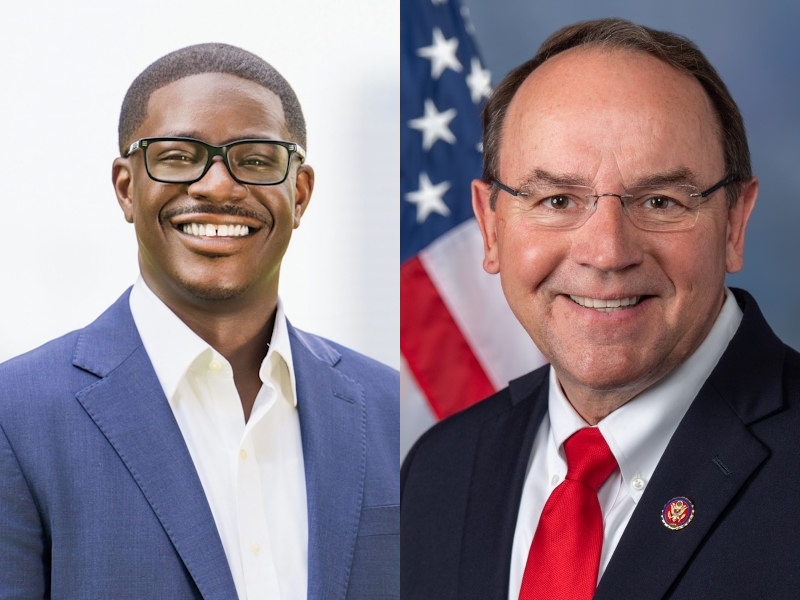
David Crowley and Tom Tiffany.
The two major party candidates for governor — Republican Congressman Tom Tiffany and Democrat David Crowley, the Milwaukee County executive — had much different goals when they served in the Legislature.
Each was the chief — or lead — sponsor of bills reflecting the needs of their very different districts and their personal legislative goals. The issues they championed offer potential clues of their legislative goals if elected governor on Nov. 3.
Tiffany, 68, served in the Legislature from 2013 to 2020, when he won a special election in the 7th Congressional District. As a legislator representing northwest Wisconsin, Tiffany authored bills on tourism, guns, hunting, fishing and forestry issues, which earned him the Wisconsin Paper Council’s Legislator of the Year award.
Crowley, 40, served in the Assembly from 2017 to April 2020, when he was elected Milwaukee County executive. Bills he authored reflected the issues important to his Milwaukee constituents — poverty, criminal justice reform and voting rights.
Bills Tiffany championed ranged from two major changes to minor ones like lowering the registration fee to register antique snowmobiles.
Tiffany was chief sponsor of a controversial 2013 bill that rewrote laws regulating the mining of metals in Wisconsin. Among the bill’s provisions was a requirement that the Department of Natural Resources issue a permit to mine if seven conditions were met, including the finding that the mine would not threaten public health, safety or welfare.
Those changes were signed into law by former Gov. Scott Walker.
A separate Tiffany bill in 2013 that would have placed new restrictions on the regulation of mines by city, county and town governments did not pass the Legislature.
In 2013, Tiffany was also the lead sponsor of the constitutional change that requires the state Supreme Court’s seven justices to elect the chief justice. That amendment rewrote a constitutional requirement that the most senior of the jurists would be the chief justice.
The change, which passed two consecutive sessions of the Legislature and was approved by voters, led to the justices’ May 1, 2015 vote that elected Chief Justice Pat Roggensack. The vote deposed Chief Justice Shirley Abrahamson, who had been chief justice for 19 years and had served on the court for almost 39 years.
Tiffany’s proposals on guns included a 2017 bill, which did not become law, that would have “created two exceptions to the general requirement that a school board must suspend and expel a pupil if the school board determines the pupil possessed a firearm at school,” according to the Legislature’s summary of the proposal.
“The first exception created under this bill is for a firearm that is lawfully stored inside a locked vehicle on school property,” legislative analysts said. “The second exception applies to the possession of a firearm for an activity approved and authorized by the school board if the school board adopts appropriate safeguards to ensure pupil safety.”
Crowley served in an Assembly controlled by Republicans, which blocked passage of bills authored by Democrats.
In his first year in the Assembly, Crowley was the lead sponsor of a bill that would have allowed the city of Milwaukee to legalize cameras to record vehicles exceeding the speed limit by more than 20 miles per hour, resulting in a traffic citation.
Crowley also introduced a bill that would have set aside $600,000 for grants to counties where “at least 10% of the population is composed of minorities.” The grants would have been used for programs “to improve relations between law enforcement and the community.”
Another Crowley bill would have required the state Department of Transportation to record the “race, ethnicity, ZIP code and gender” of anyone stopped by a law enforcement officer for a motor vehicle violation.
Crowley also proposed limits on when the state Department of Corrections could put inmates with mental illness in solitary confinement. That change would have required a mental health evaluation before any inmate is placed in solitary confinement and stipulated that they could not be held there for more than 10 days.
In 2019, Crowley was the chief sponsor of a bill that would have required anyone issued a Wisconsin driver’s license or state-issued ID to be added to the Elections Commission’s list of registered voters.
Another Crowley proposal would have waived tuition at all UW system campuses and tech colleges for “foster care and other out-of-home placement students.”
Steven Walters started covering the Capitol in 1988. Contact him at stevenscotwalters@gmail.com.
If you think stories like this are important, become a member of Urban Milwaukee and help support real, independent journalism. Plus you get some cool added benefits.
Political Contributions Tracker
Displaying political contributions between people mentioned in this story. Learn more.


The State of Politics
-
Four Health Care Questions For Wisconsin Political Candidates
 Sep 21st, 2026 by Steven Walters
-
Next Attorney General Will Control $219 Million Legal Settlement
 Sep 7th, 2026 by Steven Walters
-
It’s Been a Hot Summer for News
 Aug 31st, 2026 by Steven Walters