

Will Wisconsin’s Gerrymandered Congressional Map Be Overturned?
Wisconsin Supreme Court moving slowly toward a decision.
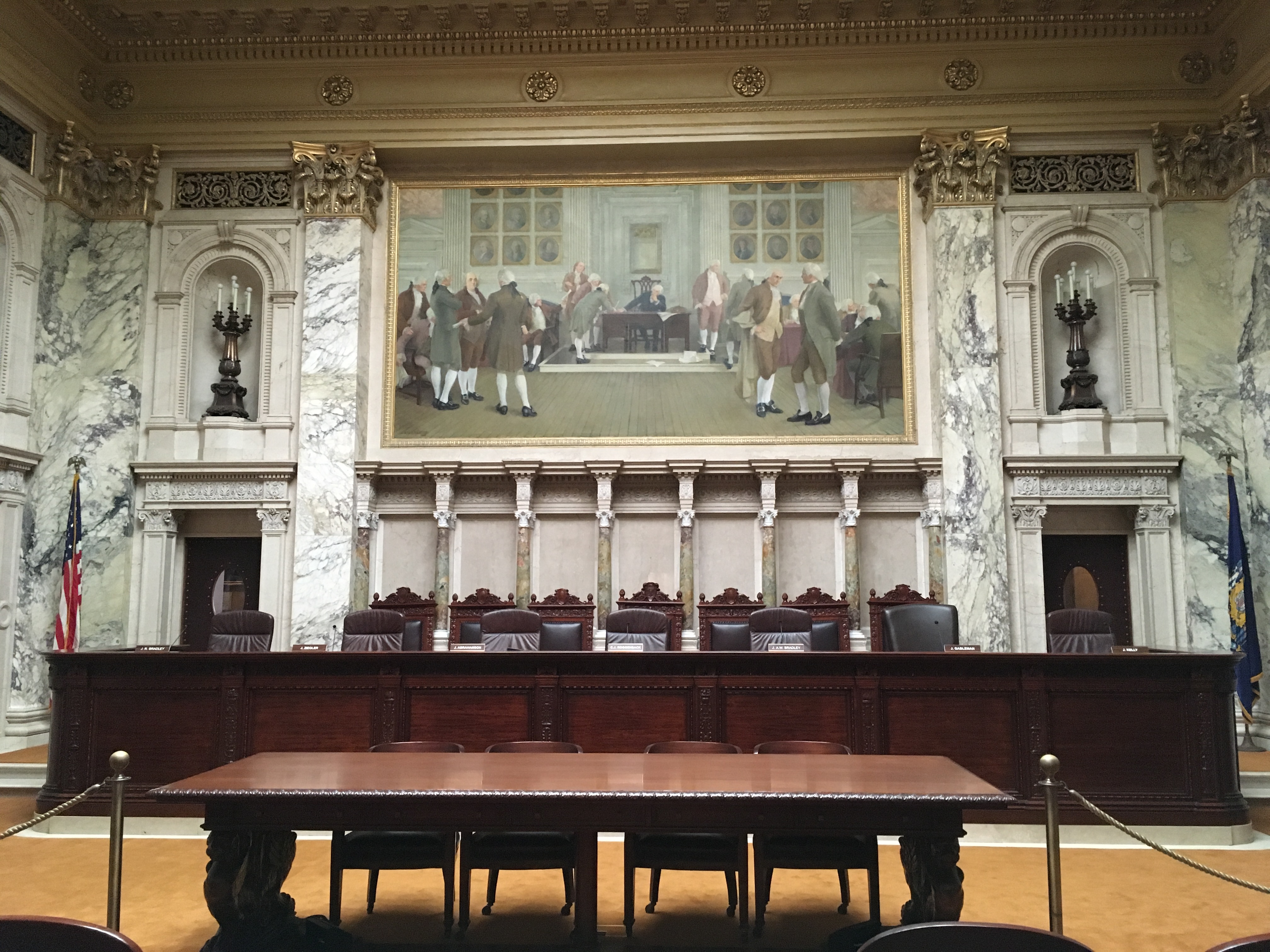
Wisconsin Supreme Court. Photo by Mariiana Tzotcheva.
Two lawsuits currently before the Wisconsin Supreme Court challenge Wisconsin’s eight U.S. House districts. The route these challenges have taken results from provisions of a Republican-backed Wisconsin law enacted in 2011.
Both lawsuits are brought under provisions contained in Act 39, a 2011 law passed with the support of all Republican members of the Wisconsin Legislature and signed by Gov. Scott Walker. Sections 28 and 29 of Act 39 added language to state statutes to create three-judge panels to consider challenges to congressional or state legislative districts.
Under this process, within five days of the filing of a challenge, the clerk of courts for the county where the action is filed must notify the clerk of the Wisconsin Supreme Court. Upon receiving this notice, “the supreme court shall appoint a panel of three circuit court judges … to hear the matter” (paragraphs 801.50(4m) and 751.035 of the statutes).
The language added by Act 39 to the statutes places several requirements on the panels. The three judges must be from different circuits. No party may move for substitution of any circuit court judge assigned to a panel. Any appeal from an order or decision issued by a panel can be heard only by the Supreme Court and not by a court of appeals.
These requirements clearly are aimed at suppressing judge-shopping, in which a party files suit in a county that is expected to be supportive.
In 2025, two lawsuits challenging Wisconsin’s congressional districts were brought. The plaintiffs advocated that the Supreme Court use the three-judge process outlined in Act 39. One suit was called Elizabeth Bothfeld v. Wisconsin Elections Commission (“Bothfeld”). The other was Wisconsin Business Leaders for Democracy (“Wisconsin Business Leaders”).
While both attacked Wisconsin’s congressional maps, they used different grounds for their criticism. The Bothfeld plaintiffs attacked the map as a violation of the separation-of-powers principle. This argument noted that the 2020 map was based on the 2010 map, under the least change principle. But the 2010 map was openly partisan, explicitly designed to favor Republicans.
The Wisconsin Supreme Court, by contrast, is meant to be nonpartisan. It should not cede its power to a partisan actor, in this case, the highly partisan 2010 district plan via the ostensibly nonpartisan least-change rule, the suit argued.
The Wisconsin Business Leaders plaintiffs also noted that the congressional district map following the 2020 census was based on the 2010 map. But the 2010 map was designed following extensive discussions with incumbents and aimed at protecting incumbents from competition, resulting in an “anti-competitive gerrymander,” the suit argued.
On Nov. 25, 2025, the Supreme Court issued an unsigned order determining that the Wisconsin Business Leaders’ “complaint does constitute ‘an action to challenge the apportionment of any congressional or state legislative district.’” Although not listed, the majority includes Chief Justice Jill Karofsky and Justices Rebecca Dallet, Janet Protasiewicz and Susan Crawford. The decision also lists the three district judges appointed to the panel.
Justice Brian Hagedorn joined the majority with one exception: “the issue is simply whether this court should appoint a three-judge panel … As the court’s order explains, I conclude these statutes apply to this case, and a panel must be appointed. Given the nature of this case and the statute’s implicit call for geographic diversity and neutrality, a randomly-selected panel and venue would be a better way to fulfill the statutory mandate.”
Justices Annette Ziegler and Rebecca Bradley each wrote dissents adamantly criticizing the court’s decision. Ziegler’s dissent makes a policy argument rather than a process argument. Rather than considering the question of whether the three-judge panel is required, it consists of a list of arguments for not changing the court’s previous redistricting decision.
By contrast, Justice Bradley spends the bulk of her dissent on the three-judge panel question, criticizing the majority decision that the law “imposes a mandatory duty” to appoint a three-judge panel (her italics). Yet the language of the law says that the “Supreme Court shall appoint a panel of three circuit court judges,” not may appoint. That sounds pretty mandatory to me.
Ultimately, both three-judge panels ruled against the plaintiffs, essentially for the same reason. To rule for the plaintiffs, they would have to rule against the Supreme Court’s earlier decision, when it had a conservative majority, to accept the 2020 congressional map. In the words of the Bothfeld panel:
In denying the Plaintiffs’ Motion for Judgment on the Pleadings and granting Intervenor-Defendants’ Motions to Dismiss, this Panel is not endorsing the current congressional map. Rather, we, as circuit court judges, do not have the authority to read into a Wisconsin Supreme Court case an analysis that it does not contain.
As expected, the Wisconsin Business Leaders challenge suffers the same fate:
The Supreme Court is the ultimate interpreter of our state constitution. When the Court speaks, its words are final unless and until it says otherwise. Because this panel is bound by the Court’s interpretations, it must alternatively dismiss Plaintiffs’ claims for failure to state a cognizable constitutional cause of action.
In other words, only the Supreme Court can overrule the earlier Supreme Court decision.
Both groups of plaintiffs appealed their panels’ decisions to the Supreme Court. A first brief in the Wisconsin Business Leaders case was submitted this week, and response briefs are due July 30. For Bothfeld, the first brief is due July 20. Oral arguments on both cases are scheduled for Sept. 16.
By then it will have been more than a year since the two cases were filed: the Bothfeld case was originally filed in June 2025 and Wisconsin Business Leaders one month later, in July 2025. Finally, the earlier decision to accept or overturn the existing district map will be before a body — the Wisconsin Supreme Court — that is authorized to assess earlier Supreme Court decisions.
Will it decide in favor of redistricting? We’ll see.
If you think stories like this are important, become a member of Urban Milwaukee and help support real, independent journalism. Plus you get some cool added benefits.


Data Wonk
-
How Partisan Are Wisconsin’s Members of Congress?
 Jun 24th, 2026 by Bruce Thompson
-
Why Are So Many Republican Legislators Quitting?
 Jun 17th, 2026 by Bruce Thompson
-
The Trump Effect on Wisconsin
 May 28th, 2026 by Bruce Thompson



















So well explained! Thank you!
The day must come when we who live in gerrymandered districts understand that we are being used as pawns by an elite few. We need to stand up and demand we have fairly drawn districts.