City Financing Will Help Complete Bronzeville Arts and Tech Hub
Construction poised to start soon on next phase of $29 million development.
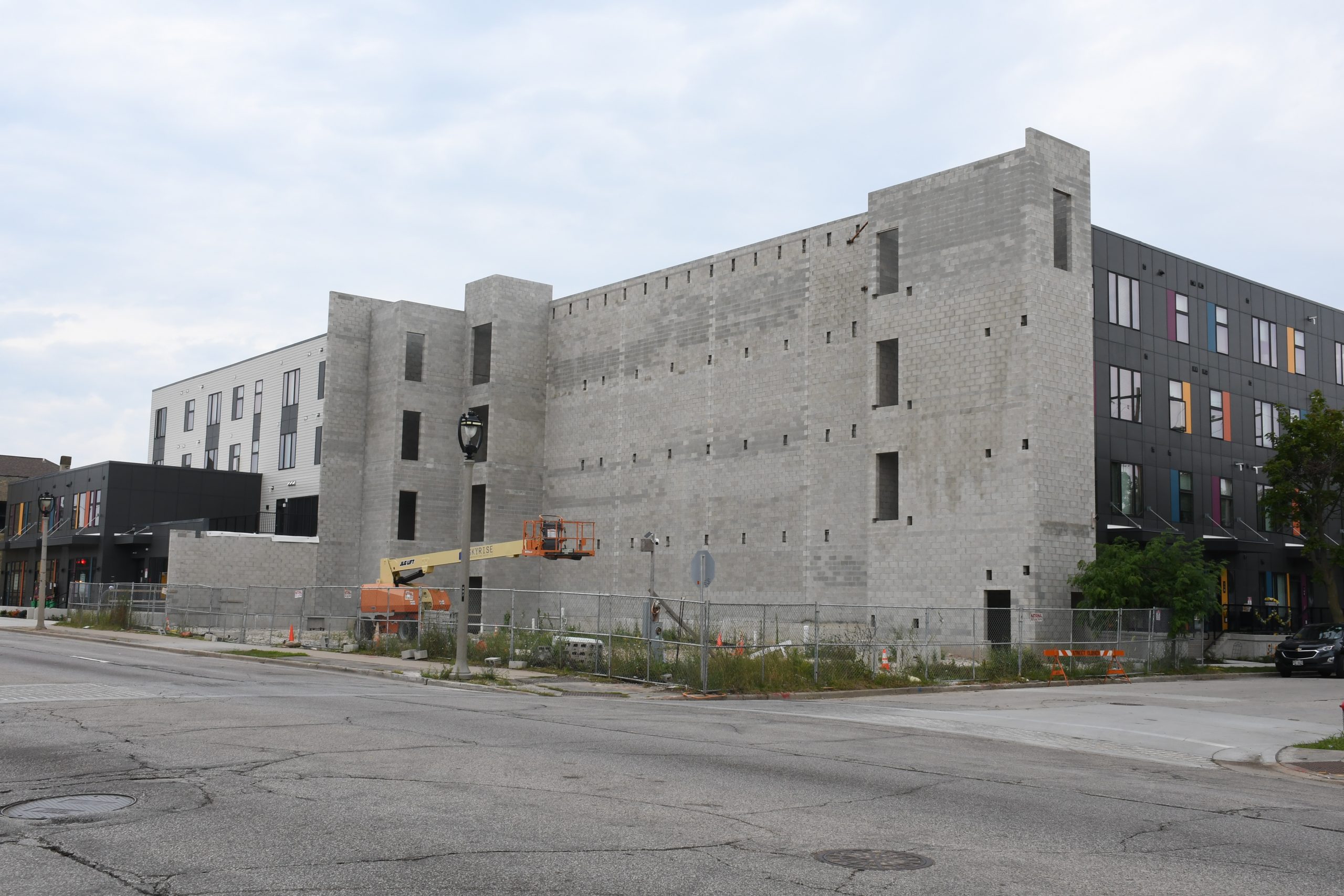
The Bronzeville Creative Arts & Tech Hub. Photo by Jeramey Jannene.
Construction is poised to start on the final phase of a long-planned mixed-use complex after the City of Milwaukee approved the last piece of the $29.3 million development’s financing package.
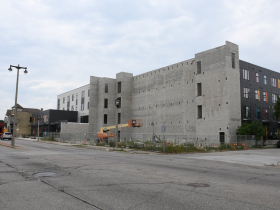
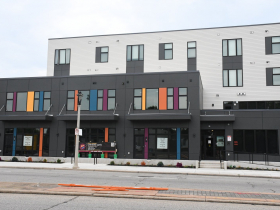
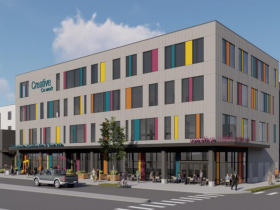
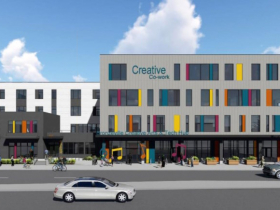
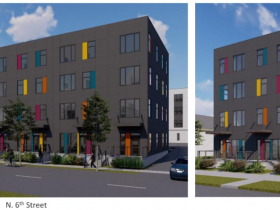
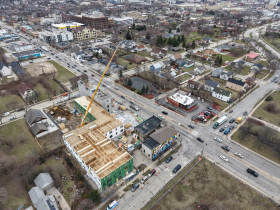
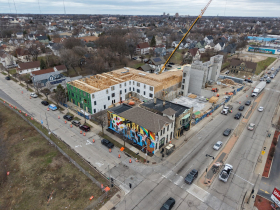
FIT Investment Group is gearing up to start construction on a 29,000-square-foot, four-story commercial building at the northwest corner of N. 6th Street and W. North Avenue. The structure will complete the Bronzeville Creative Arts & Tech Hub, which includes a 60-unit apartment building as its first phase.
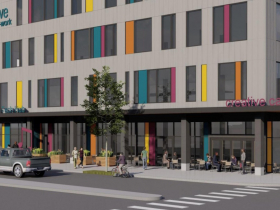
A cafe is planned on the first floor, and the Wisconsin Conservatory of Music, Black Arts MKE and Beyond STEM would occupy the upper floors.
“We are really passionate about community development, working on projects that have big impact, multiple layers of impact, that are transformative, that address challenges. I think this project is really a good project that highlights some of those elements,” FIT founder and CEO Michael Adetoro told the Zoning, Neighborhoods & Development Committee on July 28.
Adetoro initially secured approval to buy the vacant, city-owned site in 2021 and spent several years assembling the financing for the project.
FIT is now approved for a $1.65 million tax incremental financing (TIF) district subsidy. The funding would be paid out over a maximum of 25 years with 3.5% interest, from incremental property tax revenue generated by the development.
“This financing is really the last piece that’s needed,” said Adetoro of the $11.1 million second phase.
FIT and housing partner Lutheran Social Services of Wisconsin and Upper Michigan received a $700,000 TIF subsidy, plus 7% interest over a maximum of 21 years, for the first phase of the development.
Both subsidies are structured as developer-financed TIF deals, effectively property tax rebates, where the funding is only provided if the development generates sufficient incremental property tax revenue within the approved recovery period. The structure transfers the risk from the city to the project owners.
The first phase, which is almost entirely affordable, income-restricted apartments primarily funded through the state-administered low-income housing tax credit program, is nearly full. Fifty-seven of the 60 apartments are leased, said Adetoro.
The only units that remain are market-rate live-work units facing W. North Avenue. The units are intended to allow entrepreneurs to have a dedicated storefront in front of their three-bedroom apartment. The design also allows the remainder of the apartments to be set back from W. North Avenue.
Adetoro, when the Redevelopment Authority of the City of Milwaukee considered the TIF subsidy on July 16, said he expected to make an announcement on a cafe tenant “soon.”
“We fully expect to be fully leased up by construction completion,” he said.
The commercial building will include studios, office space, a first-floor cafe, music performance space and collaborative workspaces. The fourth floor will be unfinished until leased.
The RACM board on July 16 also reauthorized a $500,000 low-interest brownfield cleanup loan from its revolving loan fund. The board initially approved the loan in 2025, but Adetoro did not close on the remaining financing in time to accept the loan. The housing phase received a $700,000 cleanup loan, which supported trucking contaminated soil off site.
In addition to the TIF subsidy and cleanup loan, the Greater Milwaukee Foundation, Legacy Redevelopment Corporation, nonprofit Milwaukee Development Corporation and a $32,500 city commercial corridor grant are supporting the development. The project is benefiting from $3.5 million in federal New Markets Tax Credits that are being allocated by First-Ring Industrial Redevelopment Enterprise and sold to Wells Fargo to raise equity.
Black Arts and the Wisconsin Conservatory of Music have agreed to 10-year leases, which Adetoro said improves the sustainability of the development.
Adetoro said he plans to hire JCP Construction to build the second phase. KGI Construction Group, according to building permits, was the general contractor on the apartments. Engberg Anderson designed both phases. Emem Group is serving as an owner’s representative.
As part of the two TIF subsidies, the development team is required to have 40% of the project’s construction work hours performed by underemployed or unemployed city residents through the Residents Preference Program, spend 25% of the project’s construction costs and 18% of its design and development costs with certified Small Business Enterprises, set aside 20% of the affordable units at initial lease up for area residents through the city’s Anti-Displacement Preference Policy and forego any rights to property tax exemptions.
The council unanimously approved the latest subsidy on July 31. It was signed by Mayor Cavalier Johnson on Aug. 3.
The development is expected to be complete in winter 2027.
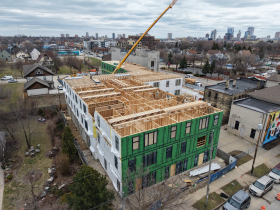
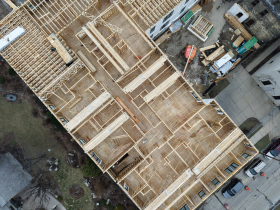
Photos
Renderings


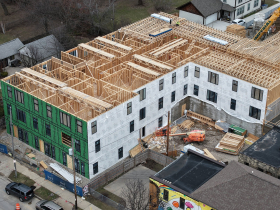
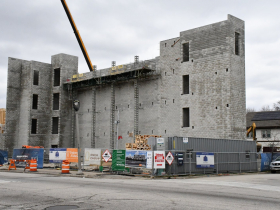
April 2025 photos
Legislation Link - Urban Milwaukee members see direct links to legislation mentioned in this article. Join today

Existing members must be signed in to see the interactive map. Sign in.
If you think stories like this are important, become a member of Urban Milwaukee and help support real, independent journalism. Plus you get some cool added benefits.