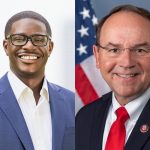

Will David Crowley’s Pragmatic Record Hurt Him in Race for Governor?
Tiffany, Republicans blame him for problems he inherited as Milwaukee County Executive.
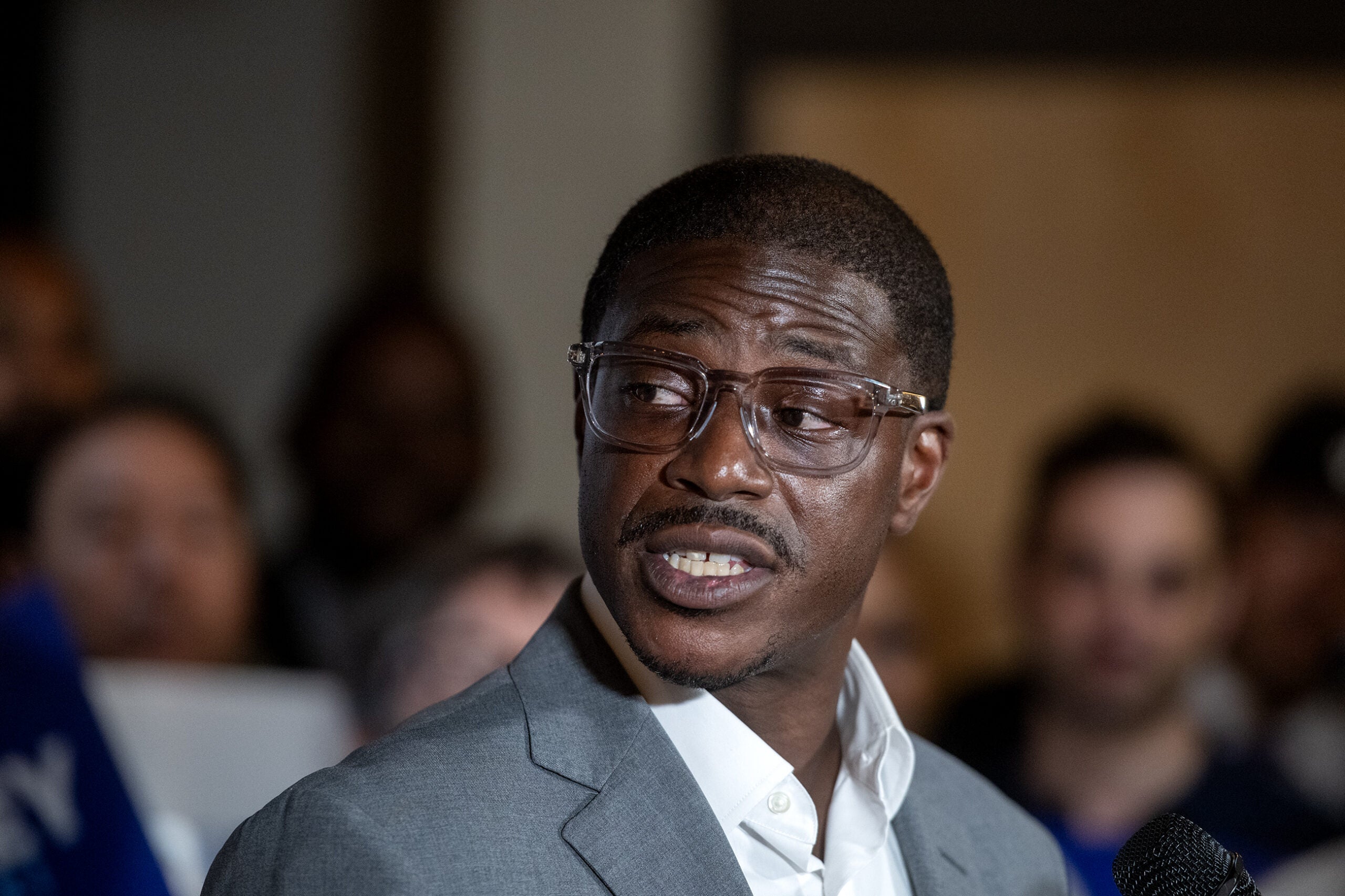
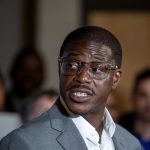
Wisconsin gubernatorial candidate Milwaukee County Executive David Crowley speaks during a press conference Thursday, Oct. 1, 2026, at Milwaukee Public Market in Milwaukee, Wis. Angela Major/WPR
There’s a photo making the rounds on social media these days of Milwaukee County Executive David Crowley, smiling broadly, and cutting a cake.
It wasn’t for any personal milestone, like a wedding or birthday. It was the day in the summer of 2023 that the Milwaukee County board approved a sales tax increase — just weeks after the city of Milwaukee did the same thing.
This was a hard-fought win for the county executive. It came after painstaking negotiations with Republicans who run the state Legislature, who had to grant permission for the sales tax hikes. Crowley, along with Milwaukee Mayor Cavalier Johnson, lobbied for years over what they described as a critical bulwark against a looming fiscal crisis.
“After 20 years of stagnation, we are making progress on meeting the needs of communities all across Milwaukee County,” Crowley said at an April 2023 press conference, where he was joined by top GOP leaders. “I think that we can all agree that we cannot continue to keep kicking this can down the road.”
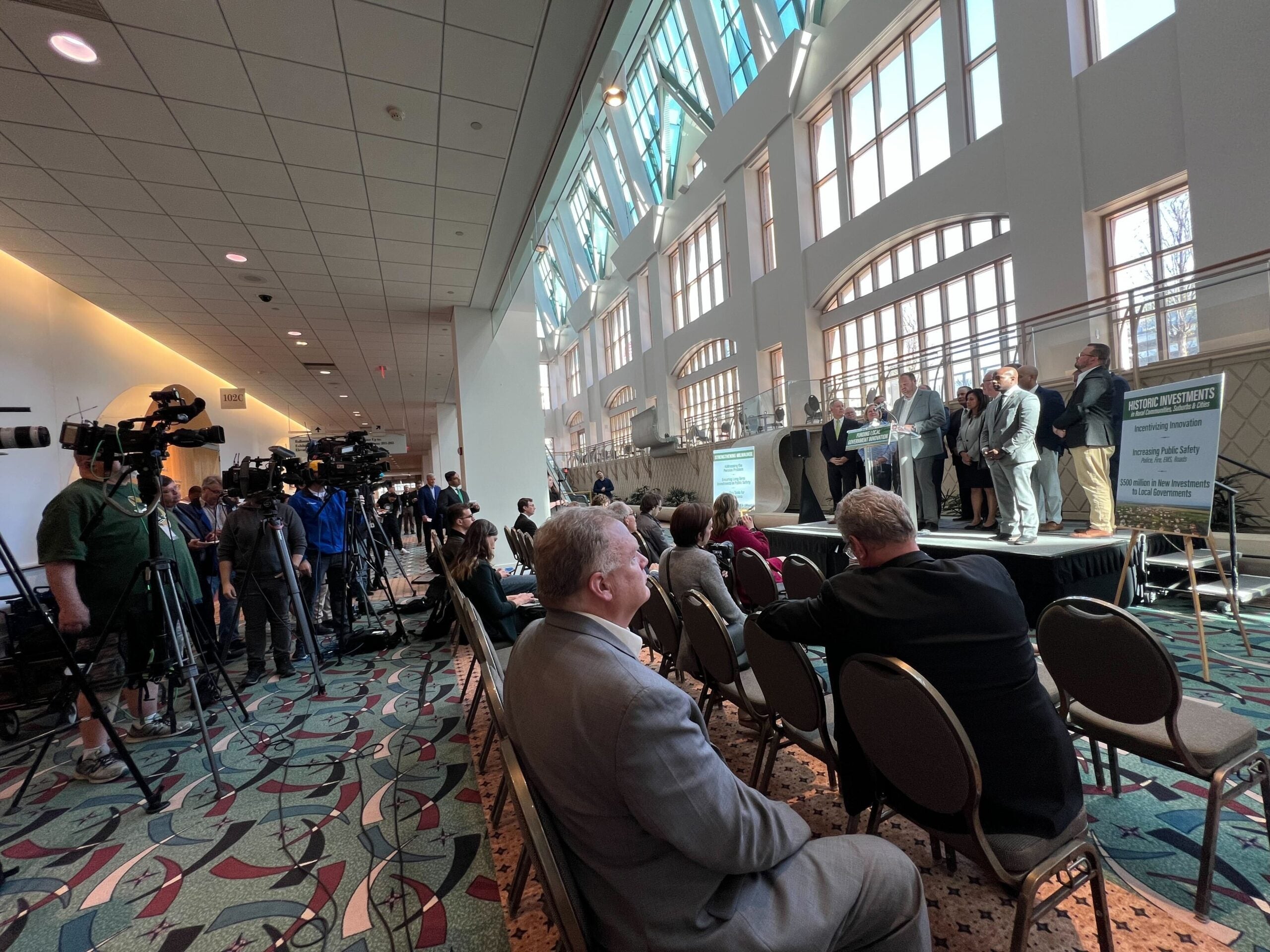
Assembly Speaker Robin Vos, R-Rochester, Milwaukee Mayor Cavlier Johnson, Milwaukee County Executive David Crowley and other government leaders speak at a press conference on a plan that would boost state funding for local governments on April 27, 2023. Evan Casey/WPR
Three years later, as he campaigns for governor, Crowley doesn’t exactly run on the phrase “sales tax.” But he proudly touts the deal as an example of the kind of bipartisan governing that he’d bring to Madison if elected. Wisconsin Act 12 — the official name for the law that allowed for the sales tax hike and boosted state funding to local governments across the state — is listed as a key accomplishment on his campaign website.
Crowley’s pragmatic approach has defined his time in office. First as a state representative for the Milwaukee district where he grew up, and then as Milwaukee County’s youngest, and first Black executive, Crowley has positioned himself as the kind of leader who will do what’s best for his community.
But many of those choices aren’t the kinds of things a person with aspirations of higher office would necessarily want on their record — like raising taxes, even if it had buy-in from both parties. Or focusing on covering basic services, even if it prevented massive cuts and prevented government bankruptcy.
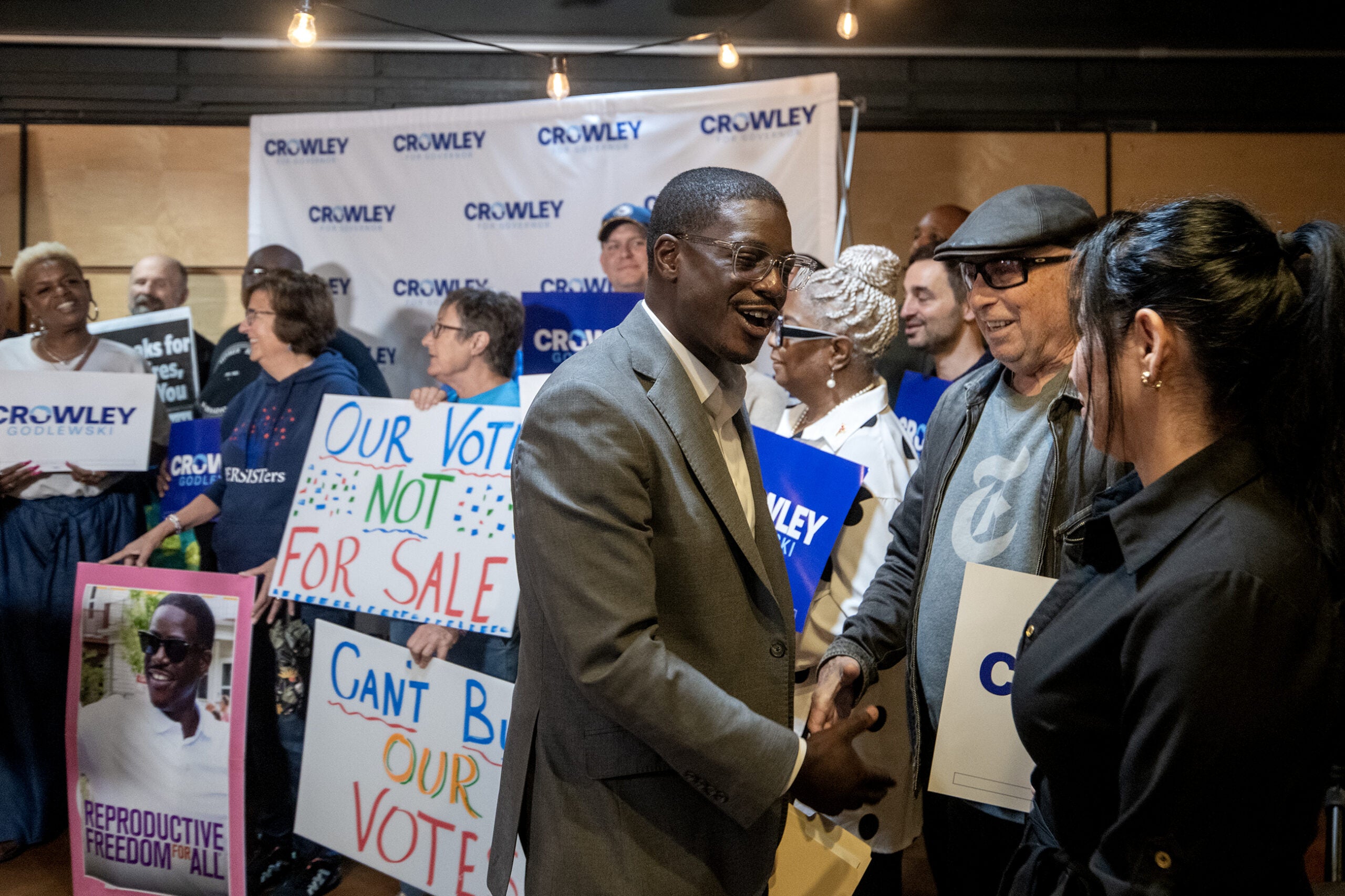
Wisconsin gubernatorial candidate Milwaukee County Executive David Crowley shakes hands as he enters a press conference Thursday, Oct. 1, 2026, at Milwaukee Public Market in Milwaukee, Wis. Angela Major/WPR
And with all the opportunities that come with running the state’s largest county — and the executive experience that Crowley argues makes him a natural fit for the governor’s office — he has also, by definition, assumed much of the baggage that voters statewide associate with Milwaukee.
In that way, his biggest accomplishments may be a double-edged sword come November.
John Johnson, a research fellow at the Marquette Law School’s Lubar Center, has followed Crowley’s record in Milwaukee closely, including the long journey towards passing the sales tax increases.
“A lot of people wondered, would they be able to make it happen at all. He did make it happen. He’s rightfully proud of it.” said Johnson. “And it’s also, I think, a little bit tough politically when your greatest accomplishment is raising taxes.”
That’s part of what Crowley’s Republican opponent — U.S. Rep. Tom Tiffany — may be counting on. And it’s likely the reason Tiffany’s campaign is making ads out of the photo of Crowley cutting that cake.
Time to celebrate with Chairwoman Marcelia Nicholson and the Milwaukee County board for their hard work and passing the Sales Tax vote. The future looks bright for our County. https://t.co/B6c5xYtj3I
— County Executive David Crowley (@DavidCrowleyWI) July 27, 2023
‘Luckiest politician in Wisconsin’
Crowley’s ascension to Democratic nominee for governor was unusual, to say the least. After dropping out of the primary election over the summer, he reentered a week later to pose a moderate challenge to Madison Rep. Francesca Hong, the democratic socialist who had surged in early polling. When he returned to the race, it was with the endorsement of outgoing Gov. Tony Evers.
Even so, it was an enormously unlikely endeavor — one that ended after midnight on primary day, when Crowley squeaked out a margin of victory of less than a percentage point.
But it wasn’t Crowley’s first time coming from behind to clinch a win. When he ran for Milwaukee County executive, he was a little-known, second term Milwaukee state legislator, according to Mordecai Lee, a professor emeritus of political science at the University of Wisconsin-Milwaukee, who himself once served in the state Legislature.
“I think his leap from the state Assembly to being Milwaukee County exec was something of being the luckiest politician in Wisconsin,” said Lee.
When Crowley’s campaign for county executive began in 2019, the outgoing executive, Chris Abele, was initially supporting another candidate to replace him. When that person failed to get enough signatures to get on the ballot, Abele pivoted to endorsing Crowley, pouring hundreds of thousands of dollars into the race. Crowley eked out a win against state Sen. Chris Larson, an outspoken progressive.
Either of them would have inherited a multimillion-dollar budget shortfall and the reverberations of a 2001 pension scandal that left the county’s finances in shambles. Part of Crowley’s pitch for the office was that he’d secure that sales tax increase to bring in much needed revenue.
“Receiving these dollars is not about expanding Milwaukee County government. This is about actually meeting our basic needs,” he told WisconsinEye during his campaign in 2020. He said those needs included the county’s transportation network, meals for seniors and a courthouse where the public could feel safe.
Johnson, the Marquette researcher, said he agrees with Crowley’s assessment — that a sales tax was a solid way to cover required county costs — but that a good governing move wasn’t necessarily a political triumph.
“The pitch always was, ‘We’re going to raise taxes so that we don’t have to cut as much as we would have to cut otherwise,’” Johnson said. “But it’s not inspiring, necessarily, unless you’re somebody who cares a lot about the fiscal health of local government.”
The negotiation process was arduous, and involved bridging a divide among Republican lawmakers, some of whom were loath to approve any kind of tax increase. Ultimately, the city of Milwaukee was permitted to bump their sales tax by 2 percent, and the county by 0.4 percent.
Attached to Milwaukee
Crowley also has a story of personal triumph that he frequently refers to when describing his political ascent. Raised in the troubled 53206 zip code of Milwaukee, a segregated neighborhood with high rates of poverty and incarceration, Crowley’s childhood included evictions and watching family members struggle with drug addiction.
As a state legislator from 2017 to 2020, many of the bills that Crowley championed reflected issues that affected his community. He called for a grant program to provide lawyers for low-income tenants facing eviction and an income tax credit for eliminating lead hazards. He led an effort to set up speed cameras in Milwaukee, where reckless driving has been a scourge.
Some of his bills also dealt with criminal justice and racial profiling. He was part of a bipartisan effort to limit the use of constraints on pregnant people in jail or prison, and he led efforts to limit solitary confinement for people with severe mental illness. Crowley also pushed to require investigations into jail deaths. He called for body cameras on law enforcement, an annual review of use-of-force incidents by law enforcement, and for the state to collect data about the race, gender and zip code of drivers stopped in traffic stops.
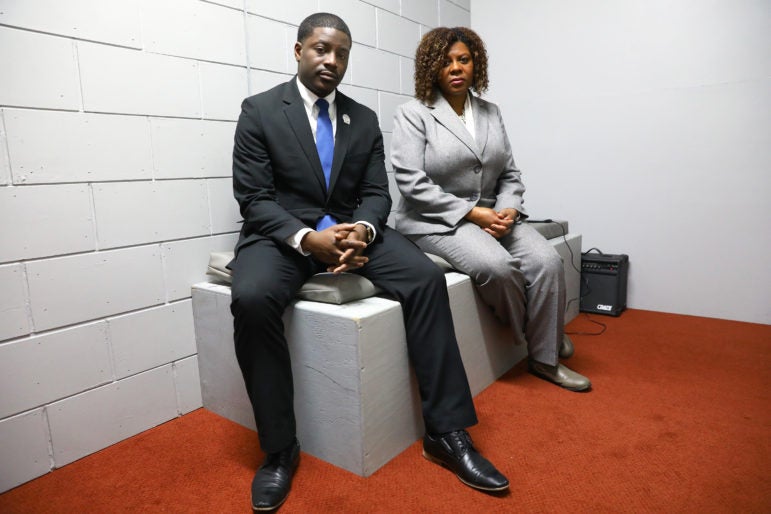
In this 2017 photo, state Rep. David Crowley and state Sen. LaTonya Johnson, both Democrats from Milwaukee, are seen in a life-sized mock solitary cell that was set up at the Wisconsin State Capitol. Coburn Dukehart/Wisconsin Center for Investigative Journalism
As a Democrat in the minority party throughout his time in Madison, almost none of Crowley’s bills went anywhere. But, as he did with the shared revenue deal, Crowley occasionally broke away from his party. He was the only Democrat to support a bill to increase penalties on people who solicit sex workers and was one of just two Democrats to cosponsor a bill to expand the definition of child pornography. Neither bill ultimately became law.
But Crowley’s hometown allegiance isn’t necessarily politically expedient. In state politics, Milwaukee is often treated as separate from the rest of Wisconsin, and its urban problems a world of its own. Lee says it was like that when he served in the 1970s.
“Anybody who wasn’t from Milwaukee viewed Milwaukee as a different state, an odd place, a terrible place, a place that just was a bottomless pit of need, a bottomless pit of every problem in the world: public education, crime, whatever it might be,” he said.
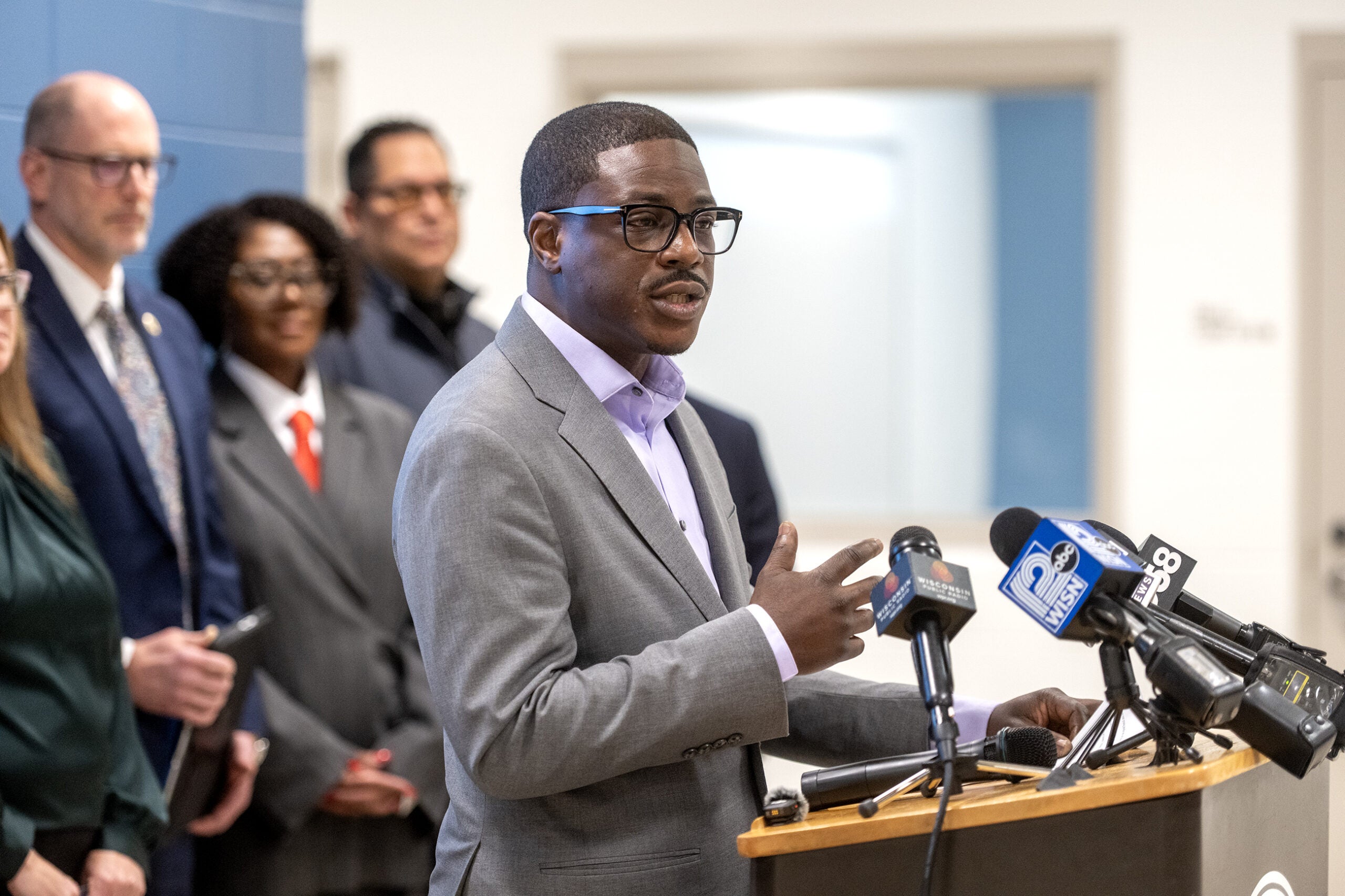
Milwaukee County Executive David Crowley speaks about the Milwaukee County Center for Youth at a press conference Thursday, March 5, 2026, in Milwaukee, Wis. Angela Major/WPR
Crowley wouldn’t be the first Milwaukee county executive to become governor. In 2010, Scott Walker made that jump. But Lee argues that Walker, who lived in the Milwaukee suburb of Wauwatosa, made a different kind of pitch for the office.
“The way that Scott Walker wiggled through it was by being a white guy from the suburbs and being a fiscal conservative to the point where (it was like), ‘OK, we won’t consider this guy to be a Milwaukee guy,’” Lee said.
Walker distanced himself from the urban woes of Wisconsin’s largest city, and even attacked it in his first campaigns for governor against then-Milwaukee Mayor Tom Barrett.
That’s not the Crowley approach. The issues that he focused on in the Legislature have also been his focus as county executive, representing 19 Milwaukee County cities, towns and suburbs. He’s put money toward eviction prevention programs, for example, and toward building affordable housing in suburban communities.
According to Lee, the question is whether Crowley can successfully argue his record demonstrates compromise and long-term thinking, or whether he’ll be too closely connected to urban challenges for many voters’ comfort.
Then again, Lee added, at a time when Wisconsinites statewide are struggling with the climbing costs of gas and groceries, maybe challenges once seen as just Milwaukee problems strike a little closer to home.
“All of a sudden, average Joe and Jane Wisconsinites in outstate Wisconsin care about exactly those issues: childcare, food stamps, affordability, cost of living, Medicaid,” Lee said. “So it could well be that he’s been able to transcend that perception, the negative perception of being from Milwaukee.”
David Crowley’s pragmatic record a double-edged sword in Wisconsin governor’s race was originally published by Wisconsin Public Radio.
If you think stories like this are important, become a member of Urban Milwaukee and help support real, independent journalism. Plus you get some cool added benefits.
Political Contributions Tracker
Displaying political contributions between people mentioned in this story. Learn more.
- February 13, 2017 - Cavalier Johnson received $834 from Chris Abele
- June 30, 2016 - David Crowley received $1,000 from Chris Abele
- August 13, 2015 - Cavalier Johnson received $25 from David Crowley