

How Partisan Are Wisconsin’s Members of Congress?
Two different rankings show who is most and least bipartisan.

Western front of the U.S. Capitol.
Two years ago, a May 2024 Data Wonk article in Urban Milwaukee explored the question of bipartisanship among the members of Wisconsin’s congressional delegation. Using a website called the Lugar Index, the article found that two Republicans, Sen. Ron Johnson and Rep. Tom Tiffany, were the state’s least bipartisan members, while Democratic Sen. Tammy Baldwin and particularly the now-retired Rep. Mike Gallagher were the most bipartisan.
The Lugar Index is named for Richard Lugar, a former Republican senator from Indiana. Lugar was known for his ability to work with his Democratic colleagues, particularly in four focus areas: global food security, weapons of mass destruction nonproliferation, foreign aid effectiveness and bipartisan governance.
For each legislator, the Lugar Index is calculated from two pieces of data: the number of co-sponsorships collected for bills from members of the other party and the number of co-sponsorships made to bills authored by members of the other party.
The graph below updates the previous analysis using data from the 117th Congress, which covered the period between January 3, 2023, and January 3, 2025. The larger (or less negative) the score, the more bipartisan the member is judged to be. As before, Johnson and Tiffany were the least bipartisan and Gallagher and Baldwin scored highest, but Gallagher subsequently left Congress.
Surprisingly, based on his behavior in other contexts, Derrick Van Orden ranked next highest, which suggests a willingness to co-sponsor bills authored by Democrats and to recruit Democrats to co-sponsor his bills.
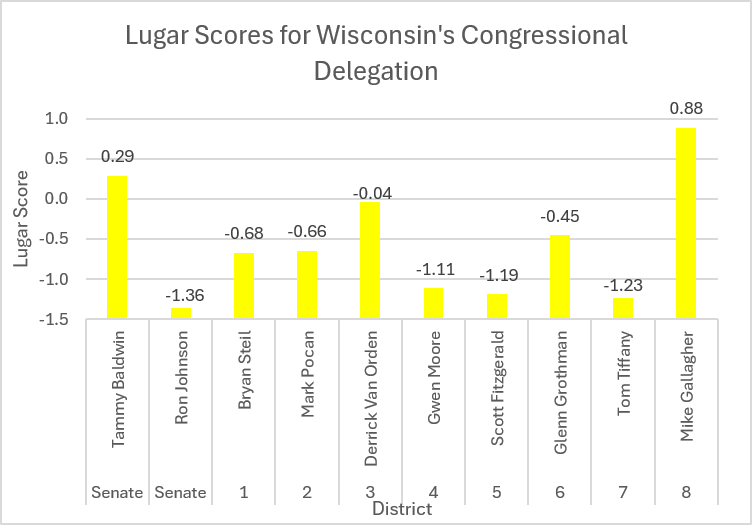
Lugar Scores for Wisconsin’s Congressional Delegation
Recently, a second website to rate the bipartisanship of members of Congress has been established on the internet. The site describes itself as a “report card for Congress (like Rotten Tomatoes for politicians).”
This site issues “Bridge Grades” for members of Congress, as in bridging the divide between Democrats and Republicans. It distinguishes between “Bridgers” and “Dividers” as follows:
Bridgers are collaborative, seek consensus, build coalitions, have a growth mindset, look for win-wins, negotiate, listen, make tradeoffs, are pragmatic, and seek solutions. They unite.
Dividers dig their heels in, are dogmatic, see the world as black and white (no shades of gray), and see the world through the lens of a “zero-sum game” – when I win, you lose. They divide.
Bridge Grades uses objective 3rd party data to score members of Congress on how collaboratively or divisively they govern.
The next graph shows the Bridge Grades for the Wisconsin Congressional delegation as of June 3, 2026. Report cards are updated monthly for every House member and every senator.
As with the Lugar scores, Bridge Grades makes heavy use of cross-party sponsorship of legislation. In addition, the Bridge Grades model credits several other factors in its ratings, including membership in the cross-partisan Problem Solvers Caucus, making fewer public personal attacks and more bipartisan public statements than their peers, and showing courage by engaging in bridging behaviors even when representing a hard-leaning voter district or when dealing with ideological positions far from the center. The higher the score, the more willing to work across party lines the legislator is judged to be.
In this ranking, Baldwin ranks highest, but Republican Rep. Tony Wied is close behind. Tiffany ranks as the worst, with Democratic Rep. Mark Pocan second worst and Johnson third worst.
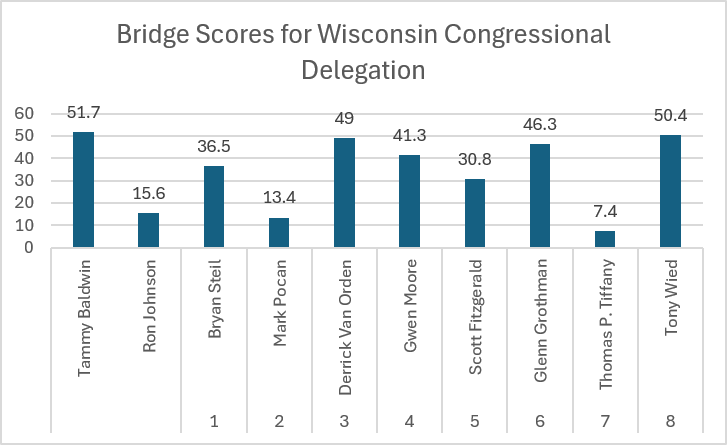
Bridge Scores for Wisconsin Congressional Delegation
The next graph plots scores for the entire House (except for recent arrivals and party leaders). The horizontal axis plots the percentile of the grade compared to all grades.
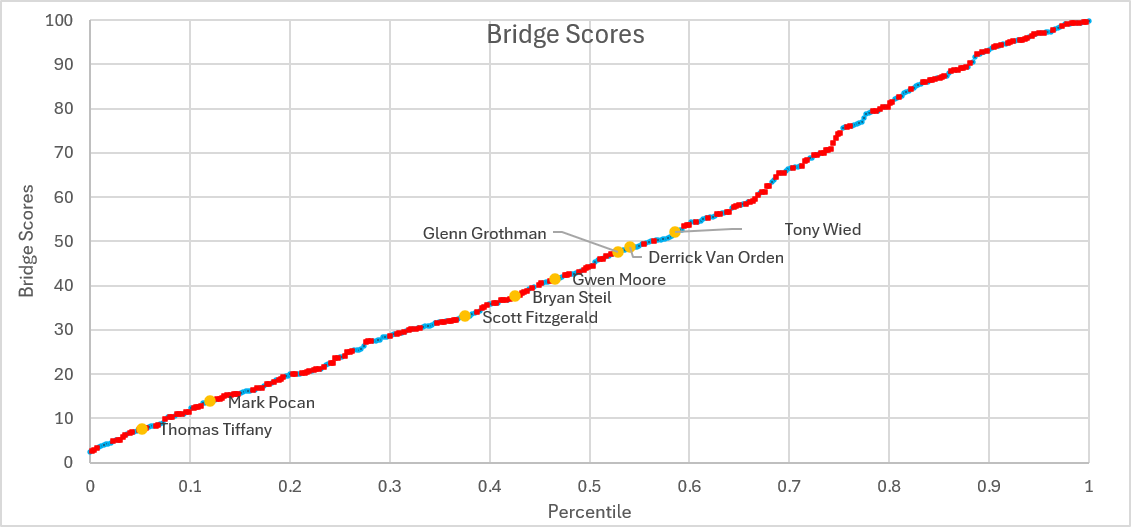
Bridge Scores
There are both differences and similarities between Lugar Scores and Bridge Grades. Both incorporate sponsorship in their model. But the Bridge Grades use many factors.
Another source of difference is the time period used in the calculation. The Lugar model looks back to the most recent two-year legislative session, which is the 118th Congress running between Jan. 2, 2023, and Jan. 2, 2025. Bridge Grades updates its model monthly, putting it into the 119th Congress.
The horizontal axis in the graph below shows the Lugar House scores for the 118th Congress. The vertical axis shows the current Bridge Grades for the same member in the current 119th Congress. While there is considerable scatter, on average a higher Lugar score is associated with a higher Bridge score.
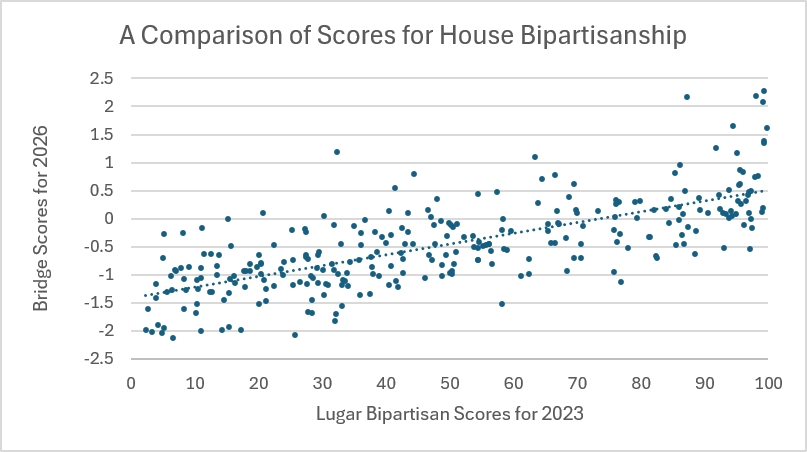
A Comparison of Scores for House Bipartisanship
The Bridges Votes website allows one to generate a summary for individual members. A look at several individual Wisconsin congressional members shows the report cards below.
Ron Johnson’s bipartisanship score is shown below. The yellow bars show Johnson’s score on five measures. The white bar shows the average Senate score. The Bridge Grades model gives Johnson an F grade mainly because of his apparent lack of interest in cross-party legislative sponsorship. This is consistent with Johnson’s Lugar score, the lowest of Wisconsin’s delegation.
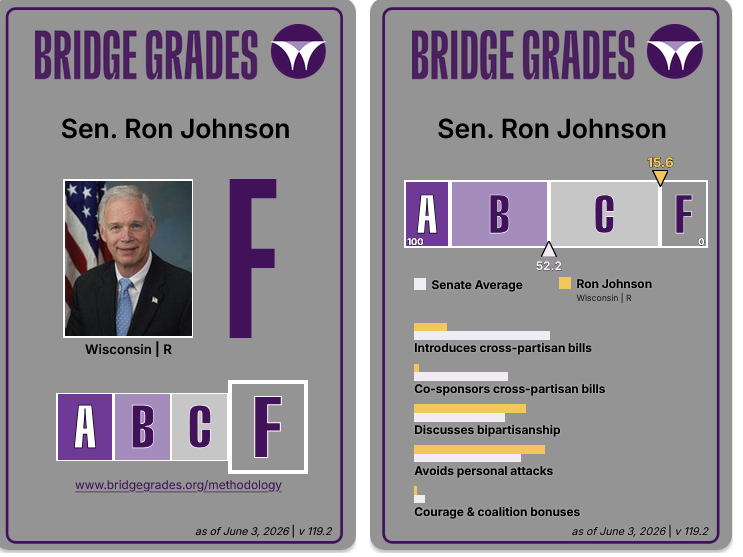
Sen. Ron Johnson’s bipartisanship score.
The next picture shows the Bridge report card for Rep. Van Orden. His grade of B is surprisingly high considering his well-publicized irascibility. Despite his attacks on Democrats, it appears that he is an active participant in cross-partisan bills.
Van Orden was one of only 17 Republicans — and the only member of the Wisconsin delegation — who broke with his party to vote for a bill to allow continuation of enhanced tax credits that would have made health insurance affordable to several million Americans. However, he then turned around and attacked Democrats for creating bad laws that necessitated the vote.
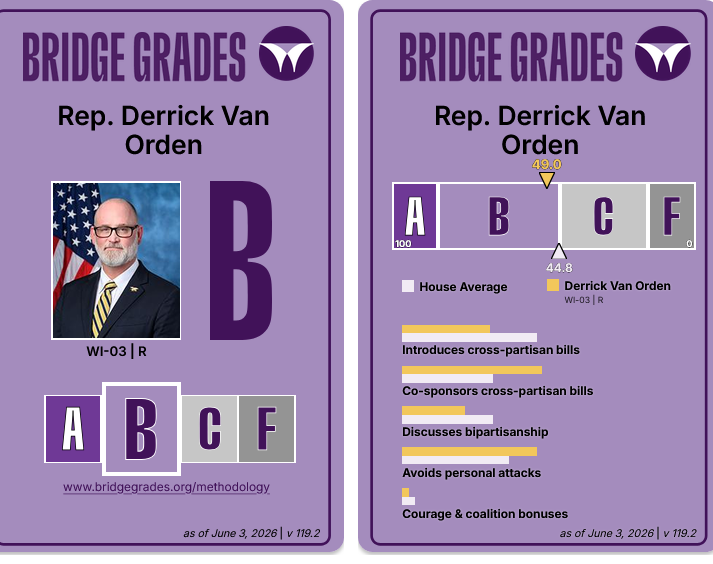
Rep. Derrick Van Orden’s bipartisanship score.
Tiffany’s report card is shown below. His grade of F is consistent with his indifference toward working across partisan divides.
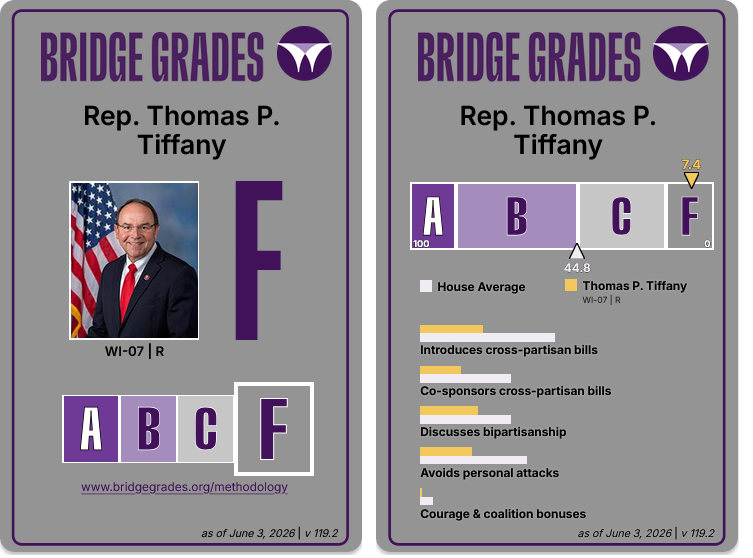
Rep. Tom Tiffany’s bipartisanship score.
Following a successful campaign for office, it is common practice for the winner of an election to include a comment to the effect that he or she is concerned about the welfare of everyone, not just his or her voters. It is hard to envision Tiffany, under the influence of President Trump, making that assurance.
The next table summarizes the scores of the ten members of Wisconsin’s Congressional delegation. There are no grades of A, three grades of B, four of C, and three of F.
| Bridge Scores for Wisconsin’s Congressional Delegation | |||
|---|---|---|---|
| District | Member | Score | Grade |
| Senate | Tammy Baldwin | 51.7 | B |
| Senate | Ron Johnson | 15.6 | F |
| 1 | Bryan Steil | 37.6 | C |
| 2 | Mark Pocan | 13.9 | F |
| 3 | Derrick Van Orden | 48.7 | B |
| 4 | Gwen Moore | 41.6 | C |
| 5 | Scott Fitzgerald | 33.0 | C |
| 6 | Glenn Grothman | 47.7 | B |
| 7 | Thomas Tiffany | 7.7 | F |
| 8 | Tony Wied | 52.1 | C |
Clearly, identifying and supporting legislators willing to talk to people in the other party is no panacea. But if it moves candidates to put more emphasis on what is good for their potential constituents, that could be a gain.
If you think stories like this are important, become a member of Urban Milwaukee and help support real, independent journalism. Plus you get some cool added benefits.


Data Wonk
-
How Successful Has The Trump Economy Been in Creating Jobs?
 Sep 19th, 2026 by Bruce Thompson
-
The Arguments Against Wisconsin’s Congressional Maps
 Sep 9th, 2026 by Bruce Thompson
-
How Gerrymandered Are Wisconsin’s Congressional Districts?
Sep 2nd, 2026 by Bruce Thompson



















The surprise here is Glenn Grothman, is he losing his crusty shell as he gets older?
We need more bridgers along the lines of senator Tammy Baldwin.
The grades given out in this article are questionable. Marc Pocan gets an “F” while Van Orden and Grothman get a “B”? Ridiculous. Why the hell would I even want to grade my politician on bipartisanship given today’s political environment?
Voters elect politicians to represent our interests in government. Bipartisanship, especially amongst Democratic politicians, doesn’t mean you are following the will of those who voted for you. (Which goes a long way in explaining the low approval ratings Democratic voters have of their own party and the sense that the Democratic party is ineffectual as an opposition party).
The Republican Party is much, much worse (corrupt) than it was when Lugar was a US Senator. Why would I want to corrupt myself to work with them?