

New Coalition Seeks to Boost Milwaukee Transit Funding
Community organizations joining to promote need for transit, push for greater funding.
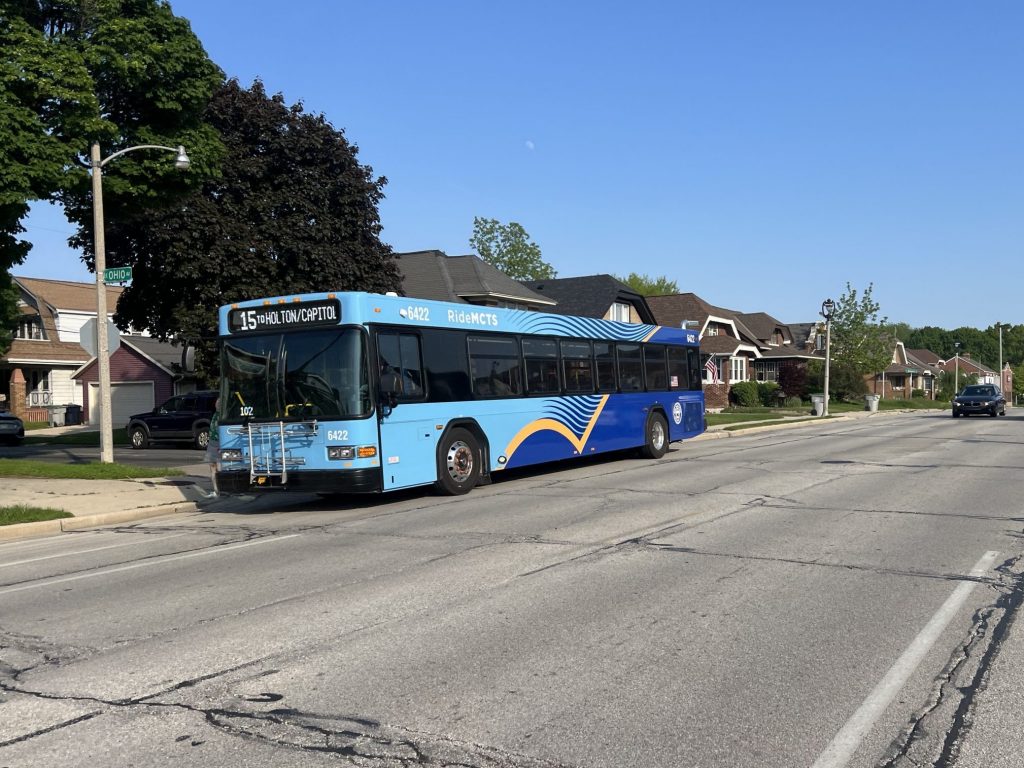
MCTS Bus. Photo by Jeramey Jannene.
A coalition of local community organizations is launching a campaign for more funding for the Milwaukee County Transit System (MCTS).
The “Transit is Milwaukee” coalition was organized by the transit advocacy nonprofit MobiliSE, which is the organization responsible for FlexRide, along with UW-Milwaukee and the Southeastern Wisconsin Regional Planning Commission (SEWRPC). FlexRide provides an on-demand taxi service that operates between specific pickup zones in the city of Milwaukee and drop-off zones near large suburban employers and business parks.
The new coalition is made up of a number of local nonprofits and advocacy organizations that do not traditionally work on transit issues but serve local residents who rely on public transit. The group plans to advocate for greater transit funding and expanded transit options in the Milwaukee metro area.
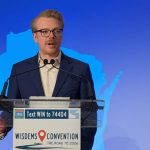
The coalition was formally announced during MobiliSE’s spring summit, attended by transit advocates, officials and politicians from the region, including MCTS President and CEO Steve Fuentes, Milwaukee County Department of Transportation Director Joe Lamers, Racine Transit and Mobility Director Trevor Jung, Wauwatosa Mayor Dennis McBride and state Sen. LaTonya Johnson.
The group’s primary focus is advocating for more state funding for MCTS, which implemented significant service cuts in 2026 to close a budget gap. The system has a structural deficit that could reach as high as $20 million in 2027. The system’s primary source of revenue, state mass transit aid, has not kept pace with the annually growing cost to operate MCTS, even as officials have pared back the system over the past two decades.
Milwaukee isn’t the only area struggling with transit funding, and that’s part of the message the group plans to bring to Madison, Dave Steele, MobiliSE’s executive director, told Urban Milwaukee.
“We’re seeing challenges in rural areas, where folks that rely on rural transit to get to jobs and healthcare appointments are being affected by service reductions,” Steele said. “Many communities across our state, urban and rural, have fixed route systems, or they have dial a ride taxis, or shuttles that help folks who can’t drive get to various places, and these services are essential for their communities.”
In May, the coalition is launching a social media campaign to promote the importance of transit. Long term, the group plans to push for an expansion of transit service running from Milwaukee County to nearby communities.
“I think it has the potential of really helping us build out a more robust mobility ecosystem in Milwaukee County, and not just there, but you can include Racine, Ozaukee, Waukesha,” Fuentes said. “If we could all come together and make life a little bit easier for the residents, that’s what it’s all about.”
The coalition is being led by the co-chairs of the MobiliSE Transit Advocacy Committee: Cinthia Téllez Silva of Michael Baker International and Claire Enders of Milwaukee County Aging and Disabilities Services. It includes organizations such as Employ Milwaukee, 1000 Friends of Wisconsin, Wisconsin Council for the Blind, Safe and Sound Inc., and Muskego Way.
“We want to send the message loud and clear that ‘Transit is Milwaukee,’” Cinthia Téllez Silva said in a statement. “Transit is freedom. Transit is independence. Transit is access to a job, to a health care appointment, to child care. It’s essential.”
If you think stories like this are important, become a member of Urban Milwaukee and help support real, independent journalism. Plus you get some cool added benefits.


MKE County
-
Rising Fuel Prices Hit County Budget
 May 4th, 2026 by Graham Kilmer
-
Dugan Seeks Acquittal Ahead of Sentencing
 Apr 29th, 2026 by Graham Kilmer
-
Airport Launches Sign Language Service
 Apr 28th, 2026 by Graham Kilmer
Transportation
-
See Costs, New Details For 794 Replacement Options
 May 1st, 2026 by Jeramey Jannene
-
See Design Concepts for 30th Street Corridor Trail
 Apr 30th, 2026 by Graham Kilmer
-
Why Milwaukee’s Potholes Are So Bad, And What’s Changing
 Apr 28th, 2026 by Jeramey Jannene















It seems that privatization of all previously managed municipal activities (museums, parks, senior centers, and now transportation) is now de rigueur by our elected leadership, which seems counter to our social democratic heritage. .
I hope they seriously consider adding $1 fee to each scooter trip which would be applied toward reducing the MCTS deficit, and also enacting at least a 5 percent hotel room tax which would also go toward reducing the MCTS deficit. I see so many Brewer fans jump on the Connect 1 without paying to get to AmFam Field. Let them pay through their hotel bill. Also, Summerfest has basically become a tourist event. Few locals can afford it. Let the tourists help reduce the MCTS deficit through their hotel bills.
What is needed is a regional transportation system. I grew up in Chicago and did not drive until I moved to Iowa for college. Now that we are retired we travel throughout the country in our motorhome and use public transportation whenever it is available. We find metropolitan areas that do not have bus routes that stop at county or city borders. We have used buses that were clean, dependable, and safe, none of which applies to the MCTS. On a recent trip to Savannah, GA we found a free transit system in the downtown area which included a ferry. Outside of the downtown we rode the CAT regional system, all day with a single $3.00 per person fare. Most of the people we talked with were locals not tourists.
This is a promising coalition because it involves a wider range of participants than just transit operators. It also addresses concerns of transit riders, such as those at UWM. Definitely, funding for MCTS is a key issue. However, a longer-term issue is recognizing that transit riders can benefit through land use proximate to transit stops.
The relationships among land use near transit stops, transit rider origins and destinations, and transit system services seem to be separated into silos of planning and practice. I can see that many of our transit stops and stations are surrounded by low-density land use. It is textbook knowledge that transportation works with trip origins and attractors. Having housing, life-serving services such as grocery stores, medical clinics and health centers, educational centers, small businesses and restaurants, and all the associated jobs within the walkshed of transit stops is key. The people traveling among these origins and destinations feed the transit systems.
Currently, low-density land use near transit stops is literally starving MCTS. Emphasis on free parking near transit stops that takes up valuable land is starving transit. Fixation on low-density, low-rise housing near transit undermines the value of transit. Certainly, a range of land uses can exist in the area, from low-density development in suburban areas to car-dependent development in rural areas, but building a complete mobility system requires thoughtful land-use planning near transit nodes. This is not a fault with mass transit fixed routes; it is a feature that a car-centric emphasis in regional planning has erased.
Thank you, John December. Your comments are always thoughtful, researched and appreciated.
The push towards privatization of public goods has not been beneficial to the public, quite the opposite. However, MCTS has not YET been privatized, but it has surely been a victim of several factors, including no dedicated funding source, an opaque and non inclusive decision making structure (hopefully this new coalition signals a change in that) and reactive planning.
As outlined in comment above, transit planning around density will be more likely to succeed, however transit is very rarely a consideration when new developments are being planned. This lack of transportation inclusion keeps MCTS on the back foot and creates transportation shortages for seniors and people living on limited means. Again, having a leadership at MCTS that is responsive and inclusive may help to change that too. MCDOT needs to be willing to facilitate that culture shift and with new leadership there …. well, we will see…