

Learning Our Lesson From COVID-19
Rather than blaming Fauci, Rand Paul and Ron Johnson should consider the impact of vaccine resistance.
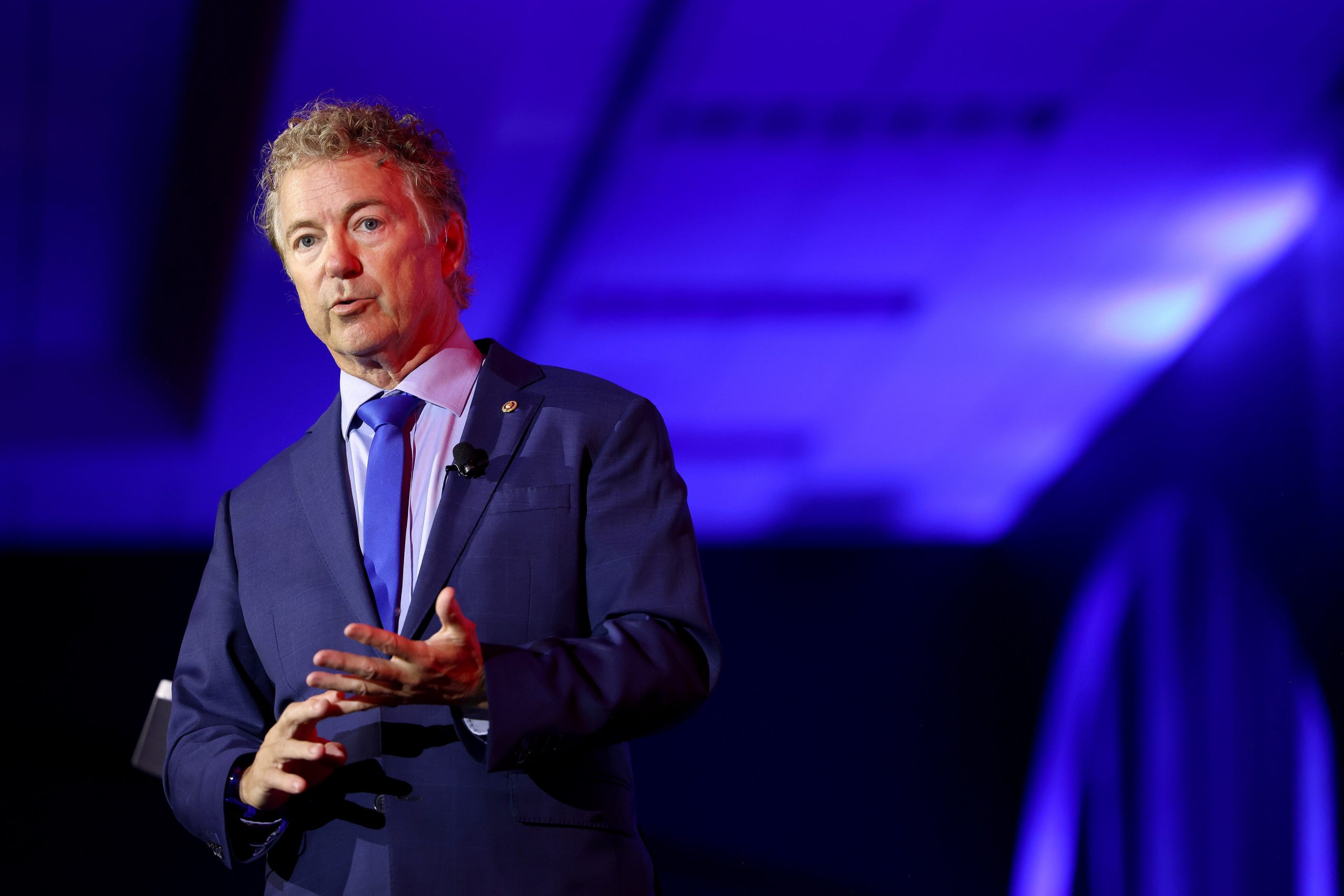
U.S. Sen. Rand Paul in 2026. Photo by Gage Skidmore, (CC BY 2.0), via Wikimedia Commons
Why Does Senator Rand Paul hate Anthony Fauci? Why have red states suffered more deaths from COVID-19 than blue states? The answer to the first question is intertwined with the second.
Members of the Senate Homeland Security and Governmental Affairs Committee recently held a hearing aimed at attacking Dr. Anthony Fauci, the longtime director of the National Institute of Allergy and Infectious Diseases. Fauci attended the hearing but declined to answer the committee’s questions, citing Paul’s stated intention to put Fauci in jail.
What explains Paul’s hostility to Fauci? One possible explanation is that, as a libertarian, Paul is averse to many of the steps taken to fight the spread of the virus, including the closure of schools, churches and restaurants. It quickly became evident that the aim of the hearing was not to better understand the course of the pandemic; rather, it was aimed at destroying Fauci’s reputation. Paul takes numerous opportunities to make the point that Fauci should go to jail. According to Paul:Fauci was funding dangerous gain-of-function research in Wuhan. Publicly, Anthony Fauci promoted the theory that the virus arose naturally. While privately, he was well-aware of a mountain of evidence suggesting the virus originated in the lab.
Wisconsin Senator Ron Johnson attacked Fauci for his lack of support for two medications. “So I would want to know to what extent were you involved in sabotaging hydroxychloroquine, ivermectin.”
The first drug mentioned by Johnson, hydroxychloroquine, was among those championed by Donald Trump, who claimed he was taking it. The Mayo Clinic reports that clinical trials showed hydroxychloroquine led to serious heart problems in some people, did not effectively treat COVID-19, and did not prevent infection with the virus that causes COVID-19.
The second drug championed by Johnson, ivermectin, apparently is not among those championed by Trump. The Food and Drug Administration reports that ivermectin is not authorized or approved by major health organizations for the prevention or treatment of COVID-19. It is described as a highly effective medication when used to treat specific parasitic infections in humans and animals. However, large-scale, rigorous clinical trials have consistently shown that it does not provide meaningful clinical benefits against the Covid virus.
Early laboratory tests showed that ivermectin could block some viruses in a petri dish, but large clinical trials proved it does not work against viruses like COVID-19 in people. Health agencies strongly advise against using it for viral illnesses. High doses are needed to stop viruses in cell cultures, but those levels can be toxic and unsafe for humans.
While endorsing these two medications that have proven ineffective in countering Covid, it appears that Johnson rejects the COVID-19 vaccine, calling it “experimental gene therapy.”The virus hit the United States and Wisconsin in early spring of 2020. For most of 2020, there was no effective vaccine for it. As a result, people turned to deep cleaning of surfaces, only to discover that the virus was mostly spread through the air. Early on, people were warned against using masks and then were ordered to put on masks whenever they were with other people. (In part, this may have reflected a plan to reserve masks for health care workers until the production of masks could catch up with demand.)
Lacking effective vaccines until the very end of 2020, many Americans turned to drugs that had little or no evidence of effectiveness. However, there were early signs of the developing partisan split about what to do about COVID-19. Rather than celebrating the speed at which vaccines had been developed, President Trump took pride in refusing to wear a mask.
The net effect of these pressures was to create chaos in 2020 following the appearance of Covid in the United States. Trump held a series of press conferences in which he would appear surrounded by Fauci and other experts. Trump would typically minimize the impact of the pandemic. Then Fauci would step forward and correct Trump’s assertions, a gutsy move.
The graph below reflects this chaos. It plots the number of Covid deaths in each state during the year 2020 (on the vertical axis) against the partisan lean of the state as measured by the vote in the 2024 election. Republican states are on the left, Democratic states on the right. Wisconsin is represented by the point surrounded by a circle. The lack of any pattern is consistent with the lack of any effective response to the virus.
This is confirmed by the R2, which is often interpreted as a measure of the percentage of the variation in one variable — in this case the state’s partisan lean — that is explained by the other variable, in this case the COVID-19 death rate. Only 5% of the variation is explained. Wisconsin is shown by the point surrounded by a circle.
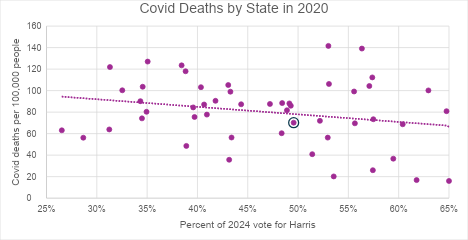
Covid Deaths by State in 2020.
All this changed as the vaccine became widely available by January 2021. The next graph shows the same relationship between COVID-19 deaths per 100,000 people and the political tilt of each state in 2021: There was a strong relationship between each state’s deaths and how its citizens voted in the 2024 presidential election.
Wisconsin, again identified with the circle, falls near the middle among the states.
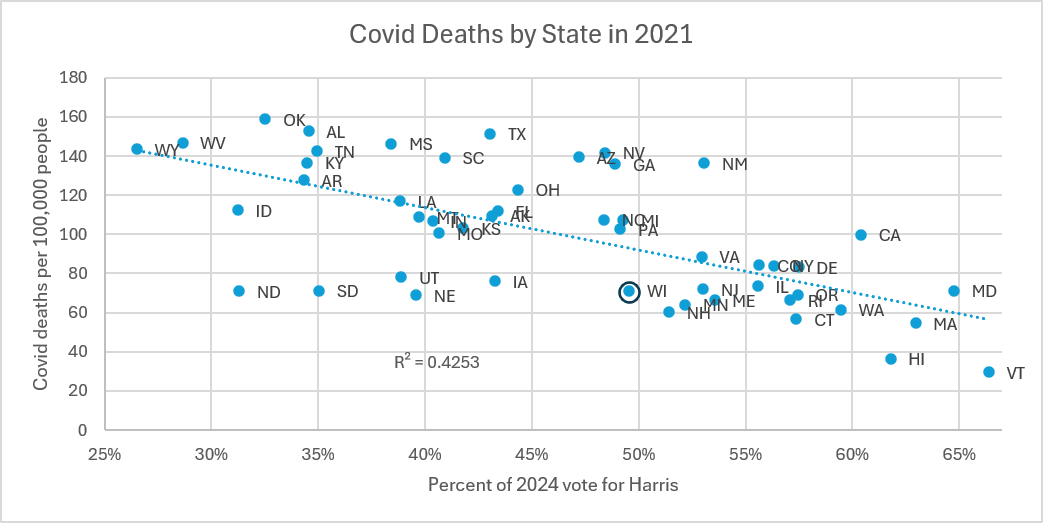
Covid Deaths by State in 2021.
The next graph shows the relationship between COVID-19 deaths and the partisan divide in the following year, 2022. The average death rate has declined substantially compared to 2021. (All three graphs use the same vertical scale.)
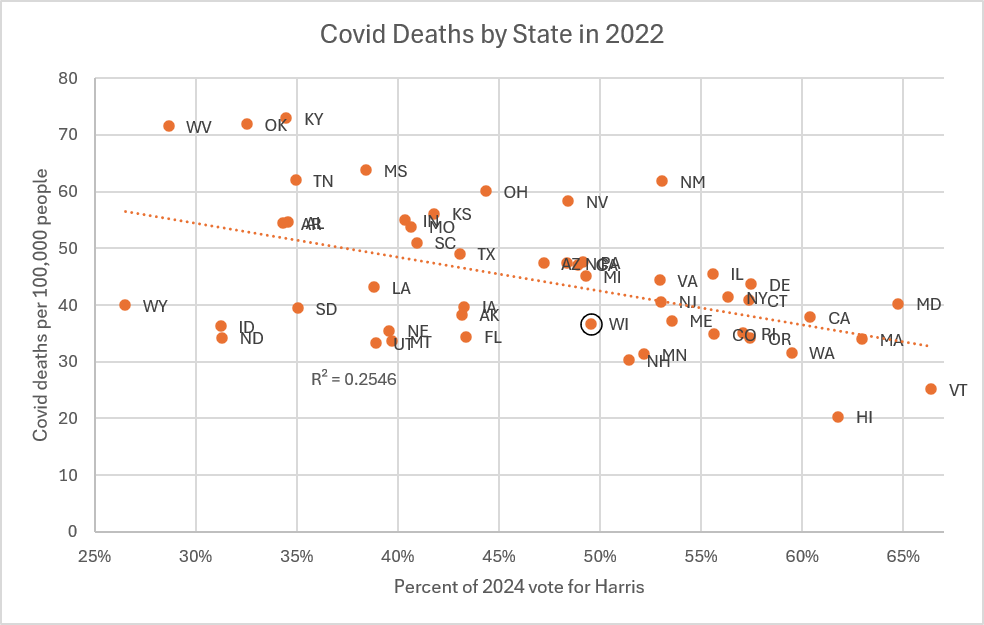
Covid Deaths by State in 2022.
The next graph compares the variation in covid death rates in 2022 to that in 2021. States that had lower death rates in 2021 tended to have lower rates in 2022. Wisconsin is located at the red circle.
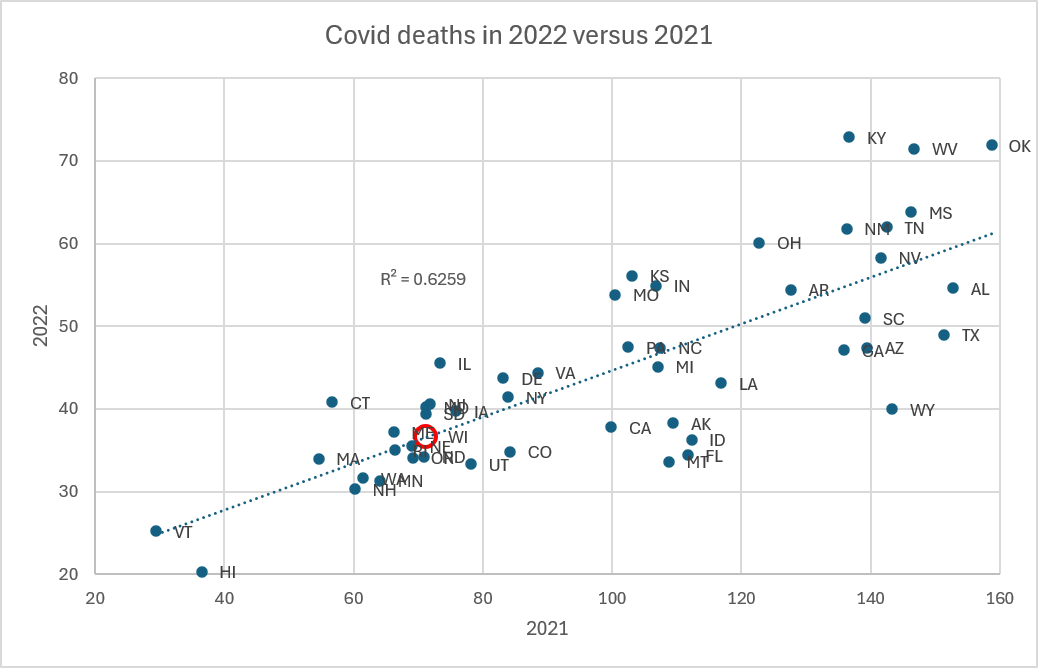
Covid Deaths in 2022 versus 2021.
The last graph of this group shows Covid deaths in 2023 (shown in red) and 2024 (shown in orange). Overall deaths continue their decline while becoming a bit flatter still.
COVID-19 deaths per 100,000 drop by a factor of 10 compared to earlier graphs. States with lower COVID-19 death rates tended to do better in 2024.
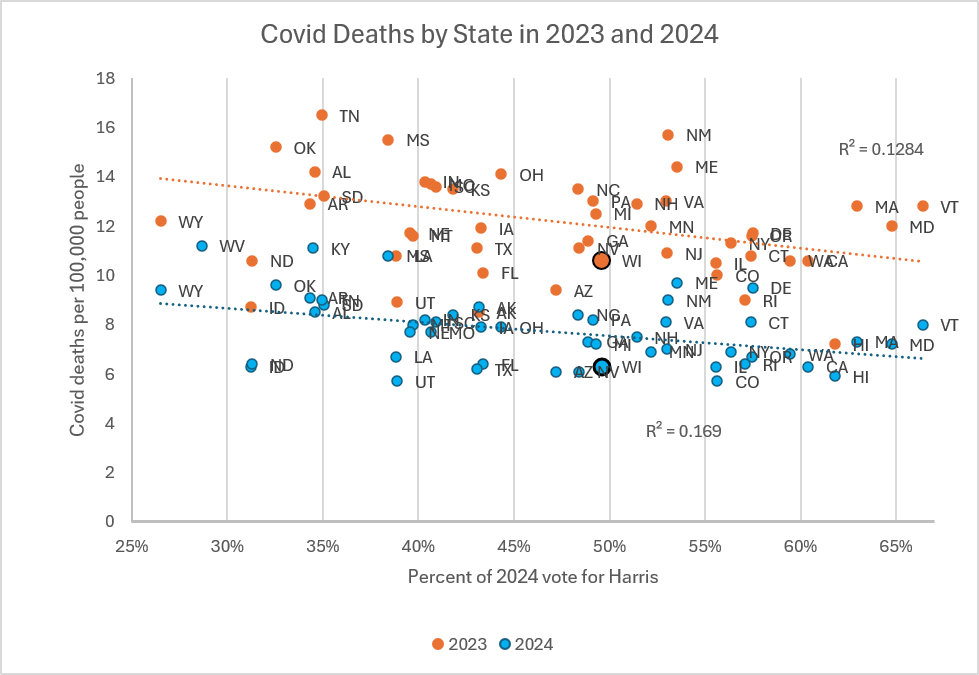
Covid Deaths by State in 2023 and 2024.
It’s been estimated that 223,000 deaths occurred in the U.S. because of a failure to get vaccinated. The attempt by Rand Paul, Ron Johnson and other Republican committee members to pin the blame for Covid’s spread on Tony Fauci simply ignores the impact of vaccine resistance. Better to use the experience of COVID-19 to learn from it and improve the nation’s response to future pandemics.
If you think stories like this are important, become a member of Urban Milwaukee and help support real, independent journalism. Plus you get some cool added benefits.
More about the Coronavirus Pandemic
- Data Wonk: Learning Our Lesson From COVID-19 - Bruce Thompson - Aug 19th, 2026
- Governors Tony Evers, JB Pritzker, Tim Walz, and Gretchen Whitmer Issue a Joint Statement Concerning Reports that Donald Trump Gave Russian Dictator Putin American COVID-19 Supplies - Gov. Tony Evers - Oct 11th, 2024
- MHD Release: Milwaukee Health Department Launches COVID-19 Wastewater Testing Dashboard - City of Milwaukee Health Department - Jan 23rd, 2024
- Milwaukee County Announces New Policies Related to COVID-19 Pandemic - David Crowley - May 9th, 2023
- DHS Details End of Emergency COVID-19 Response - Wisconsin Department of Health Services - Apr 26th, 2023
- Milwaukee Health Department Announces Upcoming Changes to COVID-19 Services - City of Milwaukee Health Department - Mar 17th, 2023
- Fitzgerald Applauds Passage of COVID-19 Origin Act - U.S. Rep. Scott Fitzgerald - Mar 10th, 2023
- DHS Expands Free COVID-19 Testing Program - Wisconsin Department of Health Services - Feb 10th, 2023
- MKE County: COVID-19 Hospitalizations Rising - Graham Kilmer - Jan 16th, 2023
- Not Enough Getting Bivalent Booster Shots, State Health Officials Warn - Gaby Vinick - Dec 26th, 2022
Read more about Coronavirus Pandemic here


Data Wonk
-
Most Republicans Support Raising the Minimum Wage
 Aug 5th, 2026 by Bruce Thompson
-
The Economics of the Minimum Wage
Jul 22nd, 2026 by Bruce Thompson
-
How Did Support For Environment Get So Partisan?
 Jul 15th, 2026 by Bruce Thompson