A Bucket List of String Quartets
Philomusica Quartet performs three must-hear works by Haydn, Mozart, Beethoven.
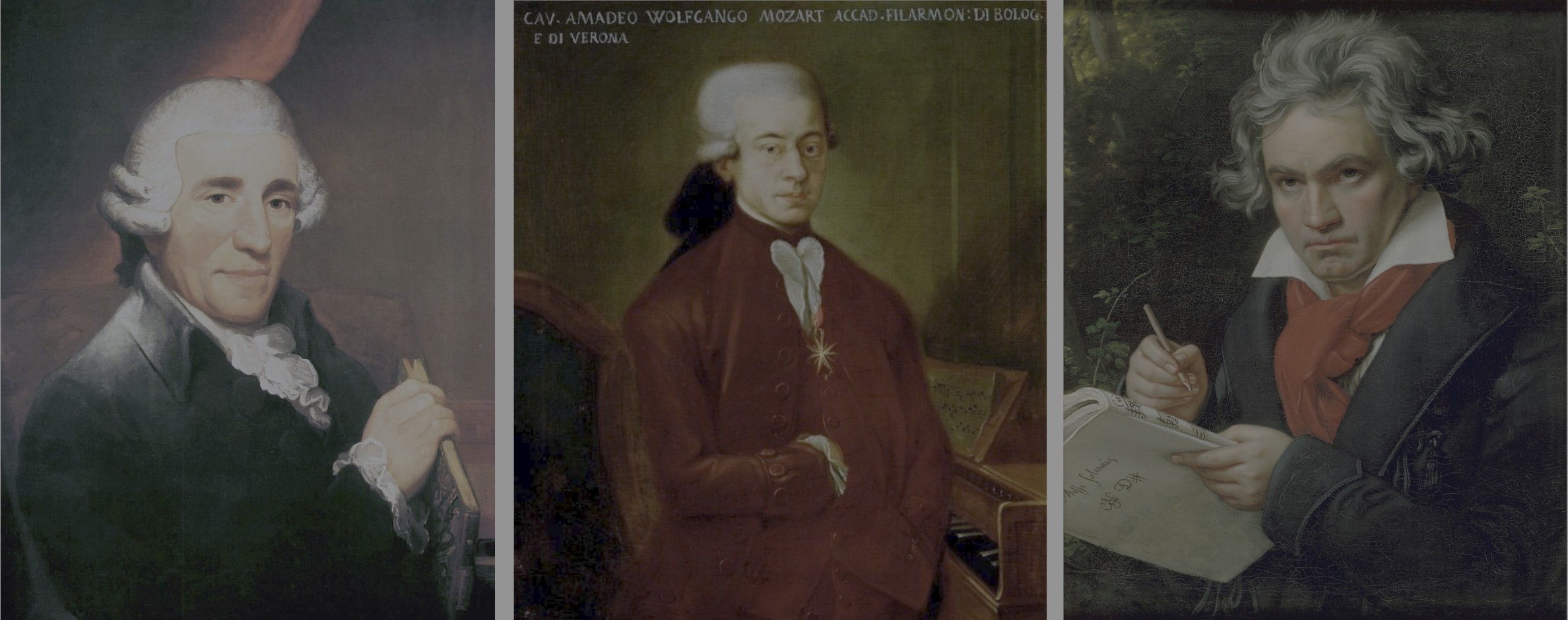
Joseph Haydn, Wolfgang Amadeus Mozart and Ludwig van Beethoven. (Public Domain).
The Philomusica Quartet opens its season at Wisconsin Lutheran College with a program celebrating the evolution of the string quartet in the Classical era, billed by violinist Sascha Mandl as “a masterclass in musical dialogue, emotional depth, and structural genius.”
Joseph Haydn, Wolfgang Amadeus Mozart and Ludwig van Beethoven, giants of composition in Vienna between 1750 and 1825, defined the critical Classical era of Western music. They did not standardize a format for the string quartet and other genres; instead, they challenged each other and continually expanded what chamber music could be.
Haydn, the father of the string quartet, shows his mature work in the String Quartet in C major, Op. 76, No. 3, “Emperor” (1796). He builds the central poco adagio movement on variations of a hymn he wrote that was adopted as the Austrian and then the German anthem. The familiar music is not lost in the variations, which create what critic Alan George calls a “backcloth of counterpoint and harmony.”
Mozart’s last quartets, including the String Quartet No. 21 in D major, K. 575, “Prussian” (1789), reflect a fully developed sense of the quartet as conversation. The dialogue among the players recalls Mozart’s command of opera, with melodic exchanges among the instruments.
Dedicating the quartet to King Friedrich Wilhelm II of Prussia, an amateur cellist, Mozart created an unusual role for the cello, assigning it a key part in the development, often at a higher-than-usual register to match exchanges with the first violin.
At a turning point in his extraordinary contribution to the string quartet genre, Beethoven’s 10th quartet, the String Quartet in E-flat major, Op. 74, “Harp” (1809), retains the sophistication of his middle-period quartets while being more approachable for the casual listener than his groundbreaking last six works.
In the opening music, a pizzicato accompaniment sounds like a harp. A presto movement is driven by a short-short-long rhythm reminiscent of his famous Fifth Symphony motif. The constant energy of this quartet’s movement reduces the expectation that the final movement will speed to a dramatic conclusion. Beethoven chooses a genial set of variations, ending brightly but with a light touch.
Matthew Michelic joins violinists Mandl and Jeanyi Kim as the violist for the season while Nathan Hackett is on leave. Michelic concluded 37 years of teaching at the Lawrence University Conservatory of Music and has extensive experience with chamber performance and as principal violist for several Wisconsin regional orchestras.
Milwaukee Symphony Orchestra cellist Madeleine Kabat will be guest cellist for this concert. She is an active contributor to the chamber music scene in Milwaukee.
The promotional material concludes that the concert is “an essential bucket-list performance for both seasoned chamber music lovers and newcomers alike.” Among the best of these composers’ contributions, the choices are also eminently approachable for the occasional listener.
The concert on Monday, Oct. 12, begins at 7:30 p.m. in Schwan Concert Hall, 8815 W. Wisconsin Ave., on the Wisconsin Lutheran College campus. Visit the box office online or call (414) 443-8802 for tickets.
The Philomusica Quartet appears next on Feb. 1, 2027, featuring a late work by Beethoven, the Grosse Fugue, contrasted with later quartets by Anton Arensky and Dmitri Shostakovich.
If you think stories like this are important, become a member of Urban Milwaukee and help support real, independent journalism. Plus you get some cool added benefits.