Most Republicans Support Raising the Minimum Wage
Why don't Republican politicians like Tom Tiffany and Wisconsin legislators?
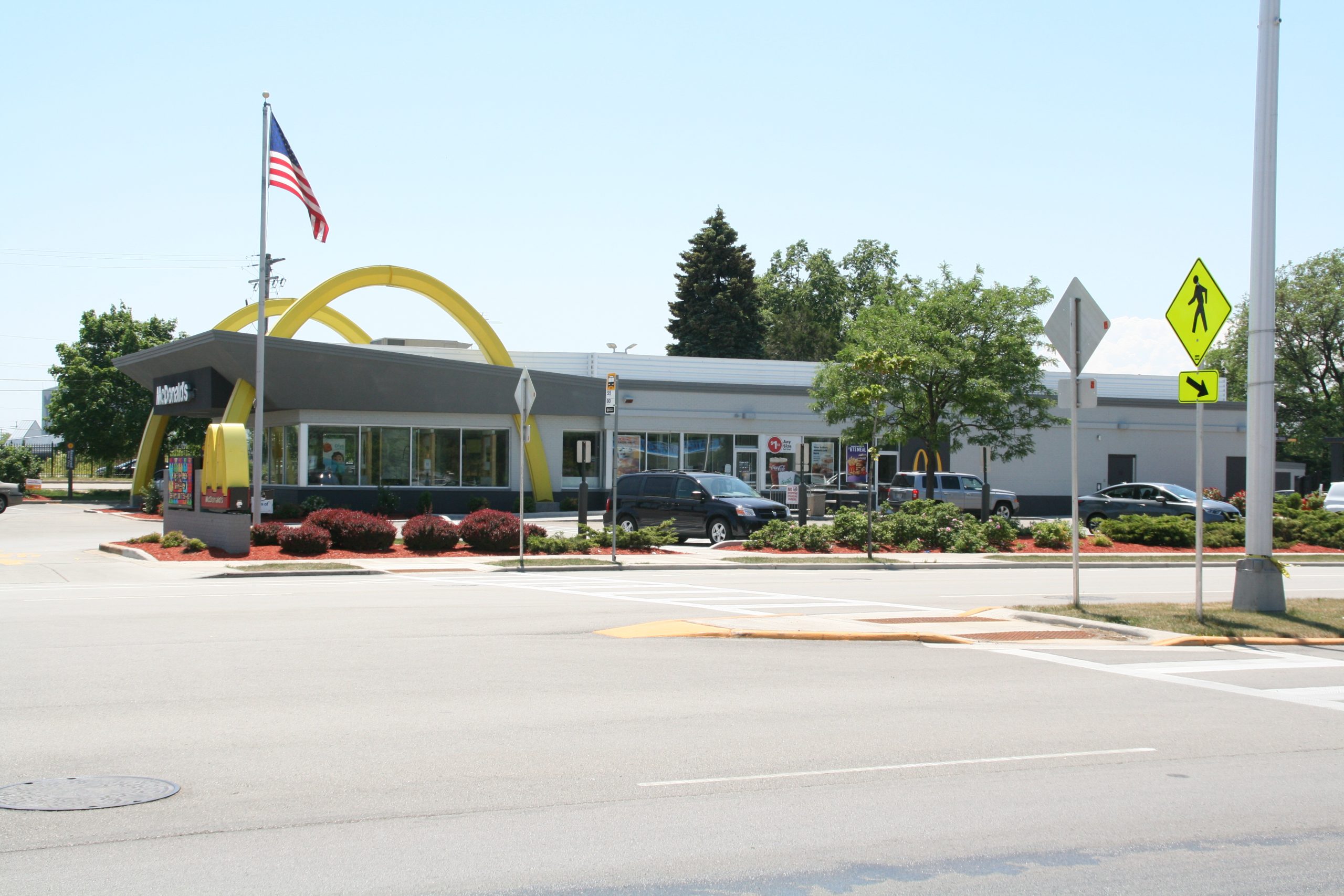
McDonald’s at 191 W. Layton Ave.. Photo by Jeramey Jannene.
Do Republicans still believe that raising the minimum wage would result in massive job loss? It appears that the answer to that question is yes, if by “Republicans” one is referring to Republicans in the Wisconsin Legislature. If, however, one is referring to Republican voters, the answer seems to be no.
Senate Bill 1123, introduced last March by Sen. Kelda Roys and Rep. Angelina Cruz, would have gradually phased in annual $1.25 increments to Wisconsin’s minimum wage until the wage equaled $20 per hour. The bill was co-sponsored by five other state senators and 39 members of the state Assembly. Rep. Francesca Hong was among the co-sponsors. No Republican was a co-sponsor.
SB 1123 was referred to the Committee on Government Operations, Labor and Economic Development, where it died with the end of the session. The committee has a Republican majority.
Tom Tiffany has not said much about raising the minimum wage, but this quote from Fox6 makes his position clear:
I would encourage any candidate proposing a $20 minimum wage to sit down with employers across rural Wisconsin and hear firsthand how a mandate like this would force them to cut jobs, reduce hours, and raise prices, hurting both workers and consumers.
Tiffany has claimed that eliminating taxes on tips and overtime is a better solution.
Recent polling of American voters suggests that Republican voters don’t share the Republican legislators’ hostility toward raising the minimum wage. The popularity of increasing the minimum wage is shown by the results of polling done by Morning Consult in May of this year. Respondents were asked whether they strongly favor, somewhat favor, somewhat oppose or strongly oppose raising the minimum wage from $7.25 per hour to $15. Sixty percent of Republicans strongly favored (38%) or somewhat favored (22%) the idea.
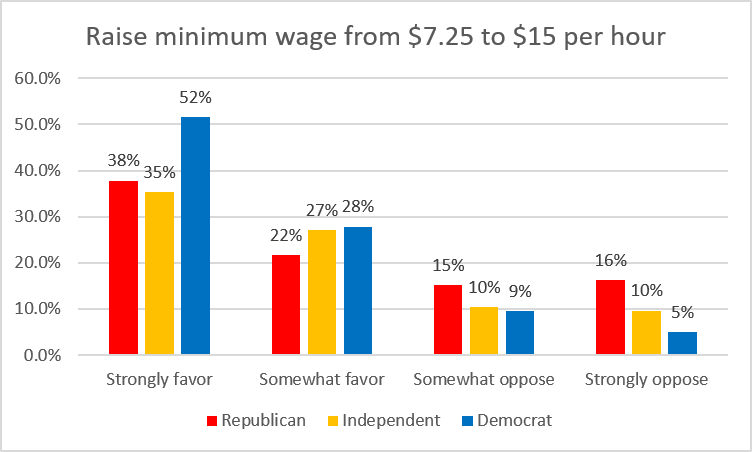
Raise minimum wage from $7.25 to $15 per hour
The next graph shows poll results when the proposed rate is increased to $20 per hour. Not surprisingly, support decreases among Republicans, independents, and Democrats, but not by much. Even most self-described Republicans support raising the wage to $20 per hour.
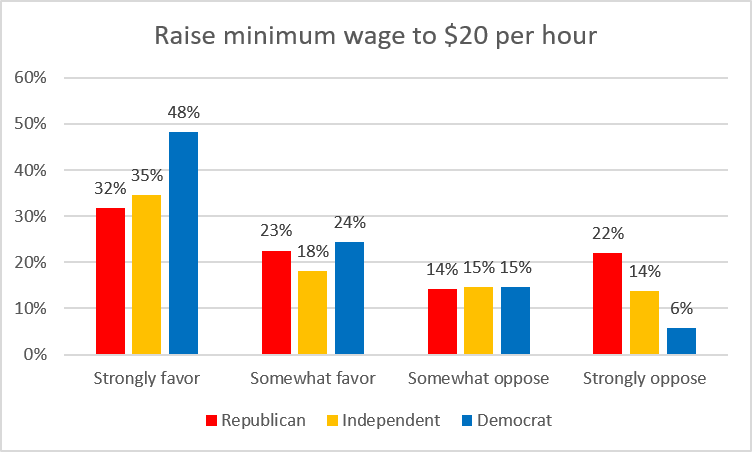
Raise minimum wage from to $20 per hour
The next graph combines those who strongly and somewhat support raising the minimum wage and those who strongly and somewhat oppose it. As the wage goes up, support goes down, but not by much. Even at a wage of $20 per hour, a majority of self-described Republicans are supportive.
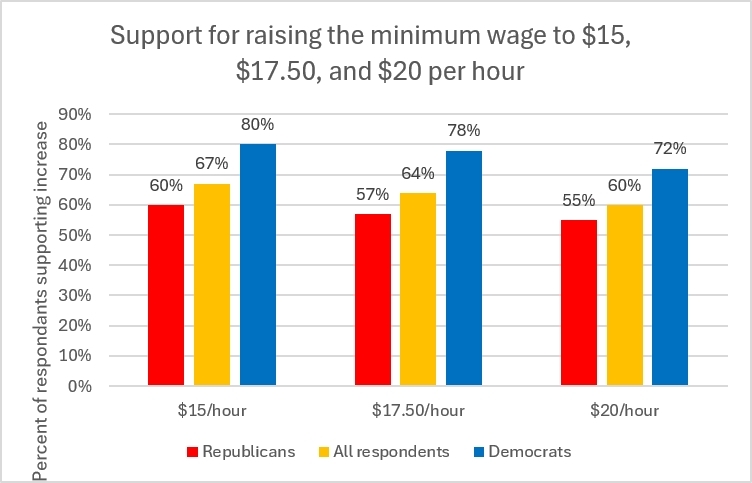
Support for raising the minimum wage to $15, $17.50, and $20 per hour
To summarize, a random sample of self-identified Republicans is far more favorable to the minimum wage than are Republican politicians.
During the past decade, voters in five states won by Trump — Alaska, Arizona, Florida, Missouri and Nebraska — voted to increase their minimum wage to $15 per hour either immediately or in coming years. If Wisconsin voters were allowed referendums, it appears that this state would have been among their number.
The next graph shows the issues identified in the most recent Marquette Law School Poll as being most important. Inflation and the cost of living was by far the most common, chosen by 42% of the people in the sample. In fact, most of the other top issues reflect concerns about affordability. The major exception to this generalization is illegal immigration and border security, chosen by 25% of Republicans compared to zero percent of Democrats.
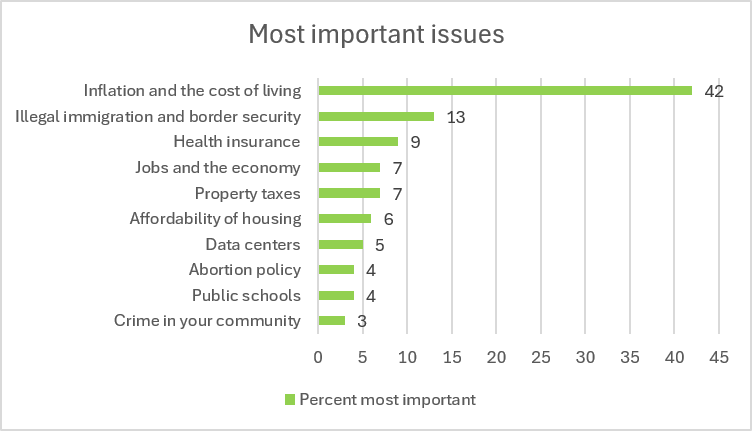
Most important issues
The issues listed in the previous graph represent only the cost side of affordability. Raising the minimum wage would address the income side of affordability.
In 2010 the federal government set the minimum wage at $7.25 per hour. It has not changed in the 16 years since. Currently, 20 states, including Wisconsin, set their minimum wage to equal the federal minimum wage.
If the wage had kept up with inflation, it would have grown to $10.70 today in order to keep the same buying power as in 2010. Put another way, today’s $7.25 hourly wage has the same buying power as $4.91 in 2010. Since the federal (and Wisconsin) minimum wage was last increased, it has suffered a loss of 32% in value.
The first serious challenge to the widespread belief that raising the minimum wage invariably resulted in unemployment came from a “natural experiment.” On April 1, 1992, New Jersey’s minimum wage increased from $4.25 to $5.05 per hour. To evaluate the impact of the law, David Card and Alan B. Krueger surveyed 410 fast-food restaurants in New Jersey and Pennsylvania before and after the wage hike and found that fast-food job growth in the New Jersey suburbs of Philadelphia was just as strong as in Pennsylvania, which had not increased its minimum wage.
Card and Krueger’s research set off an explosion of similar natural experiments. Consider this one released in May 2025:
In 2024, California implemented an innovative sectoral minimum wage policy, setting a $20 hourly wage floor for workers in large chains in fast food restaurants and snack and non-alcoholic beverage bars. The statewide minimum wage for all other workers remained at $16. The study found that the policy increased average weekly wages for covered fast food workers by 12% without reducing employment. (Sectoral Wage-Setting and Prices in California by Denis Sosinskiy and Michael Reich.)
The next table, based on data from the Organisation for Economic Co-operation and Development, shows the level of minimum wages from wealthy and middle-income nations. Most nations set the minimum wage at about half their median wage. Compared to other nations, the American minimum wage is strikingly stingy, at about 24% of the median full-time earnings in the country. This compares to about 75% for Mexico, 62% for France and the United Kingdom, 50% for Australia and 47% for Canada.
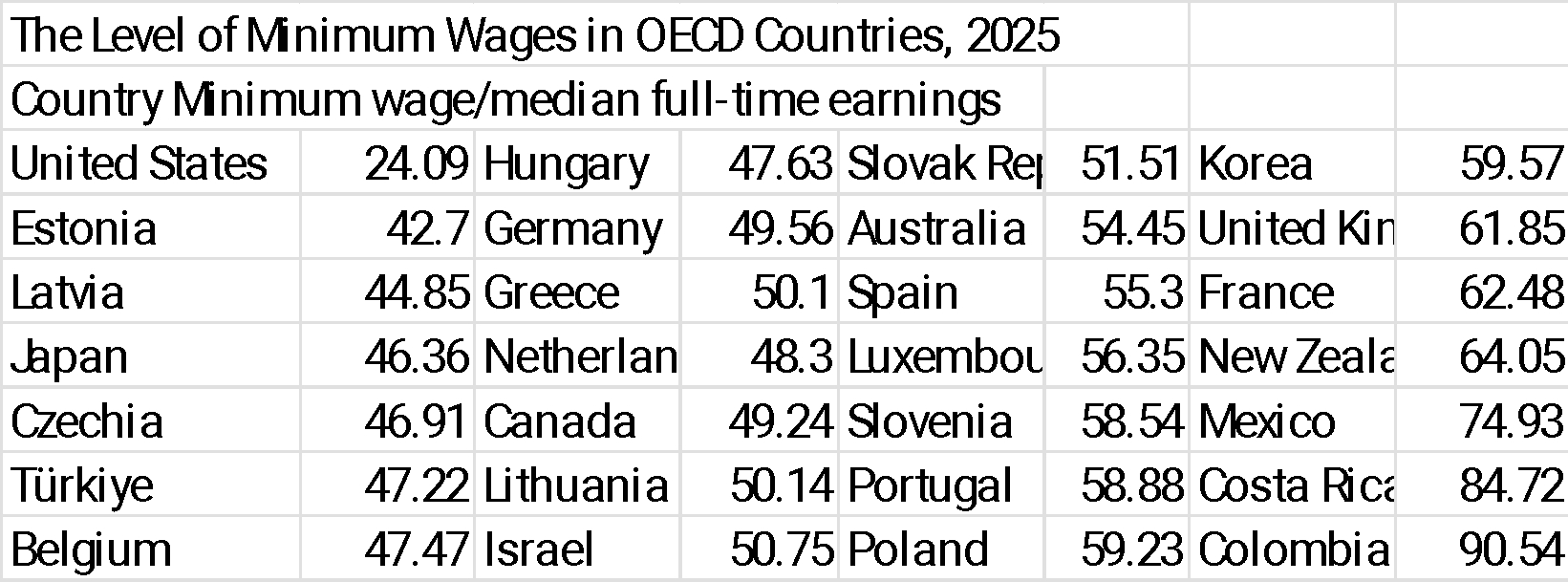
The results might help explain why the wealth gap in the U.S. is higher than in any of these countries with a higher relative minimum wage.
If you think stories like this are important, become a member of Urban Milwaukee and help support real, independent journalism. Plus you get some cool added benefits.


Data Wonk
-
How Successful Has The Trump Economy Been in Creating Jobs?
 Sep 19th, 2026 by Bruce Thompson
-
The Arguments Against Wisconsin’s Congressional Maps
 Sep 9th, 2026 by Bruce Thompson
-
How Gerrymandered Are Wisconsin’s Congressional Districts?
Sep 2nd, 2026 by Bruce Thompson