

How Did Support For Environment Get So Partisan?
Rankings show extreme split on issue. No more champions like TR and Tommy?

View of Lake Michigan from Lion’s Den Gorge Nature Preserve near Grafton. Joseph Gage/ (CC BY-SA 2.0)
Report cards from two Wisconsin environmental groups — the Wisconsin chapter of the Sierra Club and Wisconsin Conservation Voters — suggest that Republican environmentalists in the state Legislature are approaching total extinction.
Each of these reports scores members of the Wisconsin Assembly and Senate based on their votes during the 2023-24 legislative session on bills affecting the environment.
While it appears that the two scorecards were prepared independently of each other, their data are based on the same legislative session. Both include several bills in common (six for the Assembly and seven for the Senate). In addition, each scorecard includes votes not included in the other scorecard.
A striking element of each of the two reports is that they are all about votes against proposed legislation. Notably absent are bills that would be good for the environment. It appears such bills are few and far between.
Here is a partial list of proposed legislation that was included in both organizations’ scorecards. Legislators received credit for opposing each of these measures:
- Senate Bill 49 to outlaw local government bans on fossil energy sources such as natural gas. In addition, AB 141 and 142 would have prevented state agencies and local governments from phasing out gas-powered vehicles and appliances.
- SB 312, which aimed to address PFAS contamination but “did so by undermining the Department of Natural Resources’ authority and limiting the ability to hold polluters accountable.”
- AB 451, allowing developers to put fill in lakes.
- SB 139, setting an “arbitrary wolf population goal, rather than having science determine management.”
The percentage of each legislator’s votes judged pro-environment was calculated. This became the legislator’s score.
The next graph shows average scores calculated by Wisconsin Conservation Voters and the Wisconsin chapter of the Sierra Club for Democrats (in blue) and Republicans (in red). By far the most important factor influencing a legislator’s decision to support or oppose legislation affecting the environment is that legislator’s political party.
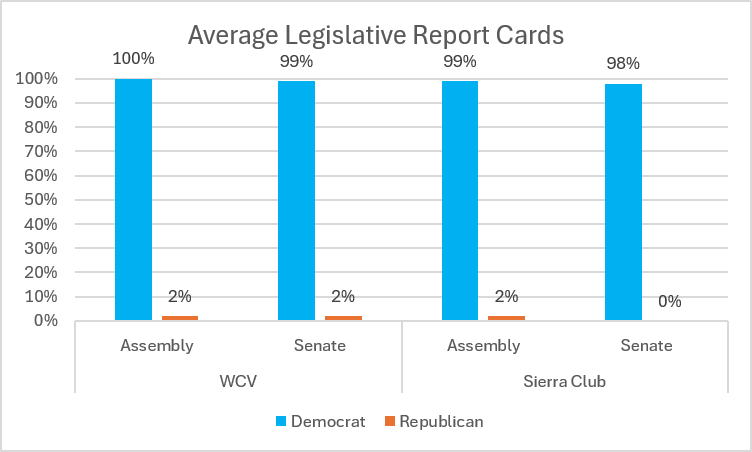
Average Legislative Report Cards.
The results suggest there are almost no Republican environmentalists left in the Legislature. While conservationists have generally been a minority among Republican politicians, there have been many notable champions.
Probably the most dramatic exception is Theodore Roosevelt. During his presidency, he established approximately 230 million acres of public lands, created 150 national forests and designated five national parks, including sites like Crater Lake and Wind Cave.
He created several conservation agencies, including the U.S. Forest Service and 51 federal bird reserves, which later evolved into the National Wildlife Refuge System. Roosevelt used the American Antiquities Act to establish 18 national monuments. He promoted the idea that natural resources should be treated as assets for future generations, emphasizing sustainable use.
More recently, between 1949 and 1975, John Saylor, a Republican congressman from Pennsylvania, served in the U.S. House of Representatives, introducing or co-sponsoring a huge amount of legislation aimed at improving or protecting the environment.
Rep. Saylor served as the lead Republican sponsor of the Wilderness Act of 1964. This landmark legislation created the National Wilderness Preservation System, protecting millions of acres of federal public land from development. Other legislative contributions include the Wild and Scenic Rivers Act of 1968, protecting free-flowing rivers from damming and development, and successfully fighting against destructive proposed dams, such as the Echo Park Dam in Dinosaur National Monument and proposed dams in the Grand Canyon.
Through his ardent protection of national parks and diligent work to add new areas to the parks system, Saylor helped propel the American environmental movement in the three decades following World War II. Saylor denounced attempts to open the Alaska National Wildlife Refuge to oil drilling. (One issue was an exception: because Saylor represented a coal-mining district, he promoted the use of coal.)
Another surprising Republican was President Richard Nixon, who established the Environmental Protection Agency (EPA) in 1970 and signed into law several landmark pieces of environmental legislation, including the Clean Air Act, the National Environmental Policy Act and the Endangered Species Act.
In Wisconsin, Democrats and Republicans in the Legislature worked cooperatively to establish the Knowles-Nelson Stewardship Fund in 1989, with strong support from Republican Gov. Tommy Thompson. The program was named for two Wisconsin governors. Gaylord Nelson, a Democrat, served as governor of Wisconsin from Jan. 5, 1959, to Jan. 7, 1963. Warren Knowles, a Republican, was the 37th governor of Wisconsin, serving from 1965 to 1971. Both governors were known for their strong commitment to conservation.
The program offered matching grants to local governments and nonprofits to fund recreational development and conservation land purchases statewide. But today’s Republicans have let it lapse: In the last budget, the state Senate failed to take up legislation funding the Knowles-Nelson program after nearly four decades.
There seem to be two reasons behind the Legislature’s inaction. Over the years, Wisconsin legislatures have added provisions to state laws, including the stewardship program, requiring that before the executive implemented any laws, the implementation had to be approved by one of the Legislature’s committees.
These included a grant to the Ozaukee Washington Land Trust to purchase and preserve the Cedar Gorge Clay Bluffs site along Lake Michigan, a bit south of Port Washington and north of the very popular Lion’s Den preserve. Although no explanation was offered, it was rumored that an anonymous member of the committee placed a hold on the grant at the request of a developer — also anonymous — who hoped to build luxury housing on the site. According to media coverage, all four committee Democrats said they weren’t the ones placing the hold and Republicans did not respond.
This action and that of other holds was appealed to the Wisconsin Supreme Court, which ruled that the committee’s action violated the principle of separation of powers.
After the media coverage, the Land Trust did purchase the Cedar Gorge Clay Bluffs property for $5 million after receiving $2.3 million in American Rescue Plan Act funding awarded by Gov. Tony Evers. But this brings up the second reason for the Legislature’s unhappiness with the stewardship program.
To amend the state constitution requires that the proposed amendment be approved by two sessions of the Legislature and a majority of the voters in a referendum. Assembly Joint Resolution 6 would have amended the Wisconsin Constitution to require approval by the Legislature for the governor to allocate federal funds on behalf of the state. Current state law allows the governor to allocate federal funds without seeking the approval of the Legislature. In the event of an emergency, this addition to the constitution could delay a response.
But the voters rejected the proposed constitutional amendment in the August 2024 primary election by a vote of 42.47% in favor to 57.53% rejecting it.
The 15% margin suggests the amendment was opposed by many Republicans. There are certainly many Republicans and independents who support a healthy environment. The question is whether there are any Republican politicians who do so.
If you think stories like this are important, become a member of Urban Milwaukee and help support real, independent journalism. Plus you get some cool added benefits.


Data Wonk
-
Will Wisconsin’s Gerrymandered Congressional Map Be Overturned?
 Jul 1st, 2026 by Bruce Thompson
-
How Partisan Are Wisconsin’s Members of Congress?
 Jun 24th, 2026 by Bruce Thompson
-
Why Are So Many Republican Legislators Quitting?
 Jun 17th, 2026 by Bruce Thompson


















It got political when dirty energy companies started stuffing money into Republican campaign coffers.