

Bus System Plans 25% Service Cut
Key question will drive changes for MCTS: should it maximize ridership or geographic coverage?
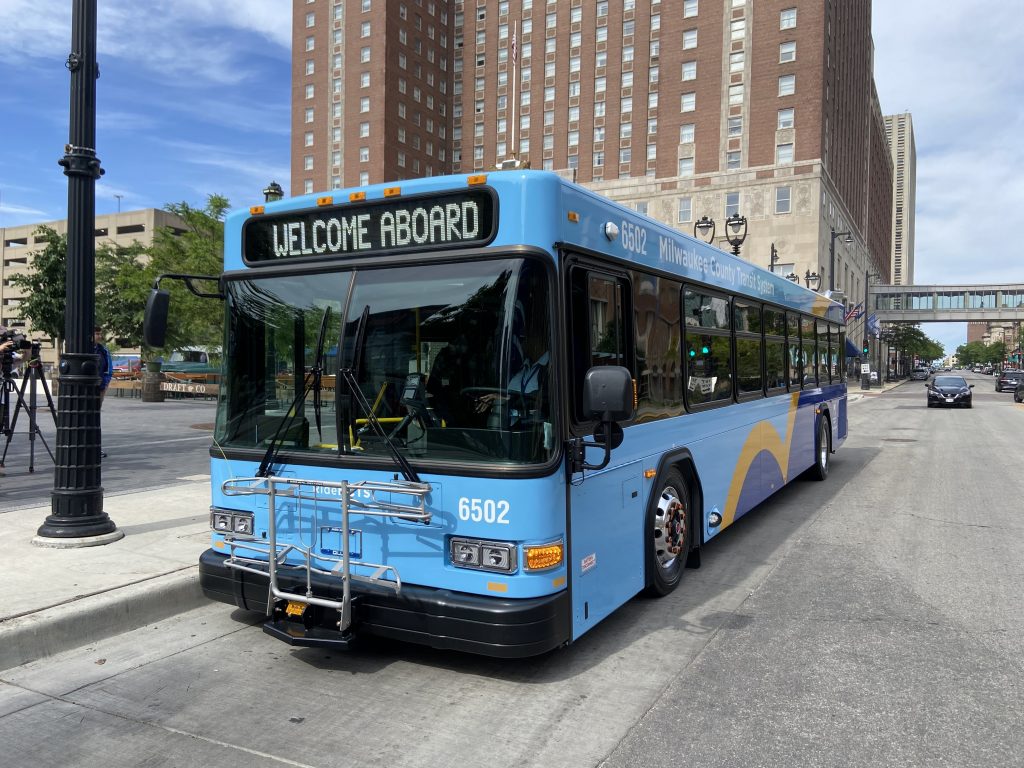
MCTS bus on W. Wisconsin Avenue. Photo taken Thursday, June 4, 2026 by Graham Kilmer.
After years of budget cuts and uncertainty, the Milwaukee County Transit System (MCTS) is planning to reduce service by 25% next year to stabilize the system as it undertakes a sweeping redesign of the bus network.
The goal is to scale back service to a level that MCTS can sustain for three years without extra funding, MCTS President and CEO Steve Fuentes told media during a briefing Tuesday. During those three years, the system will finish and implement a generational redesign of the bus network and carry out a campaign “trying aggressively to find dedicated funding,” he said.
MCTS is working with the transit consultancy Jarrett Walker + Associates (JWA) to redesign and implement a new bus network around three overarching goals: stability, sustainability and scalability. The redesign process began a few months ago. MCTS plans to work on the project into 2027, with a final design recommendation completed before the 2028 budget cycle.
The existing bus network will likely undergo drastic changes over the coming years, whether it is redesigned or not. MCTS is at the edge of a budget cliff and does not have funding to preserve existing service levels. In March, the Office of the Comptroller forecast an MCTS budget deficit of $15.7 million in 2027, growing to $37 million by 2031. The system implemented major service cuts in 2026 to close a $9.3 million budget gap.
“If we reduce the service by 25% over the next three years, we can afford to put out the same level of service for a three-year period without any one-time appropriations, which means we’re not threatening or we’re not saying that we need to cut routes,” Fuentes said.
Bringing service in line with the state, federal and local funding MCTS can actually rely on will provide riders stability, knowing their bus route will still be there next year. Redesigning the system to meet the preferences and needs of the people of Milwaukee County will also provide MCTS with an opportunity to build a scalable bus network, where service can be added and frequency increased if the county secures additional funding for transit.
The redesign process will begin with extensive public engagement aimed at answering one important question for transit: Do county residents want a high-frequency bus network that covers less area but serves more riders, or do they want a thin, spread-out bus network that serves a greater geographic area but also serves fewer riders?
Because MCTS has a fixed budget, it needs to pick one goal or another and focus its resources on achieving that goal as efficiently as possible. Under existing budget conditions, the system cannot have both high-ridership, high-frequency service and extensive geographic coverage, Ricky Angueira, a principal associate from JWA helping MCTS with the redesign, said.
“You can’t do both with the same dollar,” he said.
The Ridership-Coverage Tradeoff
If MCTS wants to serve as many riders as possible and provide fast, frequent bus service, it needs to locate bus service in dense population areas where local land use supports pedestrians and transit use. It will need to concentrate buses and personnel along these routes to provide the frequent, fast service that makes the routes useful all day long in these denser population areas.
High-frequency service is useful service. It allows riders to reliably use the bus for more than just commuting, Angueira explained. It cuts travel times, which include waiting at bus stops, putting more areas within reach. By locating it in areas where most people live, a high-frequency system will be able to provide the most usefulness, access and ridership to the most people. JWA has successfully redesigned systems in the past to increase both frequency and ridership, as Urban Milwaukee previously reported.
But there’s a trade-off, because a high-frequency, high-ridership system would cover less geographic area, meaning some riders in outlying, less dense areas may lose access to a nearby bus route, Angueira said. If a system is designed for geographic coverage, those riders in outlying areas would maintain access to a nearby bus route. The system would have less frequent bus service as resources and personnel are spread thinly across the network. Ridership would also likely decline.
“I would say that you already went through that experiment a little bit with these very recent service cuts,” Angueira said. When MCTS implemented budget cuts in 2026 they were focused on frequency. Across the system, bus frequency was reduced by 14%, but these changes led to an even greater loss of ridership, which declined 20%, according to MCTS data. “So you lost more ridership than the service that you reduced,” he said.
But ridership is just one goal; geographic coverage is another. However, without a massive infusion of new funding, MCTS can’t do both. The question also goes to the heart of what Milwaukee County residents want their communities to look like in the future because of the mutually reinforcing effects transit and land use have on each other. High-frequency, high-ridership transit will support, and thrive in, dense, walkable neighborhoods. Low-frequency, geographic coverage will support suburban, low-density development, Angueira said.
“So I’m not the consultant that’s going to come and just tell you what it is that you should do,” Angueira said. “I’m the consultant that is going to work with MCTS, with the public, with the board to together design the best network that we can.”
The first step in the redesign process will be answering the ridership versus coverage question. Then the system will be designed to most efficiently achieve the desired outcome.
“We want to make sure that that money is going where it needs to go in order to connect the most people to the most opportunities in life. We want to make every dollar stretch. We want to stretch it as far as possible,” Fuentes said. “Should we go with the frequency concept or should we go with the coverage concept? This is what we’re going to work through over the coming months.”
If you think stories like this are important, become a member of Urban Milwaukee and help support real, independent journalism. Plus you get some cool added benefits.


MKE County
-
Mayor, Congresswoman Moore Stump for Crowley As Early Voting Begins
 Oct 21st, 2026 by Graham Kilmer
-
Republicans Attack Crowley Over Wife’s Nonprofit Work
 Oct 19th, 2026 by Graham Kilmer
-
Zoo’s New Parking System Is a Success
 Oct 17th, 2026 by Graham Kilmer
Transportation
-
Wisconsin Wins $218 Million Grant To Extend Hiawatha To Madison
 Oct 16th, 2026 by Jeramey Jannene
-
MCTS Reports Rising Fare Collection
 Oct 15th, 2026 by Graham Kilmer
-
$80 Million Air Cargo Center Takes Off At Mitchell Airport
 Oct 15th, 2026 by Graham Kilmer

















Such a bummer to see the death spiral continue. An obvious follow up would be, how do similarly sized metros fund their transit systems? I would be surprised if Milwaukee is the only one with this issue.
locate bus service in dense population areas where local land use supports pedestrians and transit use. It will need to concentrate buses and personnel along these routes to provide the frequent, fast service that makes the routes useful all day long in these denser population areas.
This has to be the answer or the death spiral will accelerate after the three year truce.
The system must prioritize creating and maintaining something attractive and bring people to it, not try to be everything to everyone everywhere. Maybe it would lead to more infill housing and density over time too
@JoeFin
45 of the 50 largest metro areas in the United States have dedicated transit funding (most commonly a sales tax). MCTS presented this data in their Transit Priority presentation at https://youtu.be/-3UxA9QekEc?si=bqBJbOiMX6y5-D8e
All 14 of the peer Midwest metro areas and 13 of 14 peer National metro areas included in SEWRPC’s peer metro comparison report have dedicated funding as well (pages 39 and 40 of https://www.sewrpc.org/SEWRPCFiles/Publications/mr/mr-221-3rd-ed-comparison-milwaukee-area-to-peers.pdf). Since the release of this report, Nashville secured dedicated transit funding.
While Milwaukee isn’t unique in its funding issues, it is finding itself in increasingly rare company.
Make the fare evaders on the Purple Line pay. Have limited trips on that line, and the 27, if any. We are all paying the price for the fare evaders and prior entitled culture management at MCTS.
It was predictable that making cuts that make the service less attractive to use would result in less users and lower revenue. Until people that can afford to drive their car every day from bay view or tosa or Shorewood to downtown make the choice to ride the bus because it’s more convient and pleasant, the spiral will continue.
The USA has the least efficient bus systems in the world and Milwaukee’s is among the least efficient of the least efficient. Stops per mile needs to be dramatically reduced, which will cut ride times so it’s not 3x faster to drive or 2x faster to ride your bike. This would also require less busses and staff, reducing costs in addition to increasing efficiency (a rarity for a government program). Yes, some riders will have to walk an additional small distance.
Stop making expensive consulting firms rich from taxpayer money. These days optimization of a bus system could largely be done by a small team of data scientists with guidance from an urban planner, probably as part of their graduate theses for a modest research grant fee.
@jmpehoski you’d be surprised how little fare evasion affects the bottom line.
Yeah, fewer stops per mile would do a lot. We need an RTA with dedicated tax base
First and foremost, we need a MCTS management with a mindset that with few exceptions, no one is allowed on the bus without paying their fare. I am dependent on public transit, have never evaded a fare, even in extremely lean times, and until I realized the MCTS management had a policy that encouraged fare evasion, I carried an extra M card to pay the fare of those who couldn’t. I still see fare evasion every time I take the bus. Disgusting. I am paying the price for these fare evaders. Not one looked threatening. The other day when I was on the Waukesha Metro, the driver flatly told a guy, “sorry, no fare, no ride” and shut the door on him. Why is it so hard for the MCTS operators to do that? I think the operators who allow fare evasion of nonthreatening fare evaders should be penalized. Has the entitled culture permeated our society that much? Street Level Jimmy clams fare evasion does little to affect the bottom line. If that is true, why not make ridership free? The point is folks should be responsible citizens and pay for services rendered if there’s a fee attached..