Kinship Starts Construction On $21.5 Million New Home
Dramatically expanding the amount of food it distributes and range of services offered.
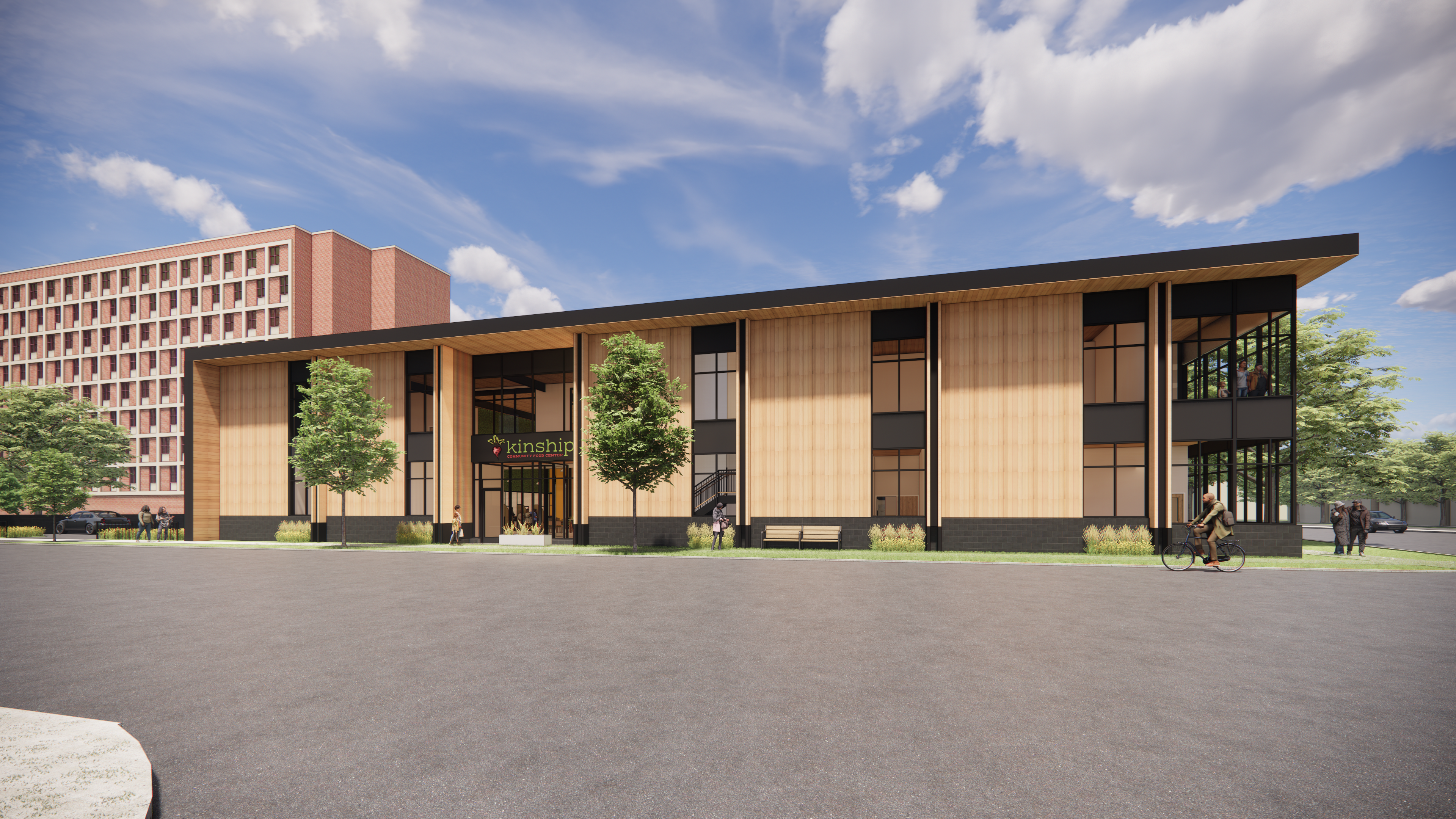
Kinship Community Food Center rendering. Rendering by HGA.
Kinship Community Food Center is starting construction on a new $21.5 million home designed to dramatically expand both the amount of food it distributes and the range of support it can offer Milwaukee residents.
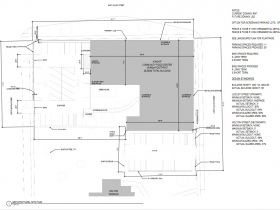
The nonprofit held a groundbreaking Wednesday for a two-story, 28,000-square-foot building at the southwest corner of N. Holton and W. Locust streets.
But President and CEO Vincent Noth said the project is about far more than replacing the cramped church space from which the organization has operated for decades.
“Ultimately, it really isn’t about a building,” said Noth in an interview.
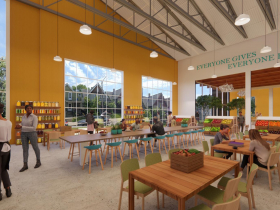
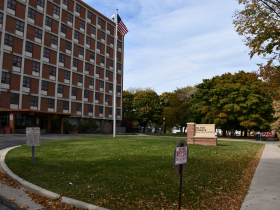
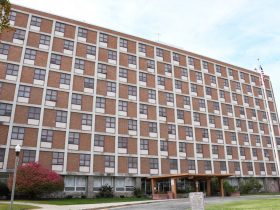
The new Kinship Community Food Center will include a free public market, commercial kitchen, food storage areas, administrative offices, community gathering rooms and space for partner organizations. The one-acre site, 421 E. Locust St., was formerly vacant land at the northern edge of the Housing Authority of the City of Milwaukee’s Holton Terrace development.
Kinship purchased the property in February and has raised about 86% of its $18 million philanthropic goal, Noth said. The organization raised about $14 million last year alone. The project also relies on a state grant and federal new market tax credits.
Noth said the response reflects growing support for Kinship’s approach to addressing hunger through food, relationships and access to a much broader collection of services.
“This is unlike anything that we have going on in the city right now,” he said. “We’re kind of a flagship of a new way of thinking about hunger in a community and thinking about food — the power of food, or food as a public good — to create change.”
The organization expects to open the building next year.
The project will allow Kinship to consolidate its administrative offices, currently in leased space at 2610 N. Martin Luther King Jr. Dr., and its food distribution operation at St. Casimir Church, 924 E. Clarke St.
Kinship’s operations have long been limited by the church facility, including a lack of storage and accessibility challenges. Noth said the organization is sometimes forced to reject food donations because it has nowhere to put them.
The new center will increase Kinship’s cold-storage capacity eightfold, expand its dry storage and allow the public market to operate about twice as often.
Approximately 19,000 people passed through Kinship’s doors last year. The organization projects it will serve approximately 110,000 residents during the first five years in the new building, including a 65% increase in participation in its free public market.
Kinship expects to distribute approximately 2.8 million pounds of food during that period.
But the building is being designed so that obtaining groceries is only the first step.
“The real vision, the exciting thing, is the building is designed with food as an entry point into this broader ecosystem of health and stability and employment,” said Noth.
Kinship provided crisis assistance to more than 230 families last year and worked with about 90 partner organizations. Those partnerships address housing and eviction prevention, shelter, physical health and basic household needs.
The new center will include dedicated space where partner organizations can meet directly with Kinship shoppers and neighborhood residents. Noth said future programming could include everything from high school equivalency assistance and financial literacy classes to therapy, addiction recovery support, and wellness activities.
“A single mom or maybe an unhoused young adult, they’re going to come through the door and see this amazing grocery,” said Noth. “But then they’ll also see this whole ecosystem. ‘Oh my God, I think I can get my GED here. What is that? Oh, well, that’s like a yoga class.’”
Noth declined to identify specific partner organizations because many of the agreements are still being developed.
A 1,700-square-foot commercial kitchen will allow Kinship to expand its catering and workforce development programs.
The organization opened Kinship Cafe in 2024 inside the ThriveOn King development, 2153 N. Martin Luther King Jr. Dr. The cafe will remain on King Drive, while the catering business launched from that location will move into and expand at the new center.
The added capacity is expected to triple participation in Kinship’s workforce training program, which now serves 15 to 18 people annually.
Noth described the program as a “train on the clock and heal on the clock” model. Approximately one-third of a participant’s paid time is spent addressing personal barriers to long-term employment.
A trainee might work a four-hour shift at the cafe or catering operation, then attend group therapy, an Alcoholics Anonymous meeting, a financial literacy course, or an educational program.
Kinship’s other operations will continue, including its 27,000-square-foot urban farm at 4355 N. Port Washington Rd. in Glendale.
The nonprofit was known as Riverwest Food Pantry until 2022, when it adopted a name intended to better reflect its broader mission. It was founded in 1979 as a program of the East Side Housing Action Committee and a ministry of St. Casimir and became an independent nonprofit in 2013.
Noth said staying near Kinship’s existing home was a deliberate choice.
“Community work like this grows at the speed of trust,” he said.
Kinship recorded nearly 30,000 volunteer hours last year, about one-third of which were performed by neighborhood residents who also receive its services. The organization provides groceries to thousands of households, crisis assistance to hundreds of residents, and deeper mentorship or workforce support to dozens of families and individuals.
“We didn’t want to uproot the soil,” said Noth. “We wanted to build from the relationships that we had been cultivating.”
The new facility will sit near the center of Kinship’s highest concentration of regular shoppers. Noth described the location as a bridge between Riverwest and Harambee, with a large share of the organization’s shoppers coming from the 53212 ZIP code.
“It’s just right on the corner between those two neighborhoods,” he said.
Kinship and project representatives previously said residents of Holton Terrace were consulted about the development and supported the plan. Noth said the organization knocked on about 600 doors and spoke directly with 275 neighborhood residents.
“What we do is cool,” he said. “But the how we do what we do is, I think, why it’s resonated.”
He acknowledged that some residents were disappointed by the loss of trees and open space at the property, but said the overwhelming response was positive.
HGA is serving as the architecture, engineering and design firm. VJS Construction Services is the general contractor.
As a federal requirement of selling housing authority land, Kinship was required to pay the assessed value of $590,000 for the one-acre site.
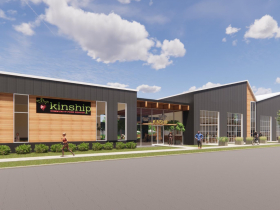
2024 Renderings and Site Plan
Pre-Construction Photos
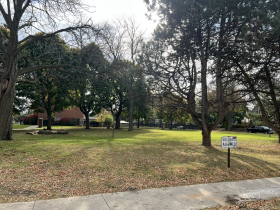
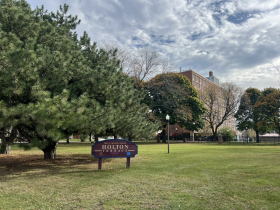
June Site Photo
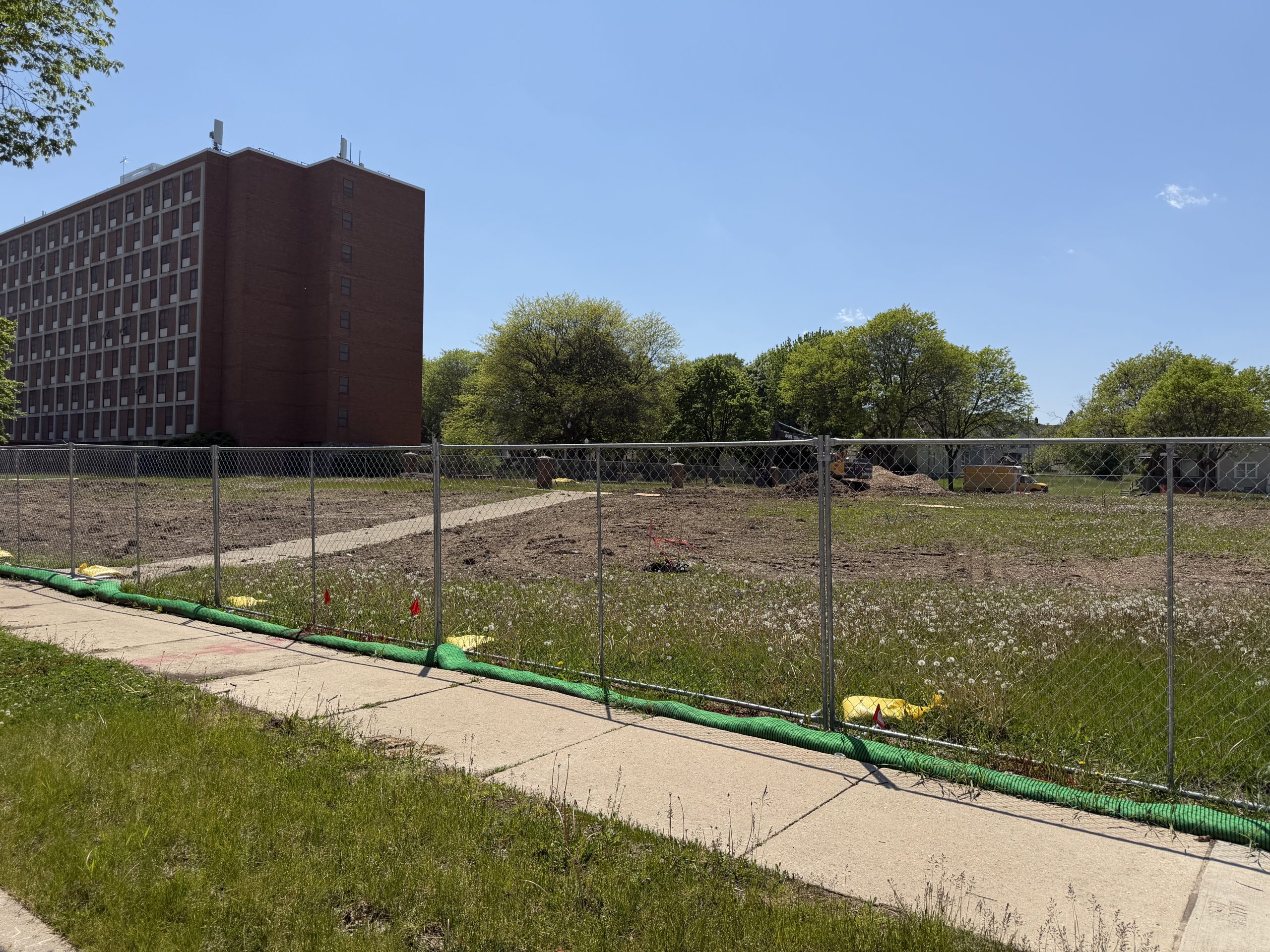
421 E. Locust St. in May 2026. Photo by Jeramey Jannene.
Noth is the son of the late Urban Milwaukee theater critic Dom Noth.
UPDATE: Noth’s job title has been updated
Existing members must be signed in to see the interactive map. Sign in.
If you think stories like this are important, become a member of Urban Milwaukee and help support real, independent journalism. Plus you get some cool added benefits.