
Milwaukee’s Sewer System Is a Success Story
The massive system beats national benchmarks and is far stronger than 20 years ago.
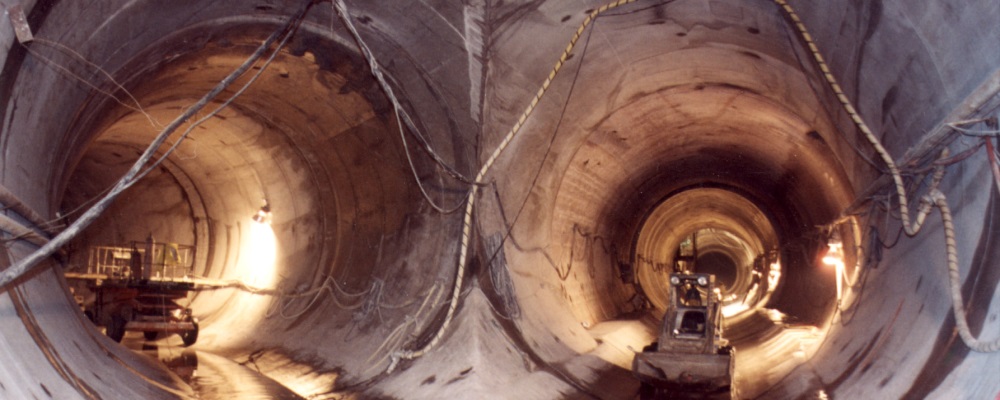
Inside the Deep Tunnel. Photo courtesy of MMSD.
Public infrastructure is easy to take for granted when it works. Most of us never think about what happens after we flush a toilet, drain a sink, or watch stormwater disappear down a grate. Yet beneath our feet in Milwaukee lies one of the most complex and important public works systems in Wisconsin and the country, a system that protects public health, safeguards Lake Michigan, and serves more than one million people across Milwaukee County and the surrounding region.
As former City of Milwaukee Department of Public Works Commissioners, we believe it is important to provide perspective amid recent criticism of how the regional wastewater system is managed.
The first thing to understand is the sheer scale of the challenge. MMSD serves 28 communities across a service area of more than 400 square miles. The regional system includes hundreds of miles of large interceptor sewers connected to thousands of miles of municipal sewer lines stretching beneath virtually every street in Milwaukee County and beyond. This is an engineering network of extraordinary size and complexity, operating 24 hours a day, 365 days a year.
No system of this scale is perfect. There will always be opportunities for improvement, modernization, and investment. Responsible public servants should welcome those conversations. But it is equally important to recognize how far Milwaukee has come.
Twenty-five years ago, sewer overflows into local waterways were far more common. Since the completion of the Deep Tunnel system and decades of strategic investments, the region has captured and cleaned more than 98 percent of the stormwater and wastewater entering the system, well above the national benchmark for communities with combined sewer systems. The Deep Tunnel alone has prevented billions of gallons of pollution from reaching Lake Michigan.
The progress extends beyond pipes and treatment plants. For decades, MMSD has worked collaboratively with municipal governments, the Wisconsin Department of Natural Resources, community organizations, and private-sector partners to implement innovative green infrastructure projects. Rain gardens, bioswales, green medians, floodplain restoration, and strategic redevelopment projects have all helped reduce the amount of stormwater entering the sewer system in the first place. Major initiatives associated with projects such as the Marquette Interchange reconstruction demonstrated what can happen when multiple partners work together toward a common goal.
Critics point to recent major flooding events as evidence of failure. But we should be honest about what any sewer system can realistically accomplish. The historic storms of 2010 and several recent extreme rain events brought rainfall totals that exceeded what engineers could reasonably design for decades ago. Across the country, communities are grappling with increasingly intense weather events that challenge even the most advanced infrastructure systems.
That does not mean we stop striving to improve. It means we continue investing, planning, and adapting.
What gives us confidence is not a claim that the system is flawless. It is that the people responsible for managing it have consistently demonstrated a commitment to continuous improvement, transparency, and collaboration. The relationship between MMSD, local municipalities, regulators, and community stakeholders has been one of the region’s strengths for many years.
Milwaukee’s wastewater system is one of the largest public infrastructure networks in the country. Maintaining it is difficult work. Improving it is even harder. But after decades of service and firsthand experience with the district’s operations, we can say this with confidence: thanks to Kevin Shafer, the MMSD team, and the system operator, the system is stronger today than it was 20 years ago, and the dedicated professionals responsible for protecting it deserve recognition for the work they do every day.
Jim Kaminski served as Milwaukee’s Commissioner of Public Works from 1996 – 2004. Jeff Mantes succeeded him and served from 2004 – 2011.
If you think stories like this are important, become a member of Urban Milwaukee and help support real, independent journalism. Plus you get some cool added benefits.


Op-Ed
-
Does Wisconsin Really Need New Gas Plants?
 Oct 16th, 2026 by John Imes
-
The Real Cost of Weakening Head Start Standards
 Sep 29th, 2026 by Ruth Schmidt and Jennie Mauer
-
No Need To Pretend; Trump Is On The Ballot
 Sep 20th, 2026 by Bill Christofferson




















Much needed commentary from experts who know the complexities of our sewer/deep tunnel system and many accomplishments of MMSD. Engineers. Public Works Directors. Guys who oversaw the building and management of a sewer system. But also are honest about its capacity limitations. Compare that to these so-called “whistleblowers” and non profit opportunists who make claims without understanding the operation nor any evidence of mismanagement. While hiding the deep pockets that are funding their wild goose chase scheme. For what purpose? With what proof?
Kevin Shafer has been a tremendous advocate for the region. An innovator and public servant who has led one of the most successful public/private partnerships in the nation for decades. As Commissioners Kaminski and Mantes attest, a true leader in the industry. Thanks to all three of you for your dedicated public service and for making our region healthier, cleaner, greener than you found it.
Refering to the previous comment, I am trying to understand how performing an audit is a “wild goose chase”. And this is the first time I have heard accusations that the nonprofit who pushed for the audit is “hiding the deep pockets” that fund it. Can you clarify that? My understanding is that Common Ground has worked amicably with MMSD to minimize sewer overflows for nearly ten years.
As a writer for The Milwaukee Journal, I followed both the Deep Tunnel here and the Big Dig in Boston, and I saw how much better our officials and and engineers (and the many workers) carried through in a remarkably short time. My brother Tom is an expert in city water and sewer systems, and he taught me the rigors in dealing with nature and humanity, overseers and rate-payers. Engineering, maintenance and vigilant oversight can’t overcome extreme events, but they can ensure quick recovery and long-lasting reliability. PR and marketing can twist reality for general readers, and city government can twist it through the sometimes-nasty skirmishes of politics, but Milwaukee has proved itself among the best providers of basic services in the country. Thanks for these insights from men who know.
There is no doubt that Milwaukee’s public works are very good. The deep tunnel was not what it was billed to be and that is the flaw. It would have been far better to have separated the system than to have built the tunnels. Yes the area served by two treatment plants is vast and that may be good verses having a treatment system for the north shore suburbs and northwest Milwaukee that would have discharged to the Milwaukee River and not having to move all that water all those miles to Jones Island.
The point being we still are on occasion and maybe more times now putting sewage (including all that is legally put into any sanitary sewer) going into Lake Michigan where we get our drinking water. Yes after the 100 crypto deaths they moved the intake another mile out into the lake but…
@Spellman. i think I’ve seen you make this argument before. It’s uninformed. In the early 2000’s the estimate to separate the combined sewer area was in the 10’s of billons of dollars. That’s BILLIONS, with a B. Now it would cost several times that and cause a decade of major disruption in the heart of the city. And that is not a cost borne by the entire district. That would have to come from the older parts of Milwaukee (read poorest) and parts of Shorewood. A massive cost to eliminate 2 overflows per year.
Secondly, from a water quality standpoint, it’s important to know that separated storm sewers basically “overflow” every single rainfall. Storm sewers direct all the dirt, oil, sediment, trash, pet waste, and all other sh@#t on our streets directly into our waterways every time it rains. They “pollute” the rivers 100 times a year. Without any treatment at all. Thankfully, due to the adoption of green infrastructure strategies (led by Kevin Shafer) MMSD and local communities have begun treating this stormwater where it falls and the pollutants don’t ever flow into rivers and streams.
The long debated question is whether it is better for our water quality to treat every drop of water (storm and sanitary) every time it rains except twice/year or treat every drop of sanitary (a very small volume which is “toilet” water) all the time while allowing billions of gallons of dirty stormwater into our lake and rivers 100 times/year. Some experts have actually argued that to prioritize water quality, the answer is not separating the small area of the system that has combined sewers, but rather combine all systems that are separate!
All this to say, informed opinions matter. Talk radio hysteria and accusations by disgruntled employees don’t make our communities more healthy and safe. Informed discussions about facts and science do.
Ah I was a citizen member of the committee that reviewed the EIS. The cost were breakeven (sorry not Billion extra) but a question was who would pay as that was part of the politics. Also would the North West side of Milwaukee and the North side Suburbs have to build their own treatment plant vs have the capacity of the Tunnel to make sure there would be no sewage backup as was the problem at the time. The tunnels cost a lot of money and we still have overflows and may have even more. Yes there was talk of treating the street run off as well. What pollution do we accept and what do we treat and at what cost. It was a trade off but for some reason sewage being discharge to the river and lake seem to be highlighted every time it happens and there is no mention of the other 100 overflows that were mentioned.
And to think that when I first disconnected my downspouts from the basement drain tile & waste sewer system(back in the early 1980’s) the City of Milwaukee was going to give me a citation for it going in the middle of my back yard …on an open 1/4 acre property.