

MMSD’s Record Shows A Clear Path For Milwaukee’s Water Future
Former alderman Michael Murphy argues facts, not rhetoric, should guide the next MMSD contract and reforms.
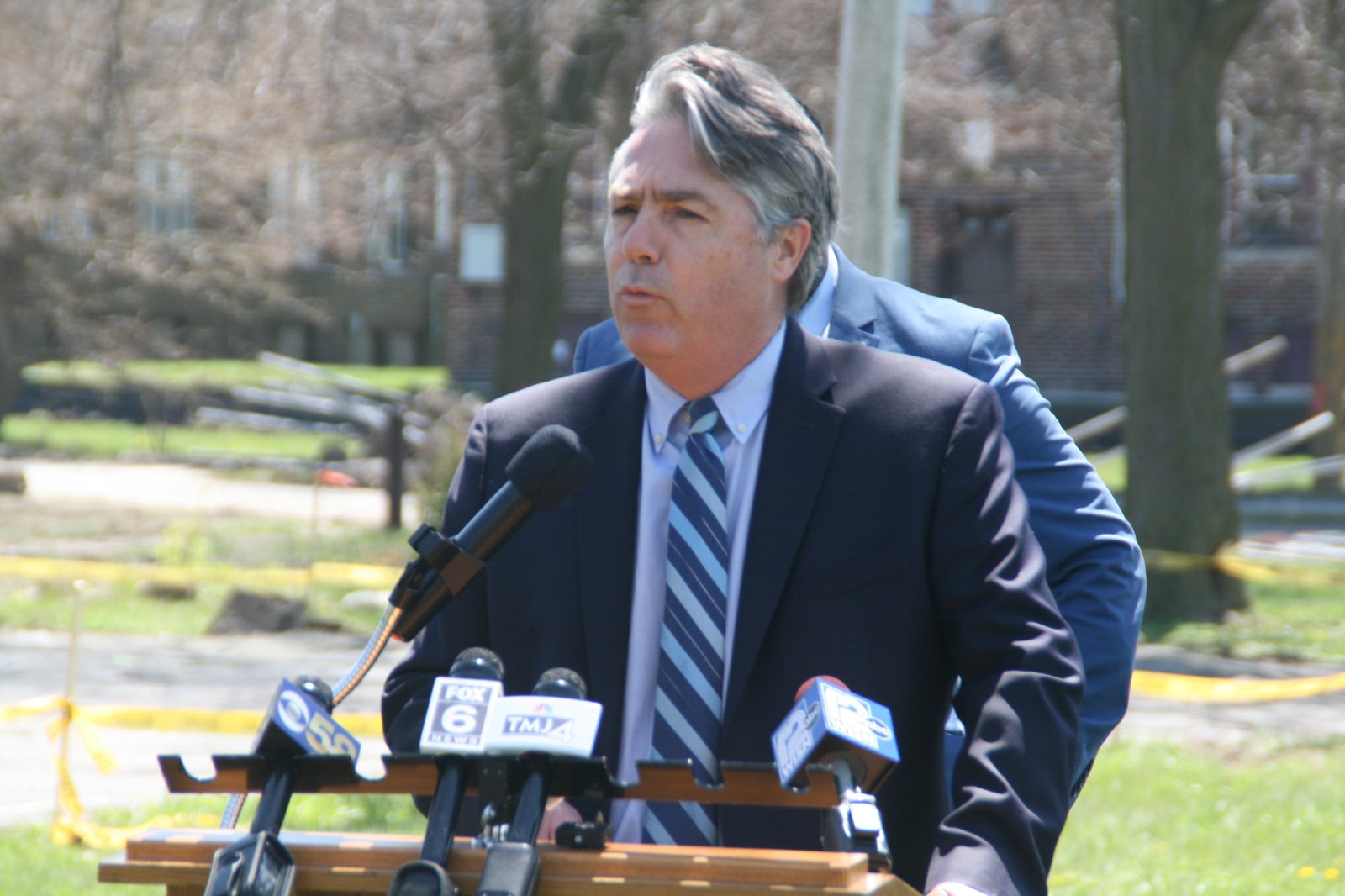
Michael Murphy speaks at the May 2023 Melvina Park groundbreaking. Photo by Jeramey Jannene.
I’ve spent my entire adult life in public service for the people of greater Milwaukee as an alderman, a Milwaukee Metropolitan Sewerage District (MMSD) commissioner and many other roles.
I’m proud to have played a part in many public debates that have shaped the city, from housing and the environment to education, finance, the opioid epidemic, reckless driving and taking care of the least powerful among us. With the perspective of time, I can see that the battles of the moment can sometimes make us lose sight of our common progress.
Now, as MMSD approaches an inflection point in its management of our regional water system, it’s time to acknowledge the obvious truth: MMSD’s public record over the past two decades demonstrates how it has transformed Milwaukee for the better and prepared the region and Lake Michigan for a new era of growth.
Amid controversy, it’s easy to lose sight of the fact, but when it comes to protecting our waterways, managing stormwater and safeguarding homes and businesses from flooding, the record matters.
There was a time when southeast Wisconsin was driven by the “sewer wars”-skirmishes between Milwaukee and its suburbs about how to manage and pay for wastewater and stormwater services. Instability in the basic infrastructure made it harder for our region to transition from its historic manufacturing base to a modern service-and tech-based growth economy. The default solution to engineering challenges was to build our way out of them, even when no amount of concrete or money was sufficient.
That changed under the leadership of Executive Director Kevin Shafer. He joined MMSD just as its transformative Deep Tunnel project began protecting Lake Michigan, and as its explicitly regional approach to our lake and our community took hold. That approach allowed MMSD in the Shafer era to move beyond a narrow, “build-your-way-out” engineering mindset to a smarter, more balanced approach.
Instead of relying solely on expensive concrete infrastructure, the district has embraced green solutions, like working with nature to manage water where it falls. Programs like Greenseams have preserved thousands of acres of floodplains, creating natural storage that protects communities while improving water quality.
Local projects tell this story even more clearly.
Investments in flood management along all of the district’s waterways, the Menomonee, Milwaukee, Kinnickinnic and Root rivers, along with Lincoln and Oak Creeks, have protected thousands of homes from flood damage and catastrophic loss. For example, in the 10th Aldermanic district I represented for more than 35 years, a 500-year rain event in 1997 caused severe flooding in the “Piggsville-Valley” neighborhood and damaging millions of dollars of property. Under Shafer’s leadership, a thoughtful flood management system was built within a few short years, protecting my constituents from similar future floods and saving them thousands of dollars in flood insurance costs.
It’s also important to acknowledge that some of the most severe flood damage our region has experienced was driven by truly historic rainfall events even larger than the 1997 event. These events are becoming less predictable and more intense because of climate change, placing increasing pressure on infrastructure designed for a different climate. In the face of these realities, Shafer and the commissioners at MMSD were early adopters of the “capturing rain where it falls” strategy. Not only has the plan been more cost-effective, but it has also worked to beautify our communities through the naturalization of our waterways and greening of urban landscapes.
These are real, tangible improvements for the homeowners and businesses across the region that didn’t happen overnight. It required consistent leadership, long-term planning, and a willingness to innovate, as well as strong partnerships across municipal borders.
MMSD’s deliberate effort to rebuild trust and focus on shared outcomes led directly to cleaner water, reduced flooding, and a more resilient region.
MMSD made another move under Shafer’s guidance two decades ago when it decided to partner with the experienced private company to operate the bulk of its system, including 300 miles of sewer mains and the Jones Island and South Shore wastewater treatment plants.
Putting public infrastructure into private hands was a bold move, but the record is indisputable that this decision has paid off for Milwaukee. Studies have shown it has saved MMSD ratepayers millions of dollars, tapped into world-class operational expertise and freed MMSD staff to focus on long-term efforts to protect and strengthen our region.
I’ve seen the recent complaints about how MMSD and its operator, Veolia, have managed the facility. I don’t know enough to evaluate those claims, which is why I’m pleased both MMSD and Veolia have launched independent investigations into them.
In my experience, MMSD has been a scrupulous and diligent manager. MMSD has put the next 10-year operating contract out to bid, which will help ensure the best outcome for Milwaukee. I remain confident MMSD is best positioned to continue managing these challenges and strengthening the system for the future, and the procurement process for a new operator is the opportunity Milwaukee needs to evaluate how our regional progress can continue.
There’s always room for improvement.
Common Ground has raised serious issues that must be addressed, and as one of the first recipients of the “Common Ground Hero” award, I know they will keep a close eye on the results of these reports. But critiques should be grounded in facts and an honest understanding of what has been achieved – and I haven’t seen enough of that in the last few months.
Milwaukee’s water system is stronger, more resilient and more forward-looking than it was a generation ago as result of thoughtful planning, proven partnerships and a commitment to innovation. MMSD and Kevin Shafer have been key to this undeniable progress.
If we want to continue moving forward as a region in every dimension, it’s time to tone down the rhetoric, focus on facts, cooperate and build on mutual progress.
The stakes are too high for anything else.
Michael Murphy was a member of the Milwaukee Common Council, representing District 10, from 1989 to 2024.
If you think stories like this are important, become a member of Urban Milwaukee and help support real, independent journalism. Plus you get some cool added benefits.
More about the MMSD and Veolia Wastewater Facility
- MMSD Denies Unfair Contracting Practices - Graham Kilmer - Oct 7th, 2026
- Despite Lawsuit, MMSD Picks New Private Operator - Graham Kilmer - Sep 28th, 2026
- Federal Judge Orders Pause In Issuing New Sewage Contract - Graham Kilmer - Sep 15th, 2026
- Veolia Sues MMSD, Alleges Biased Contracting Process - Graham Kilmer - Sep 11th, 2026
- Committee Recommends New Operator for Sewerage District - Graham Kilmer - Aug 18th, 2026
- DNR Investigating Allegations Against Sewerage District - Graham Kilmer - Jul 28th, 2026
- Op Ed: MMSD’s Record Shows A Clear Path For Milwaukee’s Water Future - Michael Murphy - Jul 16th, 2026
- Clogged Sewer Pipe May Have Worsened Bay View Flooding - Graham Kilmer - Jul 16th, 2026
- CG Backs City Investigation as New Evidence Validates Whistleblowers: Milwaukee Needs Accountability and Transparency. - Common Ground Southeastern Wisconsin - Jul 15th, 2026
- More Whistleblowers Go Public With Allegations Against Veolia - Graham Kilmer - Jun 12th, 2026
Read more about MMSD and Veolia Wastewater Facility here
Political Contributions Tracker
Displaying political contributions between people mentioned in this story. Learn more.


Op-Ed
-
Does Wisconsin Really Need New Gas Plants?
 Oct 16th, 2026 by John Imes
-
The Real Cost of Weakening Head Start Standards
 Sep 29th, 2026 by Ruth Schmidt and Jennie Mauer
-
No Need To Pretend; Trump Is On The Ballot
 Sep 20th, 2026 by Bill Christofferson

















Appreciate these comments. It’s important to have long, thoughtful discussions about our water.
As a retired elected official I have a deep appreciation for the commitment to public service demonstrated by both Mike Murphy and Kevin Shaffer and I am interested in their thinking on the threat to our water resources posed by the A I facilities being constructed through our state. A follow-up article on that issue would be helpful and appreciated.