Philomusica Quartet Closes Season With British Connections Program
World premiere of a Grendel-inspired work anchors April 13 concert at Wisconsin Lutheran College.
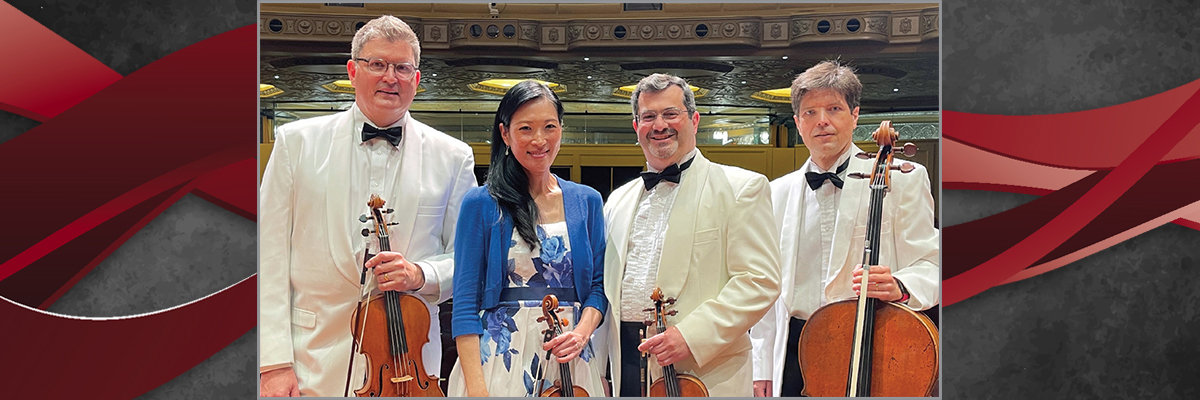
Provided by Philomusica Quartet
On Monday, April 13, the Philomusica String Quartet brings its season to a close at the Wisconsin Lutheran College campus with British Connections — a program of three chamber works with echoes of English musical life.
The quartet — violinists Jeanyi Kim and Alexander Mandl, and violist Nathan Hackett — will be joined by guest cellist Lynn Kabat of the Milwaukee Symphony Orchestra. Mandl described her adaptation to the ensemble as seamless: “She’s a wonderful chamber musician.”
The concert also features guest clarinetist Todd Levy, the MSO’s principal clarinet.
The Connections program pairs two early works by composers who studied together at London’s Royal College of Music at the close of the 19th century — John Ireland‘s String Quartet in D minor and Samuel Coleridge-Taylor‘s Quintet for Clarinet and Strings in F-sharp minor — with Milwaukee composer Brian Packham‘s The Shaper’s Song, a quartet inspired by a foundational text of the English literary tradition.
Both Ireland and Coleridge-Taylor entered the Royal College as teenagers of exceptional ability, and both works on this program were produced in the mid-1890s, before either composer had found his mature voice. They were both influenced by Royal College composition professor Charles Villiers Stanford, whose students also included Ralph Vaughan Williams and Gustav Holst.
Ireland’s D minor Quartet was written with the express purpose of impressing Stanford sufficiently to be accepted as a composition pupil. It was then largely unheard for 60 years, not performed publicly again until after Ireland’s death in 1963, and published only in the early 1970s.
The quartet moves through four movements with confidence and lyrical instinct — a robust opening sonata-form movement, a quicksilver scherzo of growing intensity, a slow movement of notable hymnic warmth, and an energetic finale. Mandl hears in the slow movement something distinctly, if quietly, English: “There is an underlying restraint that exists in English music. There is always a certain restraint underneath it. It’s like — we’re not going to go beyond pheasant under glass. The music can be highly expressive, but still: we are being respectful, we will not break that glass.”
Coleridge-Taylor’s Clarinet Quintet arose from an equally dramatic origin story. After a performance of Brahms’ Clarinet Quintet, Stanford challenged his students to write one that did not fall under Brahms’ shadow — a feat he declared impossible. Coleridge-Taylor, then 17, accepted the challenge and completed his quintet in roughly two months, sidestepping Brahms by routing his energies through Dvořák. The work received glowing reviews at its London premiere in 1895 and was then largely forgotten for the better part of a century until a well-received recording in 2007.
A defining feature of the quintet is the way Coleridge-Taylor integrates the clarinet into the texture rather than spotlighting it. “The clarinet is quite integrated with the entire ensemble,” Mandl noted. “He places a lot of the melodic material in the low register of the clarinet, which in a way sandwiches the clarinet within the strings.” The result is a work that is, in Mandl’s words, “a lovely quintet — a little more sedate, less flashy” than the Brahms model it was designed to evade. Clarinetist Todd Levy, whose range of chamber collaborations — with the Guarneri, Juilliard, Fine Arts, Miró and Ying quartets, among others — is an ideal partner for this kind of deeply integrated ensemble writing.
The concert’s centerpiece is the world premiere of Packham’s The Shaper’s Song for string quartet. Packham, a Milwaukee-based composer and pianist, has had his music performed by the Baltimore Symphony, Chautauqua Symphony, Symphony Nova Scotia, Present Music, and many others. This is among his first works for string quartet, and its premiere has been long in coming — an earlier performance by another ensemble fell through years ago when the intended dedicatee died.
The piece draws not on the Old English epic Beowulf directly, but on John Gardner‘s 1971 novel Grendel, which retells the poem from the monster’s point of view, turning the creature into an existential, philosophically reflective antihero who narrates his life to his death at Beowulf’s hands. Gardner’s novel centers on questions of meaning, isolation, and the seductive power of storytelling. These psychological dimensions are at the core of Packham’s music. The work is quiet, spare, and deliberately ambiguous, its thin texture conveying the emptiness of Grendel’s world.
Central to the piece is the figure of the Shaper — the blind bard in Hrothgar’s hall whose songs transform violent, chaotic history into heroic legend. Recurring motifs pass between the instruments in a kind of ongoing conversation.
Mandl describes the collaboration with Packham as invaluable — not merely for resolving notational questions, but for understanding the spirit the music asks for. “It is a performer’s dream,” he said. “We have found that many of the gestures actually allow a great deal more freedom than one might assume. Having him there has been crucial.”
Packham will be present at the concert.
The Philomusica String Quartet’s British Connections concert takes place Monday, April 13, at 7:30 p.m. at Schwan Concert Hall, Center for Arts and Performance, Wisconsin Lutheran College, 8815 W. Wisconsin Ave. Tickets are available online or at the door.

Existing members must be signed in to see the interactive map. Sign in.
If you think stories like this are important, become a member of Urban Milwaukee and help support real, independent journalism. Plus you get some cool added benefits.