Wisconsin To Let DACA Immigrants Work As Nurses, Teachers, Electricians
Evers signs bipartisan bill at El Rey, citing workforce shortages and fairness.
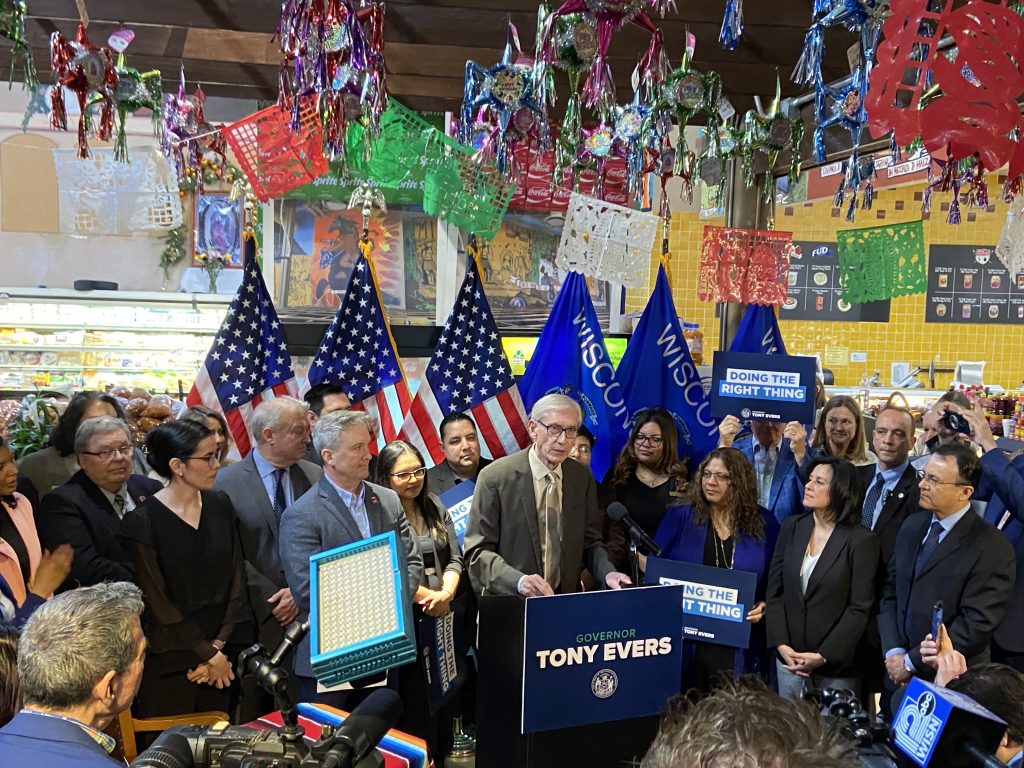
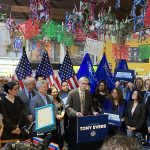
Gov. Evers speaks before signing into law a bill allowing immigrants in Wisconsin under DACA to receive professional licensing. Photo taken April 9, 2025.
Gov. Tony Evers visited Milwaukee on Thursday to sign legislation legalizing professional licensure for immigrants living in the U.S. under the protection of DACA, Deferred Action for Childhood Arrivals.
Until now, DACA recipients in Wisconsin have been unable to work in fields that require professional licensure, like nursing, plumbing, education or cosmetology.
“This legislation is a reminder of the critical role immigrants play in our economy and why we must never turn our backs on this community,” Evers said, before signing the legislation surrounded by state legislators, local elected officials and immigrant advocates at Nuevo Mercado El Rey 916 S. Cesar E. Chavez Dr. on the city’s heavily Latino south side.
Former President Barack Obama created DACA in 2012 through an executive order. The order established legal protection from deportation for immigrants brought to the U.S. as children before 2007. It also provided them with the opportunity to apply for work permits and Social Security numbers that allow them to legally seek employment, pursue higher education and travel freely. DACA recipients are often called “Dreamers” after the acronym for federal legislation from more than two decades ago, which Congress has never passed, that would create a pathway to citizenship for immigrants who arrived in the country as children.
The DACA licensure legislation was passed unanimously in the Assembly in February and passed the Senate in March on a vote of 31-2. Only Senators André Jacque (R-New Franken) and Steve Nass (R-Whitewater) voted against the bill.
The governor noted Wisconsin has maintained a low unemployment rate in recent years, 3.3% as of January, according to the Bureau of Labor Statistics. “But Wisconsin’s workforce shortages persist, and we can’t afford to leave out anyone who’s willing to participate in our success,” Evers said.
John Jacobs, business manager for International Brotherhood of Electrical Workers 494, spoke at the signing, saying the new law “eliminates an unnecessary roadblock for people who are often denied work and opportunity and through no fault of their own.”
Pamela Rubalcava, a graduate of Carroll University’s nursing school, was, until now, legally barred from obtaining a nursing license in Wisconsin. “Despite my clinical readiness, my career was indefinitely deferred,” she said Thursday.
In Wisconsin, there were nearly 5,800 DACA recipients as of 2023, according to data from U.S. Citizenship and Immigration Services (USCIS).
The bills were sponsored by Rep. Joel Kitchens (R-Sturgeon Bay) and Sen. Jesse James (R-Thorp). But Democratic Milwaukee State Rep. Sylvia Ortiz-Velez was a major booster for the legislation and worked on the bills with her Republican colleagues. She was the first Democrat listed as a sponsor on the bill. Ortiz-Velez was moved to tears Thursday, watching over the governor’s shoulder as he signed the legislation. She told Urban Milwaukee it was “surreal” to see the bill signed after three years of effort.
The legislative push began three years ago when former representative John J. Macco, a Republican, introduced three DACA-related bills with support from Ortiz-Velez, among them one that allowed professional licensure.
The new law is important for Wisconsin because “it fulfills our workforce shortages that we face together, all of us in the state, and also because it recognizes the value of the people that have been here in our state for so long with us as our neighbors,” Ortiz-Velez said.
Under the new law, any DACA recipient who has met all the requirements to obtain a professional license has an unexpired deportation deferral and an unexpired employment authorization. DACA recipients are required to renew their authorizations from the federal government every two years.
“President [Donald] Trump can try and instill fear and sow division all he wants, but here we know the facts: immigrants make essential contributions to our workforce and economy,” Evers said. “They enrich our communities with their culture, heritage, insights, perspectives, and they are good neighbors, and we must do everything we can to defend their rights and build a state where immigrant communities are valued, because that’s what being a good neighbor is all about.”
The ceremony was also attended by area alderman and Common Council President José G. Pérez, who had to hustle over from a hearing at City Hall on renaming Chavez Drive to S. 16th Street, and council lobbyist Justin Moralez.
Existing members must be signed in to see the interactive map. Sign in.
If you think stories like this are important, become a member of Urban Milwaukee and help support real, independent journalism. Plus you get some cool added benefits.