Milwaukee Reckoning With Cesar Chavez Allegations
Labor activist and civil rights leader subject of substantial sexual abuse allegations.
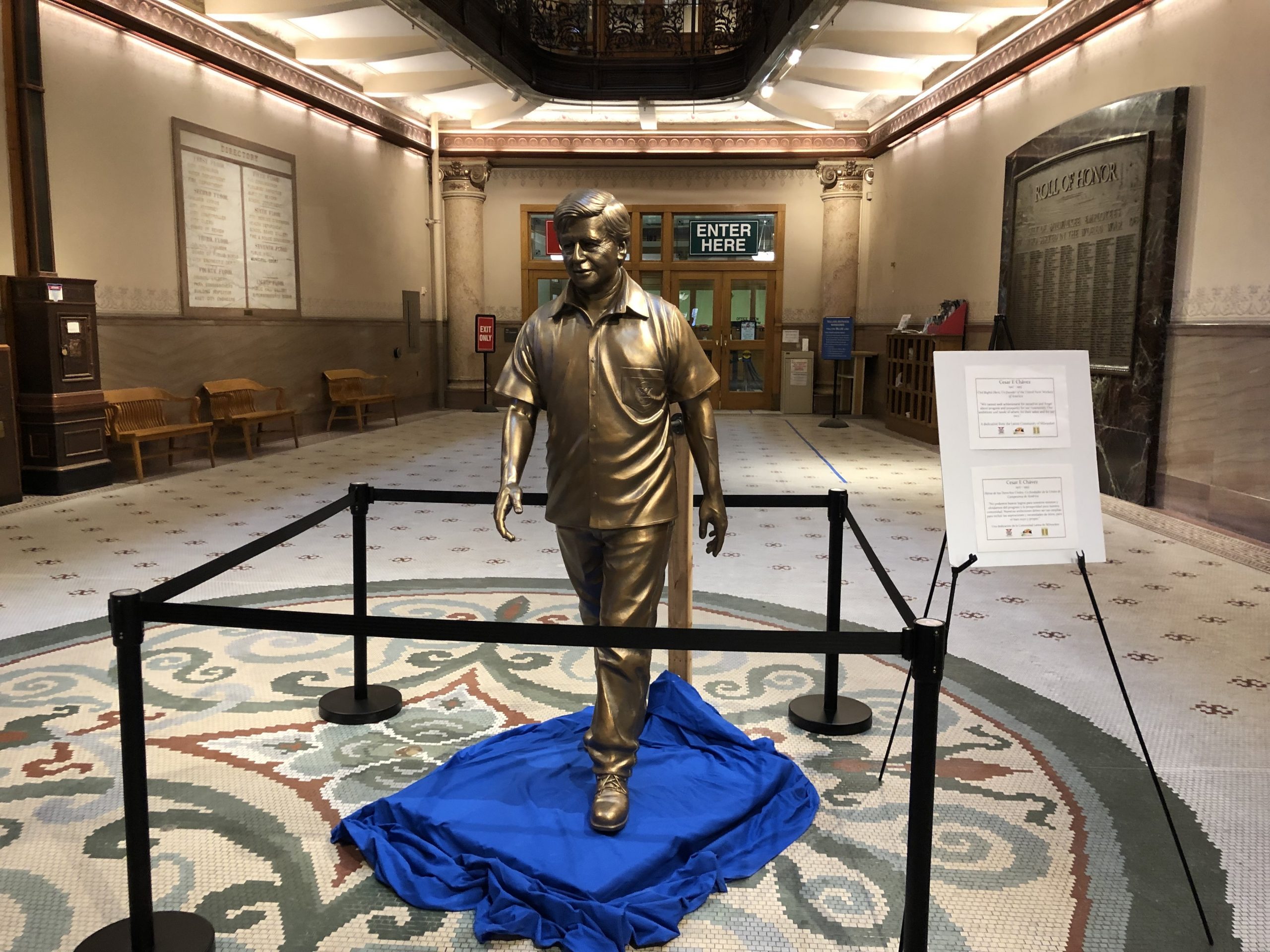
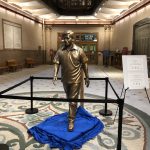
Cesar Chavez statue on display in Milwaukee City Hall in 2019. Photo by Jeramey Jannene.
Milwaukee officials and community leaders are confronting a difficult reassessment of civil rights icon Cesar Chavez following a recent New York Times investigation detailing decades-old allegations of sexual abuse against women and girls as young as 13.
The report, which includes accounts from survivors and those connected to United Farm Workers, has prompted local leaders to reconsider how the city commemorates Chavez, whose name and likeness are embedded in Milwaukee’s South Side.
Chavez is honored locally with a street named for him and a statue in front of a grocery store on the street. He also appears in multiple murals. Cesar E. Chavez Drive, one of the city’s most prominent Latino commercial corridors, was renamed in 1996 from S. 16th Street following a unanimous Common Council vote after a community-led campaign to honor the farmworker leader.
Two decades later, the city further cemented that legacy with the installation of a life-size bronze statue of Chavez in 2016 in the pedestrian plaza outside an El Rey grocery store. Funded through community fundraising and backed by local leaders, the statue was envisioned as both a cultural landmark and a symbol of the corridor’s identity as a hub of Milwaukee’s Latino community.
Chavez died in 1993 at the age of 66.
For years, the city has marked Cesar Chavez Day with annual celebrations recognizing his contributions to the farmworker movement and Latino civil rights efforts.
But that recognition is now under scrutiny.
Alderperson JoCasta Zamarripa said the accounts detailed in the New York Times investigation are “devastating,” pointing to allegations that Chavez engaged in a pattern of abuse, including grooming and assaulting underage girls.
“These women carried enormous pain for decades because they feared that speaking the truth would cost the movement everything they had sacrificed to build,” Zamarripa said in a statement. “That is an impossible burden.”
“I believe them,” she added.
County Supervisor Juan Miguel Martinez called for the street to be renamed Dolores Huerta Way. Huerta, who cofounded the National Farm Workers Association with Chavez, is one of the women who came forward with allegations against him. She is already honored with a mural along the street.
Zamarripa said the city’s planned Cesar Chavez Day celebration later this month will not take place and indicated she will participate in a broader community conversation about whether Chavez’s name should continue to be attached to the southside street.
The Marcus Performing Arts Center canceled its 8th annual Cesar Chavez Celebration.
“The farmworker movement was never one man,” said Zamarripa. “It was built by thousands of workers, organizers, and families.”
The reassessment marks a stark shift from prior official statements. Just last year, Zamarripa and Alderperson José G. Pérez praised Chavez as “a true champion for justice,” whose legacy “continues to hold significance today” in Milwaukee. As recently as 2021, Pérez was discussing the possibility of extending the renaming of Cesar E. Chavez Drive further south along 16th Street.
Now, local and national Latino organizations are emphasizing a more complex legacy.
Forward Latino, a Franklin-based national advocacy organization, said the allegations demand “truth, accountability, and compassion” for survivors.
“This movement has never been about any one individual,” said national president Darryl Morin in a statement. “It is grounded in the dignity of all… and in the ongoing pursuit of justice.”
The organization said it stands with those who have come forward and stressed that “no one is above accountability.”
The emerging debate in Milwaukee reflects a broader national reckoning over how to evaluate historic figures whose contributions are intertwined with alleged wrongdoing.
“The New York Times investigation into Cesar Chavez raises extremely troubling allegations. The victims, those who have come forward and those who are unnamed, deserve our compassion. I will have discussions with elected officials and community members to determine what steps Milwaukee might take in light of this new information,” said Mayor Cavalier Johnson in a statement.
Zamarripa said that the process will take time, but must center those who came forward.
“To any survivor who is carrying something heavy today: You are believed, and you are not alone,” she said.
Pérez, in whose district the street runs, did not respond to a request for comment.
Existing members must be signed in to see the interactive map. Sign in.
If you think stories like this are important, become a member of Urban Milwaukee and help support real, independent journalism. Plus you get some cool added benefits.
Political Contributions Tracker
Displaying political contributions between people mentioned in this story. Learn more.
- October 30, 2019 - JoCasta Zamarripa received $100 from Darryl Morin
- June 30, 2019 - JoCasta Zamarripa received $200 from Darryl Morin
- May 29, 2019 - JoCasta Zamarripa received $250 from Darryl Morin
- March 23, 2016 - José G. Pérez received $250 from Darryl Morin
- May 5, 2015 - José G. Pérez received $10 from Cavalier Johnson
- May 5, 2015 - José G. Pérez received $100 from JoCasta Zamarripa