This article, by Kaid Benfield, was originally published on Switchboard, the Natural Resources Defense Council Staff blog.
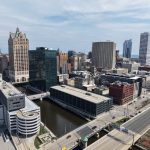
Milwaukee’s newest trendy neighborhood is likely to become one of its best, and almost certainly its greenest. The Brewery, an environmentally sensitive restoration and adaptation of historic structures among the decaying wreckage of the former Pabst Brewing Company, is already home to striking residential lofts, a great beer hall, a range of offices, Cardinal Stritch University City Center, and a small urban park. Soon it will add a senior living facility and the School of Public Health of the University of Wisconsin-Milwaukee. Look for more residential and commercial presence, including a boutique hotel, retail and restaurants, over time.
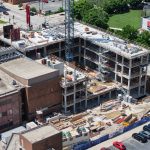
As you can see by the image above, before construction the site was pretty much a disaster. This has been a major undertaking by any measure.
When NRDC, the Congress for the New Urbanism and the US Green Building Council began taking applications from developers to participate in the pilot program for LEED for Neighborhood Development, The Brewery was one of three among the 200-plus applicants that immediately caught my eye as projects with exceptional potential. (The other two were New York City’s Melrose Commons and Victoria, BC’s Dockside Green.) The development plan for The Brewery has now earned a platinum rating under LEED-ND, one of only a few projects to do so.
Here’s why I got excited: the seven-block, 20-acre project involved the restoration and adaptive reuse of an amazing 26 structures listed on the National Register of Historic Places, surely making it one of the most ambitious historic preservation projects in the country. It also involved extensive brownfield cleanup; had a great location within walking distance of Milwaukee’s downtown; planned aggressive use of green infrastructure to manage stormwater; planned to set aside some apartments for qualifying low-income families; and included standards for high-performing green buildings. The Brewery was also strongly supported by the city government in what has been the largest public-private partnership in Milwaukee’s history.
That master plan is now coming to fruition. The master developer was the late Joseph Zilber, who had built a large portfolio of development both in downtown Milwaukee and in Hawaii. (His philanthropic portfolio was impressive, too, including a $50 million fund to improve Milwaukee’s low-income neighborhoods.) A number of the individual buildings within The Brewery site are now being developed by Gorman & Company.
When the site is fully built out, it is expected to include at least 300 homes and some 1.3 million square feet of office and retail property. My friends in Milwaukee call The Brewery “a great, great project” and say “the more I see at the old Pabst site, the more I like.” One of them also reports that the old Pabst headquarters building “was used as a setting for one of Charles Bronson’s last movies, Family of Cops 3 (which was mostly filmed in Toronto, but used the Pabst Brewery for some key scenes).”
I can’t wait to see it for myself. In the meantime, check out the plans and before and after images accompanying this post. Here’s also a neat music video that was filmed entirely within the Best Place Tavern at The Brewery:
For those of you whose video tastes lean more toward the explicitly environmental, here’s another one, of the bioswales incorporated into the site to filter stormwater. One of the things I like best about green infrastructure is the way it introduces bits of literally green nature into otherwise hardscape urban sites:
Guest post by Kaid Benfield
Kaid Benfield Director, Sustainable Communities, NRDC; co-founder, LEED for Neighborhood Development rating system; co-founder, Smart Growth America coalition; author, Once There Were Greenfields (NRDC 1999), Solving Sprawl (Island Press 2001), Smart Growth In a Changing World (APA Planners Press 2007), Green Community (APA Planners Press 2009); voted one of the “top urban thinkers” in poll on Planetizen.com and named one of “the most influential people in sustainable planning and development” by the Partnership for Sustainable Communities.
Roberta Brandes Gratz, one of Planetizen’s Top 100 Urban Thinkers, explores what makes New York City work in her book The Battle for Gotham New York in the Shadow of Robert Moses and Jane Jacobs. With a title like you would assume the book dealt heavily with details of how Jacobs and Moses operated and their battles over urban renewal, but you would be wrong if you did. Instead, the bulk of the book deals with the last legacies of the policy and planning styles of Moses and the thinking of Jacobs. Despite being poorly titled, the book is an enjoyable read, at least until a number of editing errors mar the last third of the book.
The Battle for Gotham largely focuses on the author’s perspective of what makes New York City great, and what threatens that greatness. It’s clear that much of the author’s view on cities has been shaped by a personal friendship with the late, great urbanist Jane Jacobs. Gratz’s views are broken into chapters that deal individually with a New York City neighborhood or issue ranging from the regeneration of the predominantly cast-iron neighborhood SoHo to the battle to save industrial land in the city.
Her discussions of the preservation of industrial-zoned buildings was of particular interest to me, as I think it’s a pertinent issue for cities to focus on. Should industrial buildings be preserved for that purpose if the land can fetch more tax revenue as condos, apartments, or office space? What role does manufacturing play in the global city? Gratz focuses on her family’s ownership of a small manufacturing firm, one of thousands she considers an important source of employment in New York City. She comes in on the side of saving the industrial land, but avoids discussion of the real financial impacts of her discussion versus other options that I was hoping for.
While much of the book deals with historical issues in the city (many of which ironically, given the title, fall after the time of Moses and Jacobs), including an extensive section on Westway and Jacobs views a former New Yorker on the proposed highway, the last part of the book deals with more current issues including Atlantic Yards, light rail, and the Park East Freeway.
When it comes to the Park East, as with many other areas later in the book (details below), her facts seem a bit distorted. She starts by discussing Norquist’s “Nordic look reflective of the immigrant history of that region,” which immediately makes me question her knowledge of the heavily German City of Milwaukee. On top of a few other fishy claims (the Lower East Side was reconnected to downtown after the freeway’s demolition?), she notes that “developers scrambled to build mixed-use buildings on a major portion of the reclaimed sixteen acres of city land”, which is arguably true, but misses the broader point that Milwaukee County’s land that is nearly four times that in size is almost entirely empty to this day. The Park East Freeway demolition was an improvement to the city, but not nearly like Gratz claims it was, which makes me question her other judgements in the city.
A number of other factual errors plague the end of the book (and leave me wondering what I missed earlier). Chelsea Market does not include a Whole Foods, let alone the first one in New York City (it’s located in Chelsea, but not in the redeveloped building she lauds). Who Framed Roger Rabbit? came out in 1988, not 1998 (a small error, until you consider all the other errors it piles on top of). Blair Kamin (not Kamen), is a male, not a female (she does correctly cite that he is the Chicago Tribune architecture critic). European cities, with few exceptions (London and Stockholm being the most notable), don’t have congestion pricing on the scale proposed in New York City.
Hopefully, a second edition (and possibly a retitling of the book) could correct many of these errors. Until then, I’m forced to wonder what factual inaccuracies I missed. Pile that on top of the lack of real depth on a number of issues, and this book could have been something, perhaps it would have been better off if the topic were narrowed. It’s a shame, because Gratz’s tales of neighborhood evolution were largely enjoyable until the numerous errors made me question everything I had read.
Final Rating – 2 out of 5 stars – Great potential, poor title, poor execution
Imagine this for a moment — you’re a kid in a candy store, and as things go, this candy store is opening for the first time ever and only for one weekend. Oh gosh. You’ve dreamed of this cornucopia of confections so many times before, you know every name and shiny wrapper in the store… but your eyes are bigger than your stomach. How can you pick just a choice few, knowing your slight allowance won’t let you have all that you want? It’s the best and worst kind of agony.
HMI’s first annual Doors Open Milwaukee is this candy store. One hundred sites to explore but only one short weekend to satisfy your Milwaukee-built-environment sweet tooth. To make this amazing event slightly easier to dive into, I decided to reach out to a handful of folks whose perspectives and relationships with the city I really respect, and ask them to be experts on their own curiosity. Of course, because the Milwaukee community is both panoramic and kaleidoscopic, there’s no wrong way to approach Doors Open — we’d love you to post your own personal recommendations in the comments section.
Below, find a few ideas on how you can dig into Milwaukee during the first annual Doors Open Milwaukee:
Nik Kovac is the Alderman of Milwaukee’s 3rd District.
Nik’s Picks:
US Bank Building
US Bank Observation Deck
If you’re looking for panoramic views of our lake on one side, city on the other, there are a couple of great opportunities this weekend – the US Bank Observation deck 601 feet in the air and the Discovery World Pilot House right on the water – and if you haven’t been to either of those vantage points before, do not miss them. It’s a great way to orient your curiosity as you scan the nooks the crannies, alley and elbows, rooftops and courtyards that fit together in our downtown.
Jones Island Water Reclamation Facility
I’ll leave it for you to decide from there which of Milwaukee’s prominent structures you most want to see from the inside. Instead I will recommend a couple of back of the house tours, where you will get to pull up the hood on our town and look at some of the machinery that makes us go. The Jones Island Water Reclamation Facility will be giving motorcoach tours of the 75-acre peninsula on our harbor where our wastewater is separated into waste and water – and then the waste is converted into a best-selling fertilizer.
Milwaukee County Transit Fleet Maintenance Building
If you think it’s hard some days keeping your old car running, imagine what it would be like if you had hundreds of buses that collectively put millions of miles on the odometers each year. The Milwaukee County buses are repaired and reshaped every day – at 1525 W Vine Street, just northwest of downtown at the intersection of Fond du Lac and Walnut, but you are allowed to watch only this Saturday. It’s a ten-minute ride to there from Water Street downtown on the #57 line.
Best Place at the Historic Pabst Brewery
From there, it’s a quick and scenic walk south on 13th Street, east over the freeway on Vliet, and the south again down 10th street through Milwaukee’s most surprising newest-oldest neighborhood – the Brewery – for a stop at Milwaukee’s best bar – Best Place at the Historic Pabst Brewery. You can get a tour or a beer – or both – here at 917 W Juneau. If you have not yet been inside this new old bar, make sure to get there this weekend to see a 360 degree mural explaining how to make beer – lots of beer – and read snippets of German wisdom that should not be forgotten no matter how much beer you’ve had.
Ian Abston is the event coordinator at OnMilwaukee.com & founder of Newaukee.
Ian’s Picks:
Great Lakes Distillery Not your average spirits. This place houses Milwaukee-bred Rehorst Vodka and some of the best bartenders this side of the Kinnickinnic River. Don’t be scared when you see these guys crack an egg white into your martini and top it off with a blue cheese stuffed olive. Be sure to try all the samples, ask lots of questions, and of course… try all the samples. Wow this stuff is good.
Hotel Metro
Hotel Metro
Upgrade your tour of this Milwaukee gem. Hop in the elevator and let it take you as far as it can go. You’ll arrive at the surreal rooftop patio, one of the best kept secrets in our fine city. The running fountains will set the tone as you sip a local craft brew from the best seat in the city. Avoid the temptation to toss the sampler peanuts at the birds below you. They’ll realize you’ve got food and your tranquil fountain will turn into a bird bath for these little scavengers.
John Gurda is a longtime Milwaukee historian.
John’s Picks:
For people who haven’t been downtown in a while, I’d recommend seeing some of our civic icons, including City Hall, Central Library, and the County Historical Society. I’ll be visiting as many buildings as I can this weekend, but three are highest on my list:
US Bank Observation Deck
The observation deck at the top of Wisconsin’s tallest building used to be open every weekday, but that practice ended years ago. Short of renting a helicopter, there’s no better view of central Milwaukee, and Doors Open makes it possible this weekend. I’m looking forward to the elevator ride, and to updating some slide-show photographs I’ve been using for years.
Milwaukee River bridge houses (Kilbourn, State, Wells)
These little structures are unsung grace notes in downtown’s landscape. Each has a different architectural theme, and I’m curious to see if they’re as interesting inside as they are outside.
City Lights (Westside Works, Milwaukee Gas Light Co.)
City Lights
The old gas works in the Menomonee Valley had been vacant for decades, and its current restoration is a welcome sign of the Valley’s rebirth. It seems entirely fitting that a complex designed by one of the most prominent architects in the city’s past — Alexander Eschweiler — is now the home of a prominent contemporary practice — Zimmerman Architectural Studios.
Pegi Christiansen is an arts organizer, writer, performance artist, & chair of In:Site.
Pegi’s Picks:
Calvary Presbyterian Church
I have been on a quest to find all of the labyrinths in the city, and haven’t gotten over to Calvary to walk this one. I am fascinated by the different designs that can be used and their capacity for community meditation.
Northwestern Mutual
You get to go inside the guest dining room! I can’t pass up this opportunity to feel grand.
Michail Takach is PR & social media consultant for Historic Milwaukee.
Michail’s Picks:
Pritzlaff Building
Pritzlaff Building
For decades, this tired old building stood empty, coal-stained and brokedown on a forgotten corner of downtown, virtually the last man standing in a long-vanished industrial neighborhood. Since it was long-surrounded by fast-moving, one-way streets, and cut off from our pedestrian downtown by the freeway, the Pritzlaff Building wasn’t the easiest building to access, and it certainly wasn’t the prettiest thing to look at. Nowadays, it’s no longer the grave marker for Old Milwaukee, but instead the gateway to a reborn and revitalizing Fifth Ward community. Within the past two years, the building has come alive, opened its doors and become an urban adventurer’s dream venue. In the past two years, I’ve seen everything from fire-dancing floorshows to pissed-off punk bands to high-concept art shows in this space. And through it all, this old-time hardware emporium retains its gritty 1880s mercantile feel, one that really brings you back to the rough-and-rugged roots of Milwaukee in an authentic way. See it now, before someone cleans it up and makes it “respectable.”
Best Place at the Historic Pabst Brewery
Ask any Milwaukeean over the age of 30 what they remember about touring the brewery, and they’ll definitely mention three things: the Old World Guest Center, the iconic statue of King Gambrinus, and of course, the beer. But most Milwaukeeans don’t realize they can still enjoy this experience — 15 years after Pabst ceased production here — at the last outpost of Old World hospitality on the west side, Best Place at the Historic Pabst Brewery. Best Place has done an amazing job of preserving not only the architecture and history, but the emotional connection to a brand that we used to call our own. Beer lovers will be wowed by the amazing collection of retro memorabilia that decorates the gift shop, and the fact that they can still enjoy an ice cold Pabst right on the spot. Following the return of King Gambrinus after 15 years away, visitors can once again take photos with him (and Captain Pabst) — and share them on the Best Place website. It sure beats the Bronze Fonz!
US Bank Observation Deck
Okay, okay, I know. This seems like the obvious choice. But once you’ve taken a panoramic look at our city from the 41st floor of Wisconsin’s tallest building, you’ll understand. It’s a humbling paradox to see all three of Milwaukee’s original settlement points at the same time, from 600 feet above Wisconsin Avenue, and realize how far and wide we’ve sprung from those birthplaces. Whether you’re admiring our wide open, emerald lakefront, the spires and peaks of downtown buildings, or just the sheer amount of life happening all around you, your breathless view from the top will really change your idea of “Milwaukee” forever. Make this your first Doors Open Milwaukee stop, not your last. You never know when you’ll have a chance to reach these heights again.
Guest post by: Adam Carr
A lifelong Milwaukeean, Adam Carr is a storyteller and radio producer. After two and a half years as producer at 88Nine RadioMilwaukee, he’s currently freelancing and looking for new ways to explore narrative.
It has been more than a week since Wells Street was converted to two-ways, and it has indeed been Carmaggedon. Drivers have been confused by the unusual street configuration. Two-ways, really? The fear generated by being able to turn right and go East on to Wells St. has caused mass hysteria causing more than a few people to quickly park in available parking spots. In fact just the other day there was a three-car-and-one-bicycle backup getting around a FedEx truck. And now there are more cars than one can count driving close to the speed limit. Yes, it has been Carmageddon!
Well no, much like the overhyped L.A. Carmageddon. Similar to when the 405 expressway was closed temporarily, or when the Park East Freeway spur was removed, the conversion of Wells St. to two-way traffic has actually not brought about mass confusion, traffic jams, or a significant increase in congestion. In fact it appears drivers are quickly becoming accustomed to the new configuration. Drivers are now turning right onto Wells St. instead of driving around the block to get to a parking spot, driving closer to the speed limit down Wells St., and are trying new routes to get to their destination.
As this two-way street conversion has once again not brought Carmageddon to the streets of Milwaukee, it is clear the continued effort to rebuild the two-way street network is on the right path in downtown Milwaukee, but is far from complete. The incomplete conversion of State St. needs to be rectified in the future, Broadway is just one block short of better connecting the Historic Third Ward with downtown Milwaukee, and Jackson St. still becomes a race track after crossing Wells St. These three are just some of the segments left to convert to two-way traffic in downtown Milwaukee, but if recent history tells us anything, it is that Carmageddon won’t be around the next corner.
The Agile City by James S. Russell is an easy to read, pro-city book. Feeling much like a Richard Florida book at points, the author highlights examples of cities getting things right in regard to building wealth and dealing with the effects (and causes) of climate change. It is neither a book about green washing, nor is it filled with pie-in-the-sky “green” plans for how to remake the way we live. The book focuses on practical objectives to build wealth and well-being through cities.
Released in late spring, the book is quite current and takes on the challenges currently faced as a result of the mortgage meltdown. It’s also a more insightful read today because the author draws from so many new examples including developments currently in progress across the world from the Pacific Northwest to Germany.
Throughout the book, Russell, the Bloomberg News architecture columnist, finds concrete examples of the way buildings are reducing their energy costs and impacts on the environment, as well as providing a better quality of life for their users. It’s refreshing that nearly all of his ideas are based in real world examples. He also doesn’t frequently push for large scale solutions, instead focusing on a number of the ideas that are small and incremental.
James Russell notes that “remaking transportation is perhaps the biggest untapped opportunity that is the least discussed in the global warming debate.” He highlights Vancouver’s SkyTrain system as a system that is getting it right, while noting that Seattle’s new light rail system is getting bogged down by politics into meandering routes, a perfect example of how “the United States wastefully spends transportation dollars.”
Perhaps of interest to Milwaukeeans (and frequently left out of similar books), The Agile City has a section on the costs of deploying a water system to different types of infrastructure. Russell breaks down how water isn’t priced to match the costs of getting the water to the various locations, and is instead billed equally to all customers, pointing out that greenfield hookups can easily cost up to 10 times as much as ones in established suburbs. He also warns of a not-to-distant future where there isn’t enough water in the fast-growing cities of the western United States.
If you’re not extremely well versed in all things “green” or LEED-certified, but are interested in cities or the environment, you will enjoy and get a lot out of The Agile City. At times it reads a bit too much like a standard fare “u-rah-rah cities” book, but the recency, worldwide focus, and pragmatic environmental focus make it worth your time.
Motorcycles parked along Lincoln Memorial Drive for the Milwaukee Air and Water Show.
East Town Farmer's Market
The East Town Market at Cathedral Square in downtown Milwaukee. Hosted by the East Town Assocation. The market wraps much of the park.
Zoom Room
The Zoom Room "Dog Agility Training Center and Canine Social Club" replaced a laundry mat that had no street facing windows or light up sign. Clearly an improvement, but still leaving a little to be desired (windows on the Humboldt Avenue side, use the corner door).
A good use for the building until someday something mixed-use and multi-story that mixes with the character of the neighborhood can be built there.
Up and Under
The Up and Under bar. A good place to see live music on Brady Street. Located at 1216 E Brady Street on Milwaukee’s Lower East Side
Two Way Traffic on Wells Street
Some of the first two-way traffic on Wells Street in downtown Milwaukee. Riding in a car with Alison.