

Anglers Blame Politics As Wisconsin Cuts Back On Stocking Game Fish
With two state hatcheries closed, musky, walleye and brown trout numbers are on the chopping block.
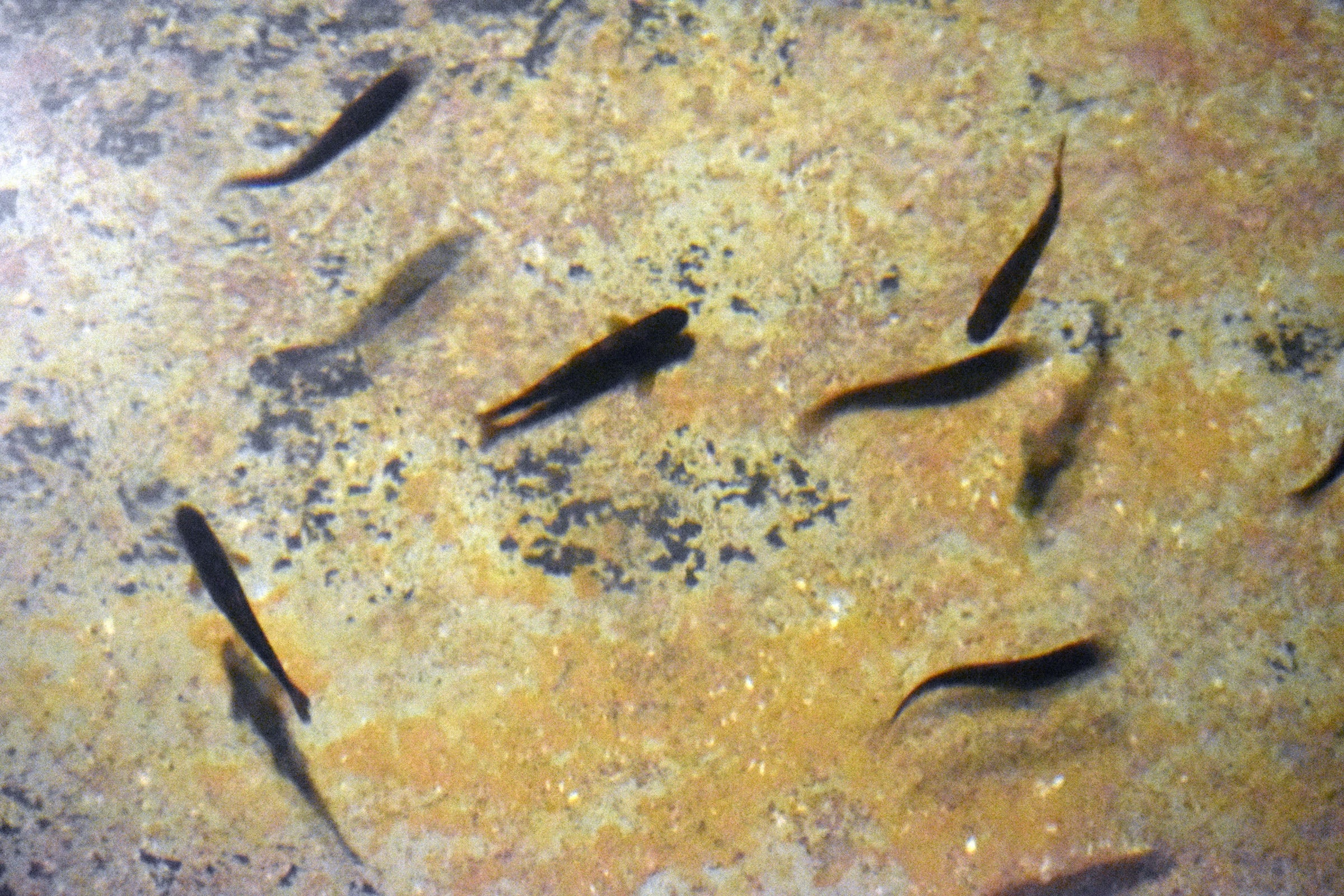
Brown trout fingerlings that are being raised at the Les Voigt State Fish Hatchery in Bayfield. Normally, the fish are transferred to the Brule hatchery to finish growing, but the DNR intends to keep the facility closed this year. Danielle Kaeding/WPR
At the Les Voigt State Fish Hatchery in Bayfield, some 30,000 brown trout fingerlings flit back and forth in a concrete tank. These fish hatched in December from eggs first collected by state staff in the Root River in southeastern Wisconsin. They were incubated at a facility in central Wisconsin.
Last year, the state stocked 372,000 brown trout into Lakes Superior and Michigan that were reared at the nearly century-old Brule State Fish Hatchery.
The Brule hatchery will sit empty this year.
Normally, around 160,000 brown trout are transferred from Les Voigt to Brule each summer to finish growing before they’re ready to be released. But a battle over funding for the state’s fish and wildlife account and a lack of spending authority forced the closure of Brule and Osceola fish hatcheries and deep cuts to fish stocking statewide.
The DNR had proposed reducing musky stocking by 70 percent and walleye stocking by 45 percent. Statewide, the cuts amounted to 11 percent, or more than half a million fish. Now, the agency said it’s nearly restored musky stocking and scaled back overall reductions to 7 percent statewide.
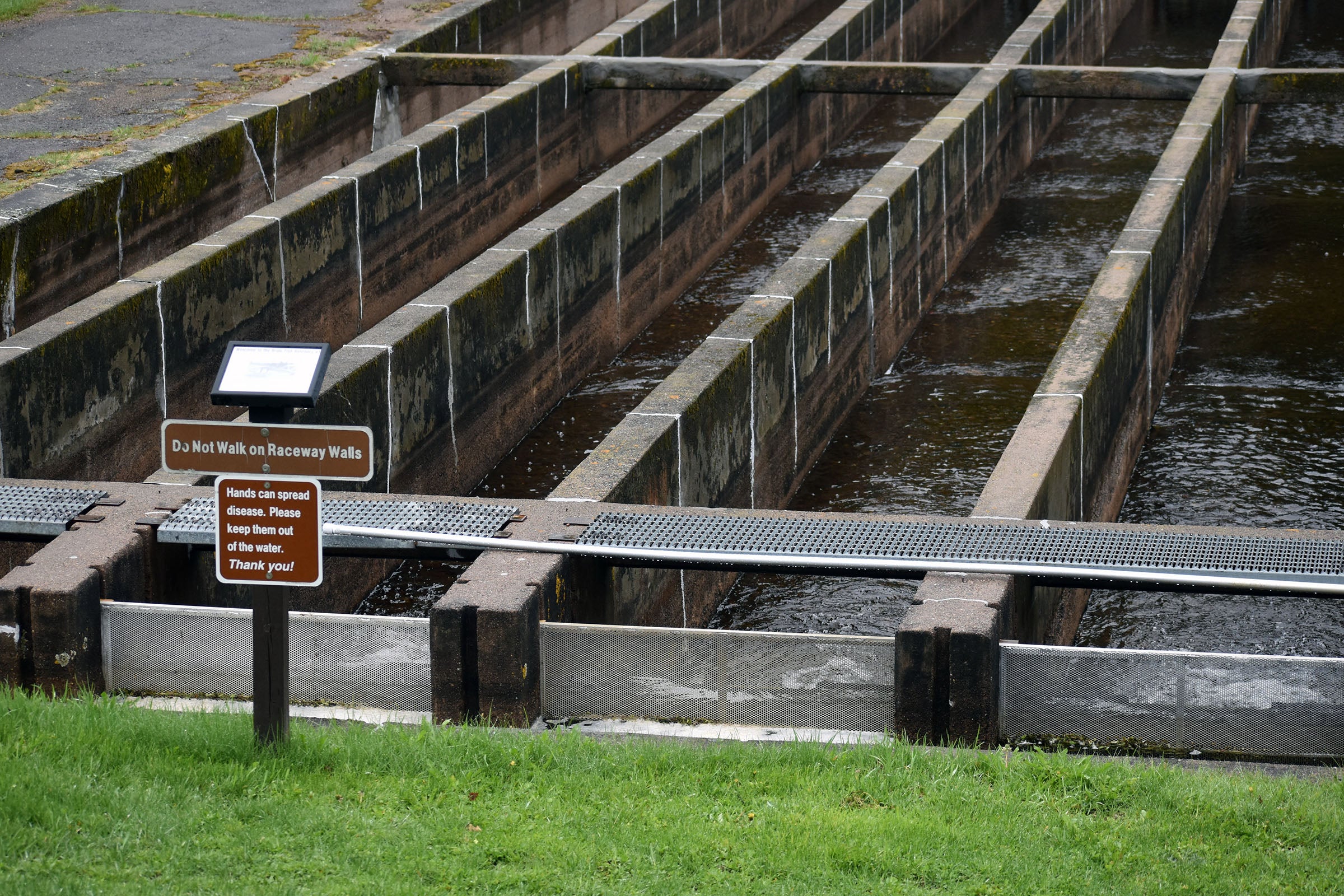
Raceways and ponds at the Brule River State Fish Hatchery are fed by the Little Brule River. The hatchery sits empty, and the DNR intends to keep it closed. Danielle Kaeding/WPR
For decades, Wisconsin’s statewide, interconnected system of fish hatcheries and fish-stocking practices have helped fuel Wisconsin’s recreational fishing industry, which attracts tourists from around the Midwest. Federal data released this year shows that boating and fishing generates around $1 billion for Wisconsin’s economy.
Now, some anglers say the cuts to stocking that resulted from a partisan standoff between the Democratic administration of Gov. Tony Evers and Republican state legislators could damage that industry. GOP legislators say they made no funding cuts to the state’s fish and wildlife account and faulted the DNR for providing little notice to avoid cuts.
In mid-May, the 2-inch fingerlings at Les Voigt were about 6-and-a-half months old and were set to be transferred to a larger tank. They’re usually stocked into Lake Superior when they’re 18 months old. With the Brule hatchery closed, some will be released early this fall.
Fish stocking activities are planned two years in advance. Fisheries staff say they have limited time to make decisions because some fish, such as walleye and muskies, spawn in the spring.
“If we do not collect eggs at a certain time, we can’t come back a month later and pick up eggs,” said Darren Miller, who supervises operations at the Les Voigt and Brule hatcheries. “We operate on what Mother Nature does, and there’s a narrow window when she’s supplying our eggs that we need for our production.”
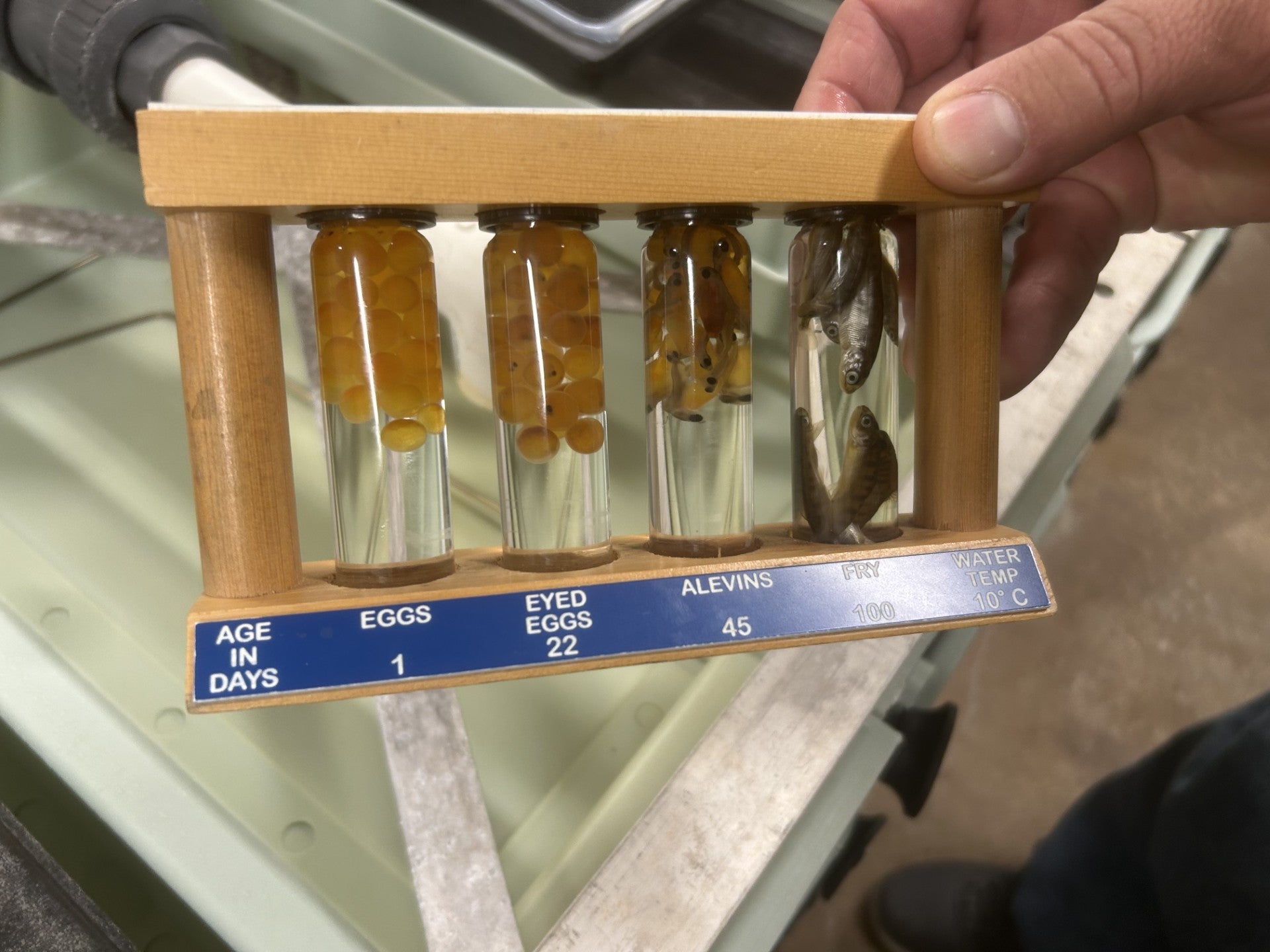
The DNR’s Darren Miller holds a display of fish eggs at the Les Voigt State Fish Hatchery in Bayfield, Wis. Danielle Kaeding/WPR
Some say the cuts and closures are an affront to all outdoor enthusiasts
Fishing is not just big business in Wisconsin — it’s a constitutional right. In 2003, around 82 percent of voters passed an amendment to the Wisconsin Constitution to preserve their right to hunt and fish. It’s a favorite recreational activity and part of the cultural identity for many anglers, including Todd Berg. He recalled a day last spring where he and his wife were fishing on the Chequamegon Bay of Lake Superior, hoping to catch some coho salmon for dinner.
“One of our light rods went off and went off and went off to a point that I thought it was a snag,” Berg said. “It ended up, 20 minutes later, being a 32-inch brown trout that was just short of 20 pounds.”
Berg is a representative of the newly-formed group Friends of the Wisconsin Fisheries, which is lobbying against the cuts and closures of the Brule and Osceola fish hatcheries.
“The state brings in a tremendous amount of money from people who visit here that want to go out and fish,” Berg said. “Why would we cut our own throats?”
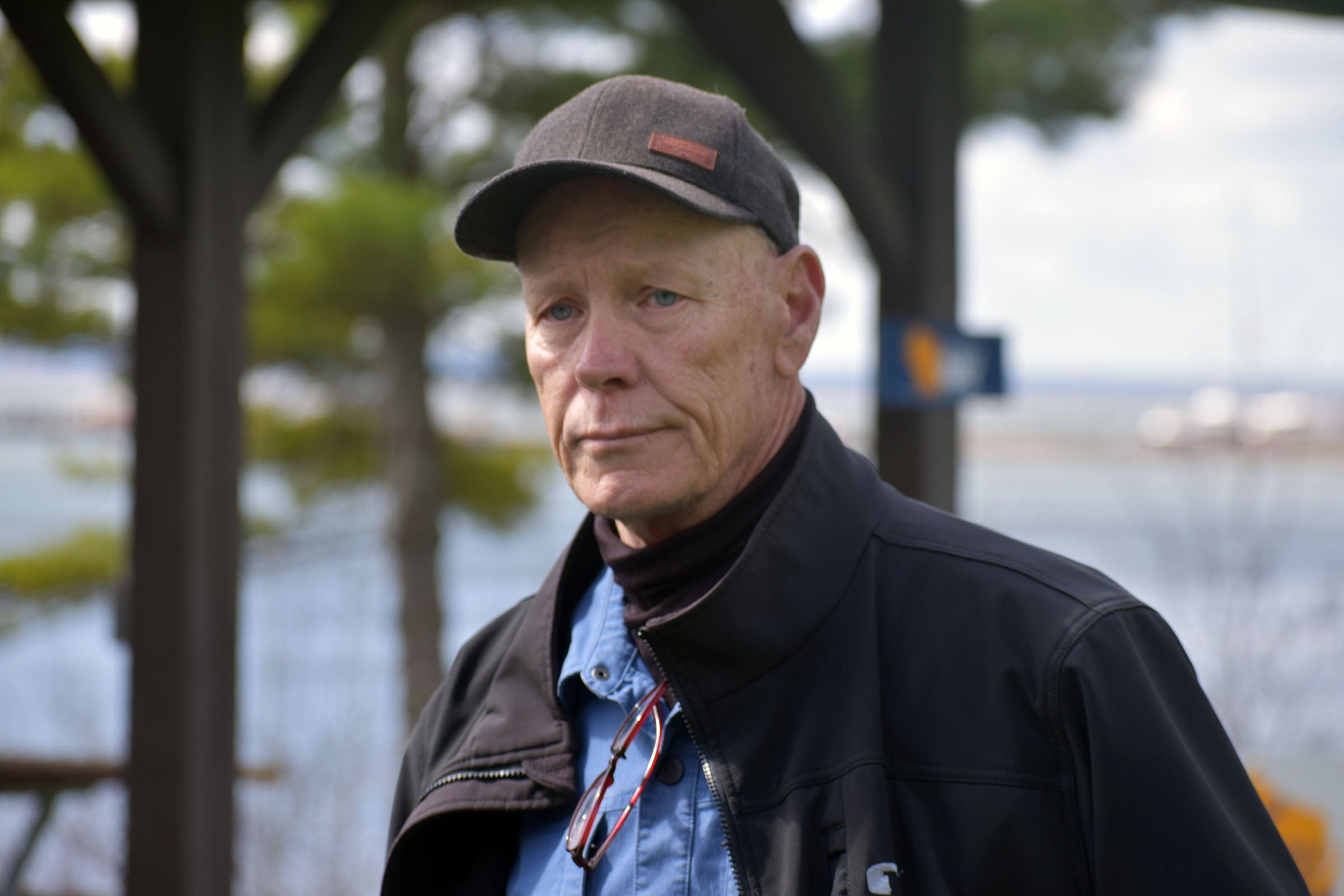
Angler Todd Berg with the group Friends of the Wisconsin Fisheries blamed a political vendetta between the Republican-controlled Legislature and Wisconsin DNR for fish stocking cuts and hatchery closures. Danielle Kaeding/WPR
In recent years, the state fish and wildlife account has faced a roughly $16 million shortfall as license fees for hunting and fishing have remained largely flat since 2005 amid rising costs and declining license sales. Lawmakers in last year’s biennial state budget approved a $15 million transfer from the state’s forestry account in each year of the 2025-27 budget to cover the estimated deficit. Despite the transfer, the agency lacked permission to spend some of those funds.
Amid less-than-expected federal funding, the DNR made a last-minute plea to lawmakers for authority to spend $4 million by April 12 to avoid cuts. After the deadline came and went without action from the Legislature’s finance committee, the agency forged ahead with reductions. Lawmakers have since approved their request.
But DNR staff said it’s unrealistic to reverse all cuts and hatchery closures, and the fish and wildlife account still faces an $11 million shortfall. While budgetary transfers should make up that gap, they say it’s likely to grow worse in future years amid projected declines in federal funding and stamp-funded programs.
Tom Johnson with the Douglas County Fish and Game League said groups have been trying to address the lack of funding since the DNR first proposed shuttering Brule in 2012. During Gov. Scott Walker’s administration, a consultant recommended closing Brule and other hatcheries, but the DNR ultimately decided against closure at that time.
“Our Legislature has an ultimate responsibility to fund Wisconsin natural resources: the fisheries, the wildlife, the law enforcement, the parks and rec,” Johnson said. “They failed us.”
A DNR spokesperson said focusing the agency’s “limited and insufficient stocking resources” at other facilities will result in the smallest reductions to fish stocking.
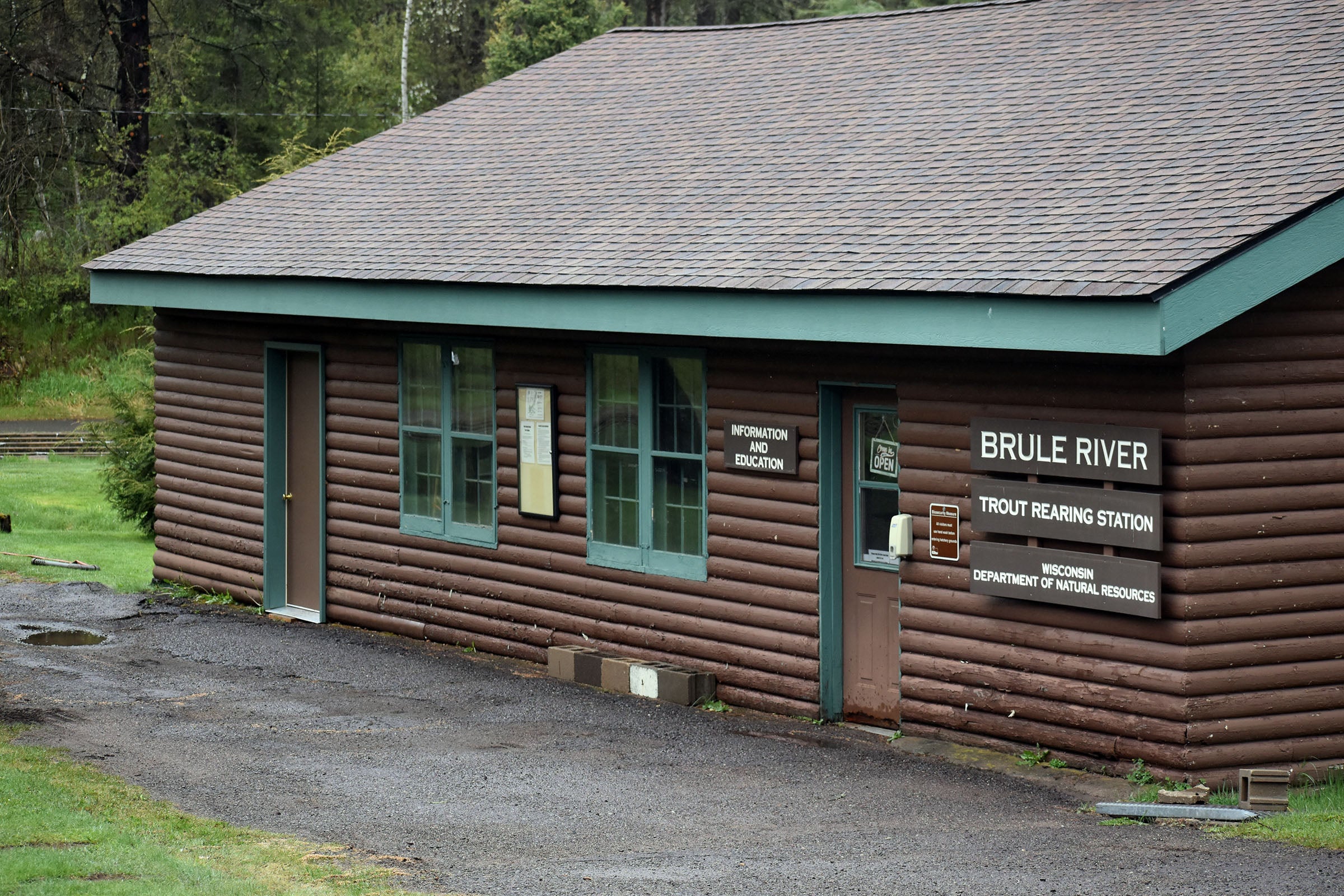
The DNR intends to keep the Brule River State Fish Hatchery closed the rest of this year, citing overall costs and staffing shortages. Danielle Kaeding/WPR
DNR has struggled to face rising costs amid declining revenues
Last month, GOP lawmakers with the Legislature’s budget-writing committee blasted the DNR for making cuts with limited notice. Lawmakers stressed they never cut funding for the state’s fish and wildlife account. State Sen. Romaine Quinn, R-Birchwood, whose Senate district includes the Brule hatchery, said the agency’s decision was short-sighted and reflected poor planning.
“(I’m) just hoping this never happens again,” Quinn said. “I hope we can learn from this, and I don’t believe there’s anyone on the finance committee, let alone either party, who wants to see cuts to stocking the state.”
Quinn argued the account had a roughly $28 million available balance, saying cuts didn’t need to happen. But without the committee’s approval, the DNR couldn’t access those funds, according to the nonpartisan Legislative Fiscal Bureau.
While it’s true the Legislature hasn’t made cuts, lawmakers haven’t increased funding either aside from budgetary transfers to fill the gap, said Eric Lobner, DNR Fish, Wildlife, and Parks Division administrator. At the same time, inflation has hiked prices more than 70 percent since lawmakers last raised resident hunting and fishing license fees, the account’s main source of revenue.
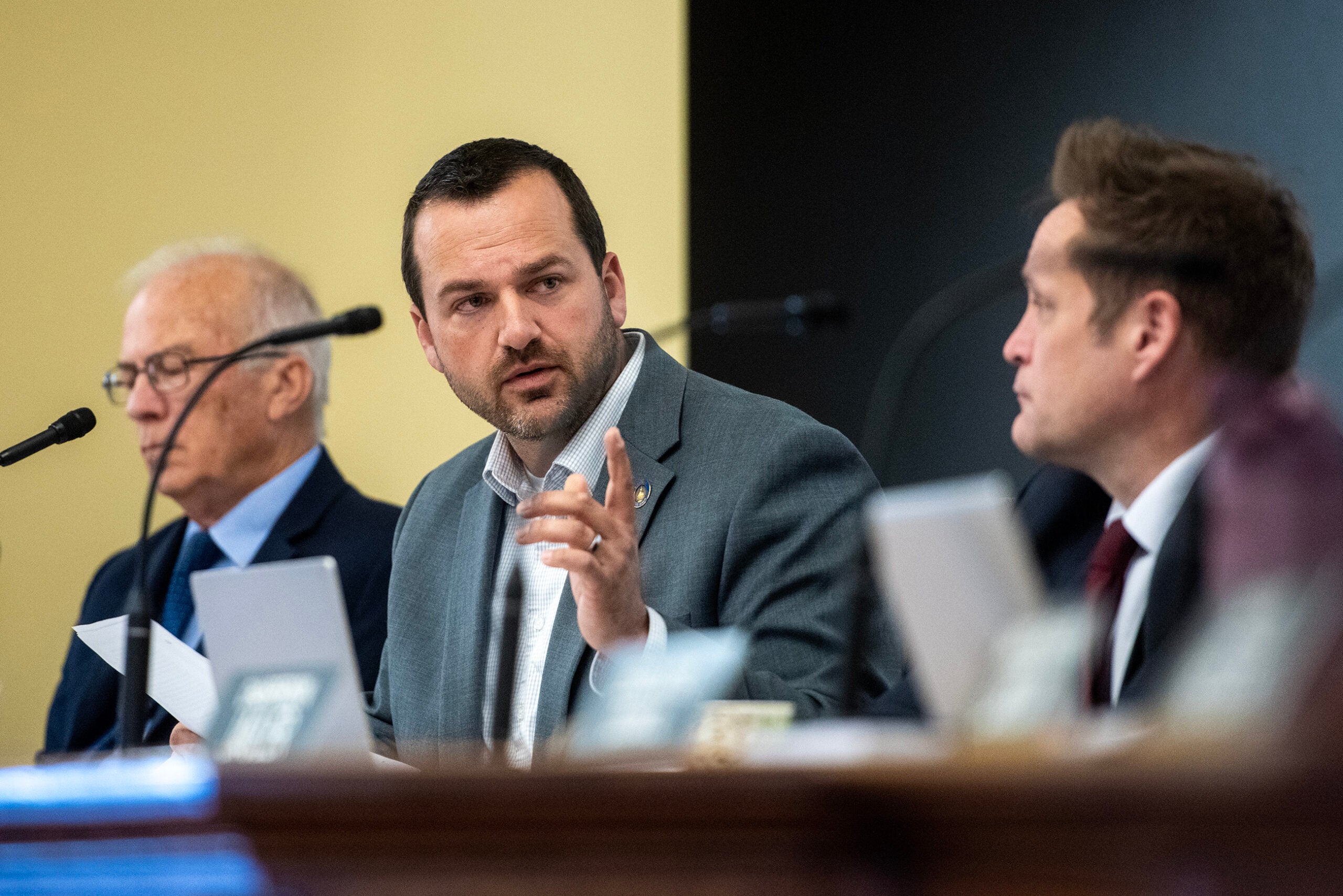
Sen. Romaine Quinn, R-Birchwood, speaks during an informational hearing on Tuesday, Nov. 4, 2025, at the Wisconsin State Capitol in Madison, Wis. Angela Major/WPR
At the Les Voigt Fish Hatchery, the juvenile fish, or fry, are fed eight times a day. Over the last two decades, fish food costs have skyrocketed at least 229 percent.
A 50-pound bag “used to be about $16,” Miller said. “Now, it’s about $55.”
Lobner said the agency has been holding things together with “shoe strings and duct tape.”
Agencies can make do for a little while with flat budgets, said Adena Rissman, professor of human dimensions of ecosystem management at the University of Wisconsin-Madison.
“But after decades of cuts and budgets not keeping up with inflation, they just end up doing less,” Rissman said. “This means less of what hunters, anglers and all people outdoors want.”
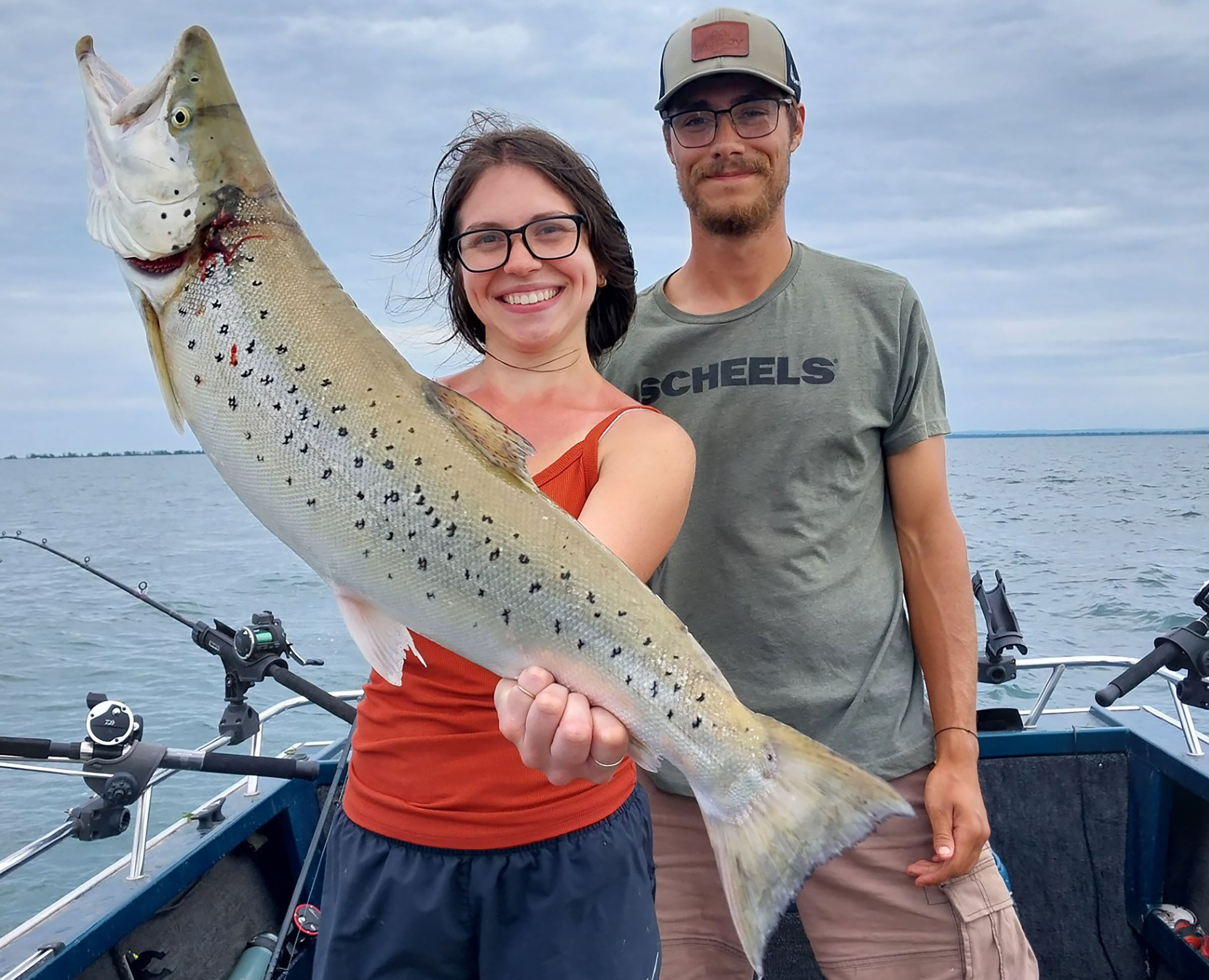
Rachel Niemi, along with Tyler Miller, shows off a brown trout reared at either the Brule or Les Voigt fish hatcheries. Darren Miller/Wisconsin DNR
Why did the DNR need an additional $4M in spending authority?
The DNR sought authority to spend $4 million after learning on Feb. 12 that it would receive around $1.5 million less than anticipated in federal funding under the Sport Fish Restoration Act. At the same time, the agency faced higher-than-expected staffing costs due to wage adjustments.
Lobner and agency officials said they spent six weeks scrambling to review hundreds of activities to identify where to make cuts and justify the spending request.
When lawmakers approved the agency’s request, they directed the DNR to continue operations at the Brule hatchery and spend the money on fish stocking. Rep. Mark Born, R-Beaver Dam, co-chairs the Legislature’s budget-writing committee.
“The DNR needs to do its job, use the authority that was approved and focus on carrying out its core fish and wildlife responsibilities instead of pointing fingers over agency-made deadlines and management decisions,” Born said.
Quinn said both Brule and Osceola should remain in operation, and added that the state should contract with private hatcheries if needed.
Lobner said it is not that simple.
Private hatcheries typically don’t collect more eggs than they can sell. Darren Burant, owner of Central Wisconsin Fish Farm, said he’s under contract to sell 10,000 walleyes to the DNR this fall. He said it’s possible he may have up to 40,000 extra fish depending on their survival and demand.
“If the DNR wanted to buy them, I would gladly sell them to the DNR,” Burant said.
Even if fish are available, the DNR’s Fisheries Management Bureau Director Justine Hasz said not all hatcheries may have fish with the right genetics. And even if fish with the right genetics were available on the private market, DNR facilities are short on food to feed walleyes.
“There’s only so many fish we can produce at this point,” Hasz said.
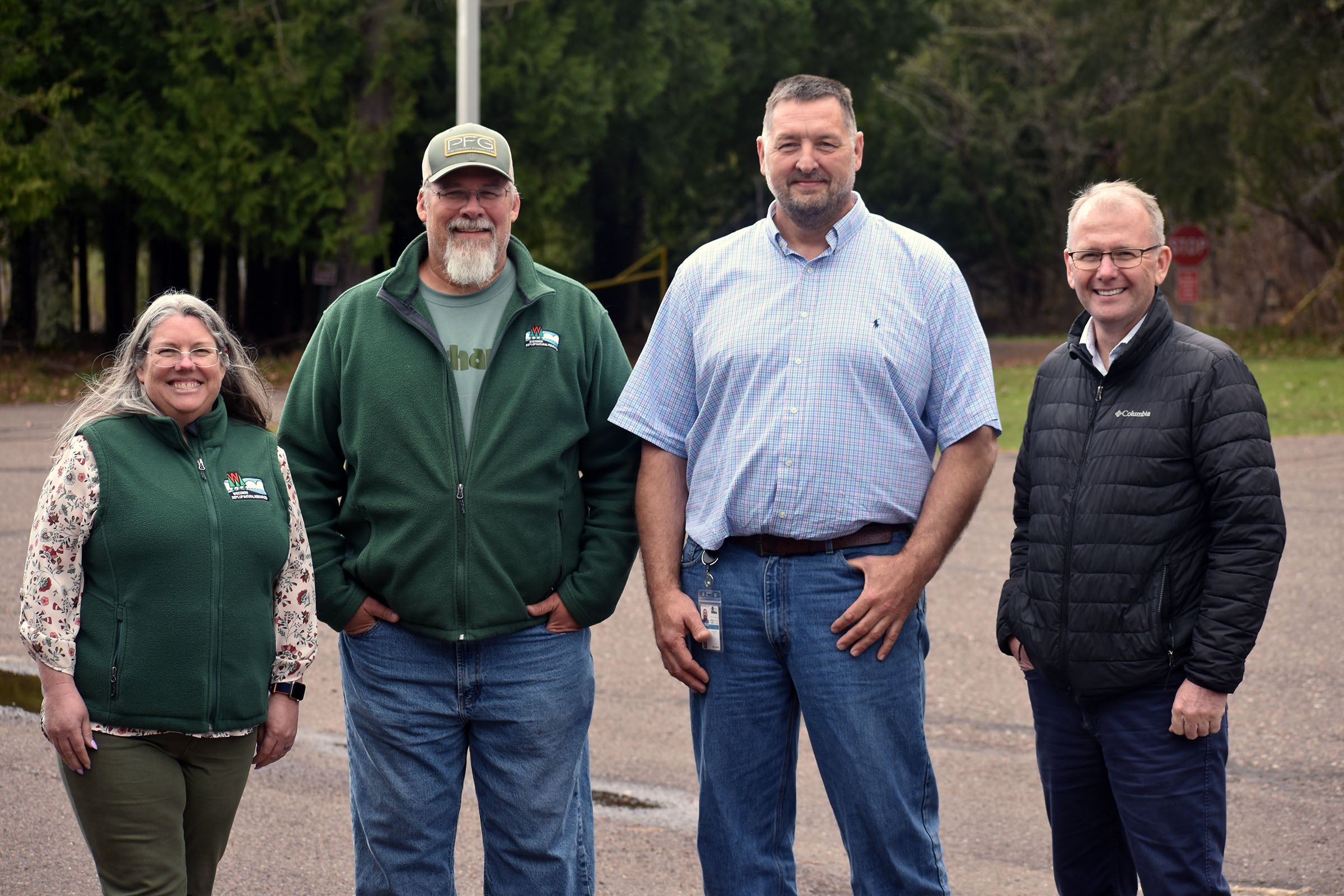
Justine Hasz, Darren Miller, David Giehtbrock and Eric Lobner with the Wisconsin Department of Natural Resources stand outside the Les Voigt State Fish Hatchery in Bayfield. Danielle Kaeding/WPR
Hasz said they aim to produce as many fish as possible, but that takes staff. When approving spending authority, lawmakers said the agency couldn’t use the money for hiring.
Hasz said the agency is authorized to have 203 fisheries positions, but they currently have around 185 staff. Regulators say the agency has lost around 50 positions over the last two decades.
At Osceola, the hatchery lacks any permanent staff. When that’s the case, Hasz said the DNR typically backfills positions with limited-term employees. But the agency has kept positions vacant longer amid the ongoing shortfall. Last year, Gov. Tony Evers requested nearly $2.5 million for those positions, but the Legislature stripped that provision from the budget.
As of July 1, neither Brule nor Osceola will have any employees aside from supervisors overseeing the hatcheries. Lobner said the agency intends to keep the facilities closed this year due to staffing shortages and overall costs, including maintenance.
Quinn noted he had previously sought $2.5 million in bonding authority under the Knowles-Nelson Stewardship Program for upgrades to the Brule and Les Voigt fish hatcheries under the 2023-25 state budget. Gov. Tony Evers vetoed the funds. In his veto message, Evers objected to earmarks for specific projects and highlighted the finance committee’s use of an anonymous objection process to block conservation projects, saying the veto would allow funds to be used to protect and preserve the state’s natural resources.
Supporters of fish and wildlife activities divided over how to fund them
Conservation advocates and lawmakers agree cuts should have never happened, but they disagree on long-term solutions for funding the account.
Berg with the Friends of Wisconsin Fisheries said most anglers support an increase in the state’s hunting and fishing license fees.
“No business can survive without proper budget planning,” Berg said.
At spring hearings by the Conservation Congress, a citizens group that advises the DNR, nearly 69 percent of voters said they support a 25 percent fee increase. In recent years, Wisconsin Republicans have raised license fees for out-of-state residents, but they rejected fee increases for Wisconsinites under the current budget.
Quinn said lawmakers were waiting on the results of an audit ordered to examine the DNR’s handling of the account’s funds. The audit released in August by the nonpartisan Legislative Audit Bureau found the DNR had spent money appropriately under the account.
The audit made nine recommendations for improvement, including establishment of written policies and financial reporting. The DNR said it implemented the audit’s recommendations.
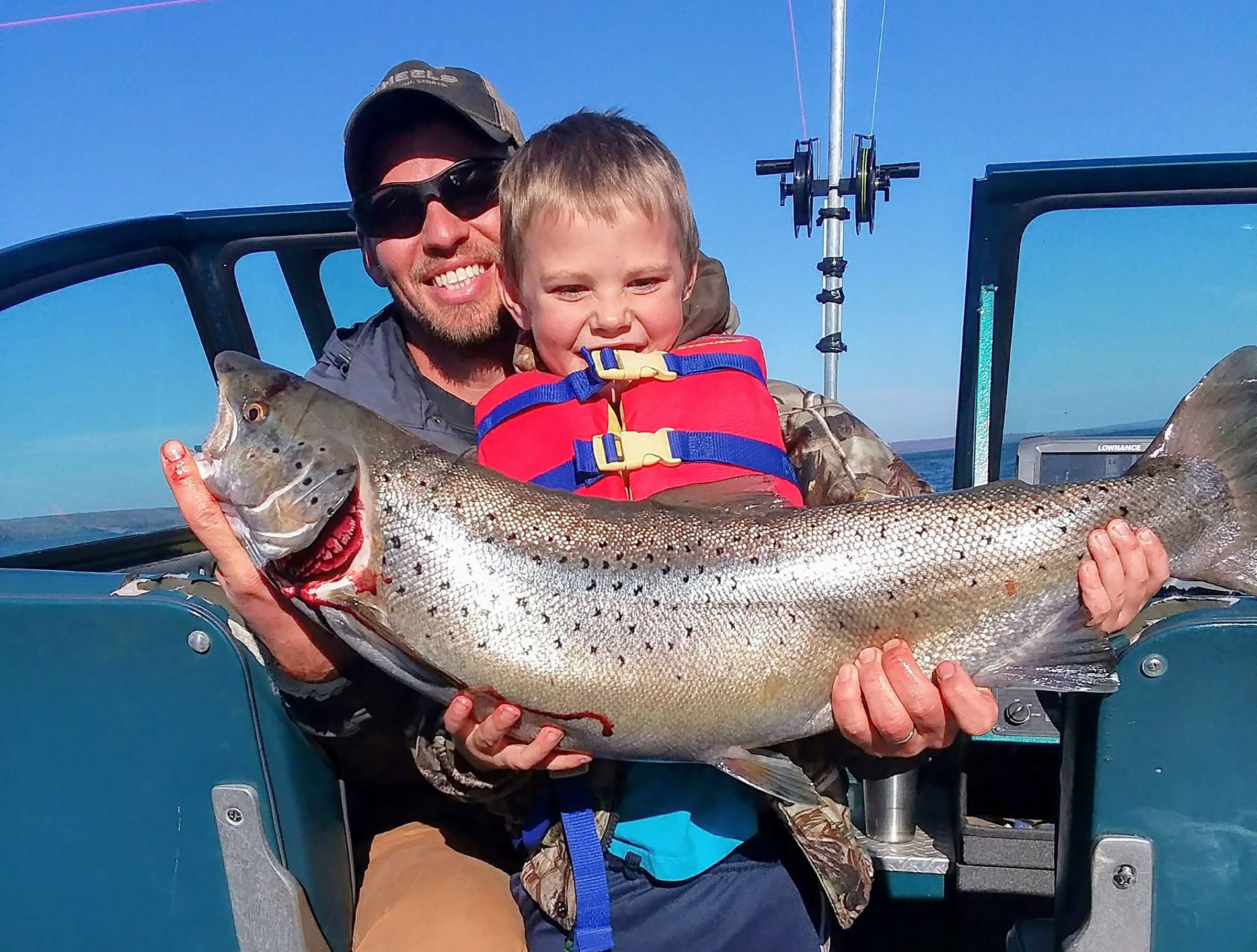
Andrew O’Krueg and his son Nathan hold a brown trout reared at the Brule or Les Voigt fish hatcheries. Darren Miller/Wisconsin DNR
UW-Madison’s Rissman said Wisconsin is not alone in struggling to fund agencies conducting fish and wildlife management.
“Partly because this user-pays model has struggled to keep up with costs across the country, and so a lot of other states have explored some creative solutions,” Rissman said.
Some states have used a sales tax to fund similar work. Voters in Missouri and Minnesota passed constitutional amendments to direct a portion of state sales tax to fund fish and wildlife management among other programs. The DNR’s Lobner said a sales tax of one-eighth of 1 percent similar to Missouri’s could generate up to $200 million based on Wisconsin sales tax revenues last year.
For Berg, he fears less brown trout stocked into Lake Superior may result in more pressure on other fish species or anglers heading elsewhere to fish. Wisconsin has consistently ranked among the top 10 states as a destination for anglers.
“People come here from all over the world, not just to see this, but to experience it firsthand,” Berg said. “I want them to have fish to be able to catch.”
After political standoff, Wisconsin closed fish hatcheries. Anglers say it’s a huge mistake. was originally published by Wisconsin Public Radio.
If you think stories like this are important, become a member of Urban Milwaukee and help support real, independent journalism. Plus you get some cool added benefits.


















People engaged in fishing would be glad to pay for increased license fees to help fund the DNR. Like most all other programs except for the $700,000,000 million dollar handout to religious schools under the school choice program, Republicans consistently do not fund or cut funding for recreation, public schools, roads, and colleges. Republicans have a system where legislation is not supported if two members of the legislative caucus in either other does not support the bill.
The Federal government has all kinds of money to blow on Israel’s war on Iran as well as an out of scale ballroom but chooses cuts to sport fishing support among many things people actually want. At the state level, the Republican legislature has a similar bias against things people want. As was mentioned, Scott Walker was the initiator of many cuts to the DNR.
Good reporting.
Blame Trump you Republican hypocrites.
Cut millions in funding.
Republicans wastes of oxygen and lazy self serving drifters. Everyone of them.
Thanks Urban Milw and WPR for the news and updates. The part about the “Finance Committee use of an anonymous objection process” lead to a Supreme Court decision stopping the use of that process in committees. Which led to the Republican’s majority in the Finance Committee that was using that process being outed and unhappy about it and stopped the funding of Knowles-Nelson Stewardship Program for the next decade.. Knowles-Nelson funds have been used in every county in the state and is extremely popular. 80 per cent support for funding it at the WCC spring hearings. Remember when you vote who the stop the funding candidates are, Tiffany et al.