Can Democrats Win Control of Wisconsin Senate?
'Our backs are against the wall,' says Republican leader. $4 million from 3 donors should help GOP.

Senate Chambers in the Wisconsin State Capitol. (Photo by Baylor Spears/Wisconsin Examiner)
Out of the 98 state legislative bodies across the U.S., the Wisconsin Senate has been deemed the “most flippable” by Wisconsin Democrats. Still, Sen. Patrick Testin (R-Stevens Point) told the Wisconsin Examiner that he sees a definite path for Republicans to maintain their majority.
“We have our chessboard fully laid out. I don’t think there’s any question that, you know, this cycle, it seems as though our backs are against the wall,” Testin said.
Testin is leading the Committee to Elect a Republican Senate (CERS), which is the campaign arm of the Senate Republican caucus, as Senate Majority Leader Devin LeMahieu (R-Oostburg) decided to retire this year.
Senate Republicans currently have an 18-seat majority, meaning that they only have room to lose one seat this year. Four seats have been identified by Democrats and Republicans as essential to determining control:
- Senate District 5: covering Wauwatosa and other parts of Milwaukee County. State Rep. Robyn Vining (D-Wauwatosa) and Republican Mike Roberts are vying for the seat that is currently represented by Sen. Rob Hutton, who opted not to run for reelection.
- Senate District 17: A southwest district covering Iowa, Lafayette, Green, Crawford and Grant counties as well as parts of Dane County. Sen. Howard Marklein (R-Spring Green) faces a challenge from Rep. Jenna Jacobson (D-Oregon).
- Senate District 21: Incumbent Sen. Van Wanggaard (R-Racine) is retiring this year, leaving open the southeast district that includes part of Racine and Milwaukee Counties. Democrat Trevor Jung, the former Racine transit and mobility director, is running against Republican businessman Jim Croft.
- Senate District 31: Sen Jeff Smith (D-Brunswick) is seeking another term in office and faces a challenge from Republican Michele Magadance Skinner, an Eau Claire County board member. The district covers Eau Claire County and parts of Dunn, Trempealeau and Chippewa counties.
Senate Minority Leader Dianne Hesselbein (D-Middleton) expressed confidence in her party’s effort to take over the chamber during a press conference after the August primary, saying that Senate Democrats flipped four seats in 2024 and her caucus expects to do the same this year. “I think we’re going to be able to do it with David Crowley leading the way,” she said.
There are a few factors that have contributed to Democrats’ confidence.
The midterm election environment is expected to be friendlier to Democrats with a Republican in the White House, according to the National Conference of State Legislatures. President Donald Trump’s popularity has steadily declined in Wisconsin since he took office for his second term, according to Marquette Law School polling.
A recent Marquette poll found that 46% of Wisconsin voters said they would vote for Democrats in legislative races, while 42% said they’d vote for Republicans. The survey did not deliver detailed information on specific districts.
Democrats also got to work early, immediately after the state budget was finished last year, hoping to take advantage of new, more favorable voting maps.
“We had these maps early,” Hesselbein said. As a result, campaigns got started sooner than they had in past years.
Senate Democrats are targeting two districts that went for Trump in 2024. Democrat Charly Ray and Republican Erik Severson are competing in Senate District 25, an open district that encompasses Douglas, Bayfield, Ashland, Washburn, Iron, Sawyer, Polk and Burnett Counties. In Senate District 29, which includes Marathon, Wood, Portage and Waupaca Counties, Sen. Cory Tomczyk (R-Mosinee), who was elected to the seat in 2022, is facing a challenge from Democrat Gillian Battino, a retired radiologist.
Republicans didn’t know until this year how many of their incumbents would run for reelection — one-third of the caucus ended up deciding to retire including Sen. Van Wanggaard in SD 21, Sen. Rob Hutton in SD 5 and Sen. Jesse James, who had previously planned to challenge Smith.
Testin said the environment around the races “means we have to work overtime between now and November to help our candidates get across the finish line and do what we can to contrast our candidates versus the Democrats in the key races.”
Testin said this may be the year that not having incumbents in a seat could turn into an advantage, noting that there’s been “sort of an incumbency malaise that we’ve seen in the electorate” and Republican Senate candidates are being encouraged to stay “hyper focused on local and state issues”, including affordability issues and lowering property taxes, and to avoid “getting wrapped into the national narratives of what’s happening out in D.C.” He said their candidates are relying on a good “ground game” to protect their seats and candidates have strict metrics for doorknocking and are on track to get to 15,000 to 20,000 doors in the key seats.
“So far our candidates have done exactly that,” Testin said.
“We have our budget set for our key races,” Testin added, noting that it could be anywhere from $1.5 million to $2.5 million allocated to the competitive seats. “Based on what we’re able to raise, we are going to make adjustments on the fly as needed, and as things sort of evolve on the ground and things change as they always do in campaigns, you have to be nimble and flexible.”
According to July reports, the Committee to Elect a Republican Senate has raised nearly $5 million this year and had $5.3 million on hand. The bulk of that fundraising came from billionaires Diane Hendricks and Elizabeth Uihlein, who each gave $2 million.
Testin said he is proud that the Republicans have been able to outraise Democrats so far and they are running ahead of where they were in 2024 when it comes to fundraising, but he is expecting money to flood into the state now that the primary is over.
“These races are expensive. It costs a lot of money to get our candidates’ message out there, to get them up on air to do digital ads, radio, direct mail, and that’s just the sad reality,” Testin said.
When it come to the Uihleins and Hendricks, he said they’ve been strong supporters of the caucus and “despite the criticism leveled against those individuals, what never gets a light shined onto it is the money that comes in from states like Illinois, New York, California, billionaires and multi-and mega-millionaires from the liberal elite who have flooded Democrat coffers for years.”
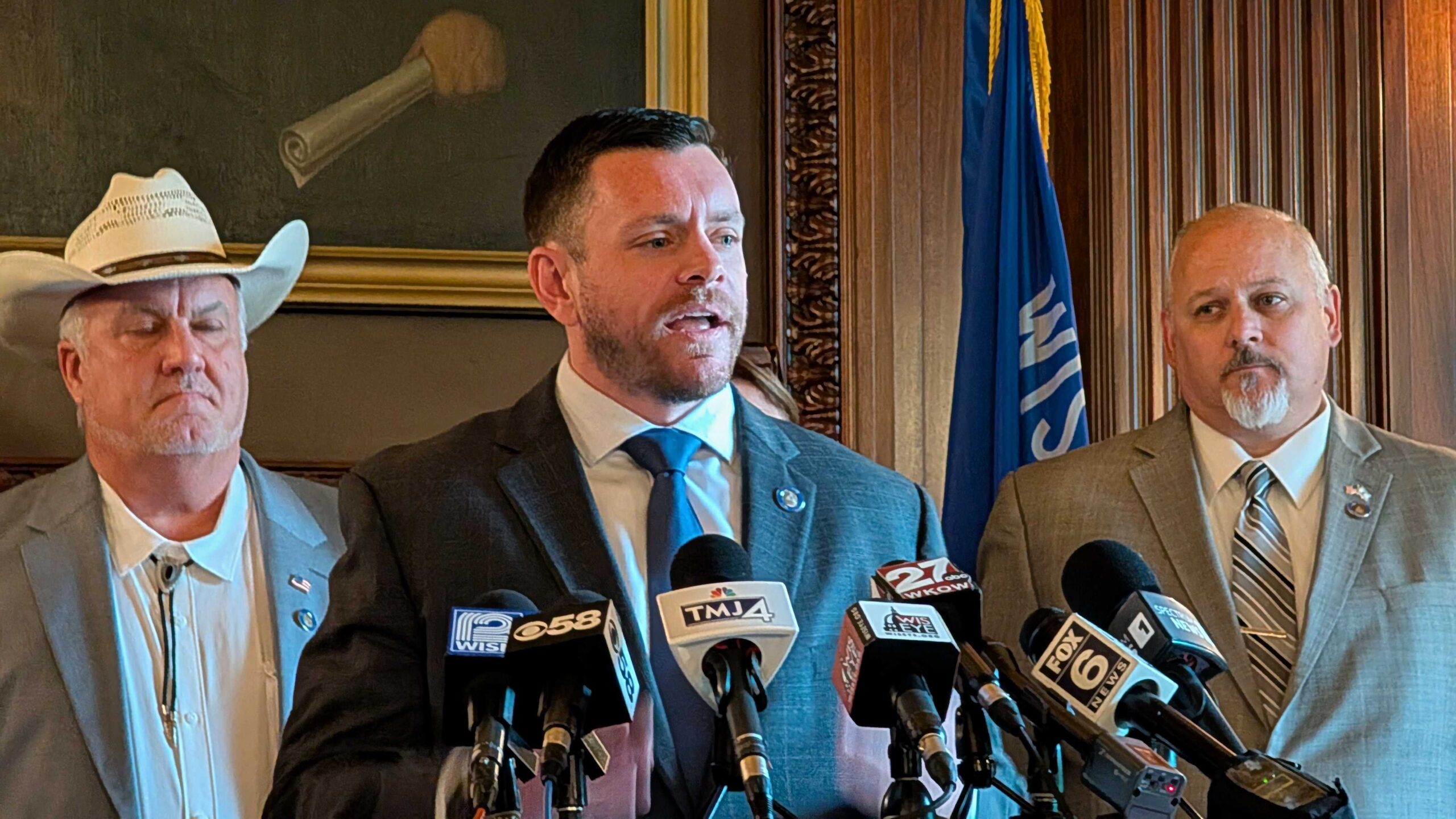
Sen. Patrick Testin (R-Stevens Point) speaks at a Republican news conference before a Senate floor session in June 2025. (Photo by Baylor Spears/Wisconsin Examiner)
The Republican Senate committee is also working closely with its Assembly counterpart, which is being led by Assembly Majority Leader Tyler August: “I often joke that — we speak on the phone more often than we speak to anyone else,” Testin said.
“This is what’s sort of unique, as opposed to previous cycles, where we have historically sort of operated in our own silos,” Testin said. “We are working hand in hand to ensure that there is no daylight between us,” he said, including “coordinating as best that we can with their candidates in the key seats that overlap ours.”
Senate Democrats’ recently filed a lawsuit against Skinner, who is running in Eau Claire, over questions related to her residency, attempting to get her removed from the ballot in November.
The effort was blocked by a Dane County judge this week. State Senate Democratic Committee Executive Director Andrew Whitley said in a statement that questions still remained, but the issue would be left up to voters.
Testin said ahead of the hearing that the effort smelled of “desperation.”
“You would think if they would spend more time propping up their own candidate and his record and track record, that they’d be able to highlight that. But they haven’t been able to,” Testin said. “From our standpoint, we are in the driver’s seat between now and Nov. 3.”
The Wisconsin governor’s race is expected to have some influence on downballot races. Testin said Republicans were “salivating” at the prospect of running against State Rep. Francesca Hong, a democratic socialist, who narrowly lost the primary to Milwaukee County Executive David Crowley. Her loss, Testin said, makes the job of Republicans a little bit harder.
Crowley faces Republican U.S. Rep. Tom Tiffany in November.
“Full disclosure, I mean, I consider David Crowley a friend of mine,” Testin said, adding that they were freshmen in the state Legislature at the same time. “Obviously, I don’t agree with him politically.”
Testin said Crowley will have to grapple with controversies during his tenure as Milwaukee county executive, including a lapse in an employee health insurance contract and projected future budget deficits. He also mentioned comments that Crowley made minimizing his differences from Hong.
“I think that’s going to be a real problem for them because the Democrats in these key seats are going to have to answer for some of those policy positions,” Testin said, citing “some of these radical policies that have been pushed by the DSA.”
Testin said a potential Crowley governorship is part of the reason it’s crucial that Republicans hang onto the state Senate.
“It’s so crucial and important that, at the very least, if Tom Tiffany were to fall short in his bid for governor — which I don’t think he will — that at the very least, that we have a backstop in the state Senate as well as the state Assembly, to have a counterbalance to any of the proposals that would come out that administration,” Testin said.
Republicans on defense as Democrats seek control of the Wisconsin Senate was originally published by Wisconsin Examiner.
Political Contributions Tracker
Displaying political contributions between people mentioned in this story. Learn more.