

Can A Bigger Superior Refinery Lower Gas Prices? Economists Say No
Tiffany pitches expansion to cut Middle East reliance as Iran war drives up fuel costs statewide.
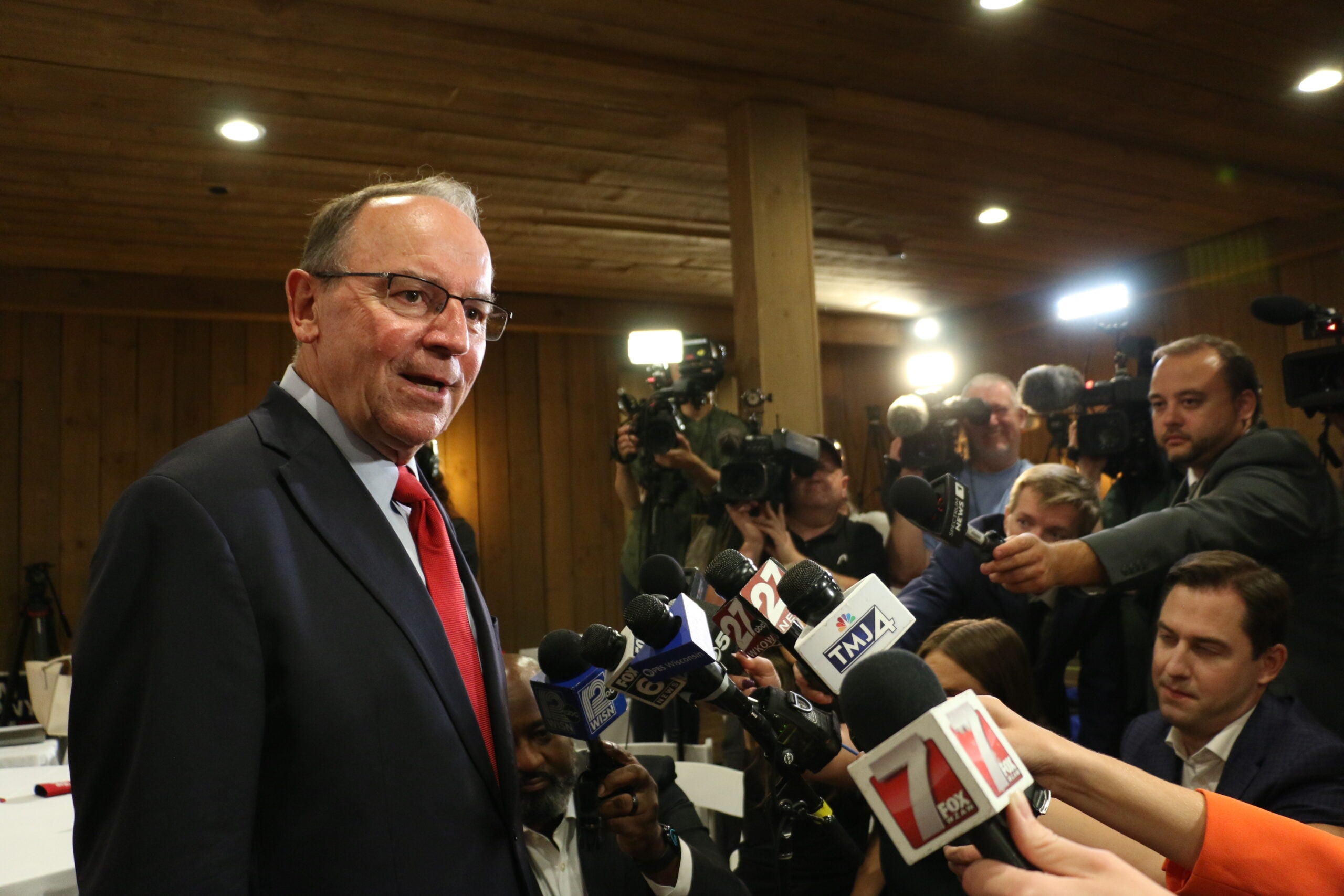
Republican U.S. Rep. Tom Tiffany addresses reporters at the Rustic Manor 1848 wedding barn in Hartford Tuesday, Aug. 11, 2026, after winning the GOP primary for governor. Rich Kremer/WPR
U.S. Rep. Tom Tiffany is encouraging the expansion of Wisconsin’s only oil refinery as a way to reduce reliance on the Middle East. But energy experts say that would have little effect on bringing down local gas prices.
In an interview with the Milwaukee Journal Sentinel editorial board, Tiffany called the Canadian-owned Cenovus Energy refinery in Superior a great asset that has room for expansion.
“I think we should be looking at trying to encourage them to expand, produce more gasoline and diesel fuel here in Wisconsin, in America, so we’re not in this position where we’re dependent on the Middle East,” said Tiffany, R-Minocqua.Wisconsin produces none of its own fossil fuels, importing oil and gas into the state. The crude oil delivered to the Superior oil refinery comes from Canada and North Dakota through Enbridge’s mainline pipeline system.
Federal data shows the refinery has capacity to produce nearly 50,000 barrels per day of heavy fuel oils, asphalt and liquified petroleum gas, and it historically produced around 17,500 barrels per day of gasoline.
Corbett Grainger, an energy economist at the University of Wisconsin-Madison, noted Wisconsin’s gasoline consumption in 2024 was nearly 163,000 barrels per day or roughly 6.8 million gallons daily, according to latest data from the Energy Information Administration.
“If we’re thinking of expanding capacity at that refinery in Superior, that could affect where we’re producing some of the fuel that we’re consuming here, but it certainly wouldn’t eliminate our exposure to global oil prices,” Grainger said.
The U.S. war with Iran is the major factor driving up oil and gas prices due to ongoing attacks in the Strait of Hormuz, which handles one-fifth of the world’s oil and gas. When conflicts arise in the Middle East, global and U.S. crude oil prices rise and gas prices soon follow.
Greg Nemet, energy expert and public affairs professor at UW-Madison, said oil is a global market.
“We’re linked to the rest of the world, whether our refinery is the size it is now or bigger in the future,” Nemet said. “The prices that we pay for gasoline, for diesel, are affected by world events, and there’s no way getting around that as long as we’re continuing to use those products. Really, the only way to get around it is to use less of them.”
The campaign for Tiffany’s Democratic opponent for governor, Milwaukee County Executive David Crowley, didn’t respond to a request for comment.
Crowley has criticized Tiffany for voting five times against U.S. House resolutions directing President Donald Trump to end the use of U.S. forces against Iran. Tiffany told the Journal Sentinel that Trump has authority to declare war, but would need approval from Congress to deploy troops on the ground. He told reporters last month that the U.S. should exit Iran. Both candidates support a repeal of a state law that sets minimum gas prices.
A Cenovus spokesperson didn’t respond to questions about its capacity or whether it may expand and referred questions about domestic refining capacity to the American Fuel and Petrochemical Manufacturers. An AFPM spokesperson said high fuel prices reflect a global supply crunch, not a lack of U.S. fuel production.
“We produce more fuel in the United States than we consume, and our refineries are running all-out to keep Americans supplied and the global economy moving despite major disruptions and actual fuel shortages in other parts of the world,” an AFPM spokesperson said.
Last year, oil production in the U.S. surged to a new annual record of 13.6 million barrels per day. But petroleum exports have also grown substantially in the last decade after Congress lifted a ban on crude oil exports and global demand has increased.
Most of the crude oil produced in the nation is refined at U.S. facilities along with imported oil, according to the Energy Information Administration. But some refineries are set up to refine heavier crude oils from Canada and elsewhere.
“I do think energy security is a legitimate concern that we should discuss, but I think we need to be careful about what refining capacity on its own, especially thinking about one refinery in Wisconsin, can actually accomplish,” Grainger said.
Tiffany floats expansion of Wisconsin’s oil refinery to reduce reliance on Middle East was originally published by Wisconsin Public Radio.
Political Contributions Tracker
Displaying political contributions between people mentioned in this story. Learn more.




















Tiffany needs to read the US Constitution – Article I, Section 8 clearly states that Congress has the power to declare war, not the President.