
Milwaukee Earns LEED Gold For Citywide Sustainability Efforts
National certification validates local climate work and offers a new tool to lure visitors and business.
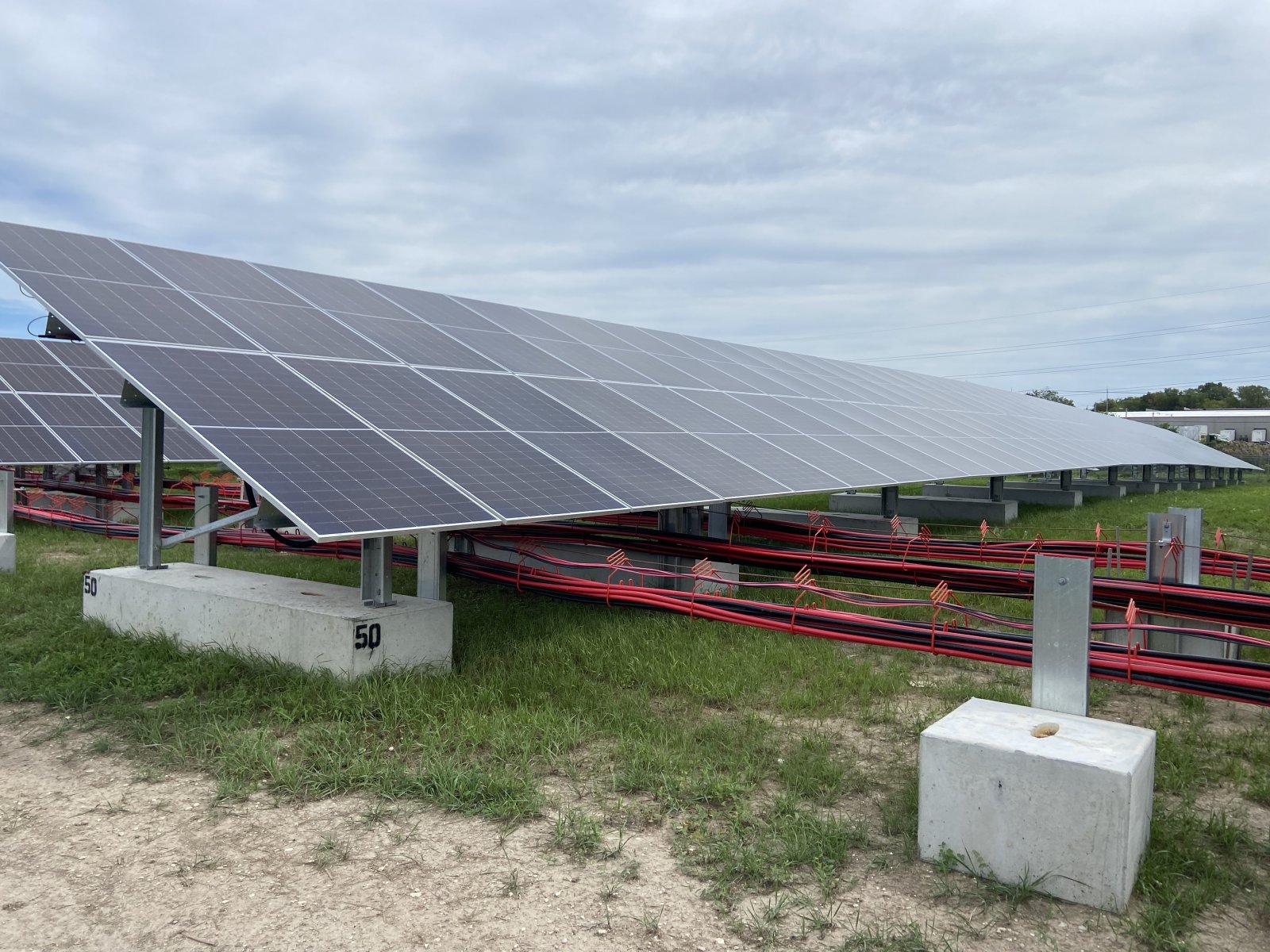
4.6-megawatt solar panel array on former city landfill. Photo taken Sept. 10, 2026 by Graham Kilmer.
Milwaukee is going for gold. And this time, it’s not the Brewers.
The city has earned LEED Gold certification from the U.S. Green Building Council (USGBC), a designation that recognizes Milwaukee’s environmental sustainability efforts and could provide a new tool to attract tourists, conventions and businesses.
The designation, formally announced Wednesday, Oct. 21, is the second-highest certification offered by the organization, which is best known for evaluating the environmental performance of individual buildings.
But Milwaukee’s certification applies to the entire city, not just City Hall or other municipal buildings. It evaluates everything from water quality and transportation to energy efficiency and quality of life.
And now city officials want to capitalize on the recognition.
“I do think some of the value out of having this is for tourism,” said Erick Shambarger, director of the city’s Environmental Collaboration Office, in an interview with Urban Milwaukee. “We’re going to be working with VISIT Milwaukee to get the word out about this as well.”
Shambarger said the independent certification could be particularly useful in attracting conferences and conventions for organizations that prioritize environmental sustainability.
“I do think this kind of thing can help with attracting conferences, especially conferences that care about these sorts of things,” he said. “And there are plenty of those.”
It’s also a way for Milwaukee to demonstrate that its environmental initiatives are producing measurable results, rather than relying solely on the city’s own claims.
“I think it helps validate the work that we’re doing to have a third party come in and say, ‘Yeah, we rank you against other cities, and this is how you do,'” said Shambarger.
Mayor Cavalier Johnson made a similar case during a Wednesday press conference at the 809 Broadway building, which features a green roof.
“We want to make this city attractive so that people from around the country want to visit and even move here permanently,” said Johnson in prepared remarks. “We are competing on a national and even a global scale.”
The mayor said environmental sustainability and economic development go hand in hand.
“Our eco-friendly strategies are making Milwaukee a healthier place to live and a more attractive place to visit and do business,” he said.
Beyond Green Buildings
LEED, which stands for Leadership in Energy and Environmental Design, has long been the leading certification system for environmentally sustainable buildings.
Milwaukee already has numerous LEED-certified structures, including the Baird Center, Fiserv Forum and Northwestern Mutual Tower and Commons. The Brewery District, the redevelopment of the former Pabst brewery complex, also earned LEED Platinum certification.
But the USGBC has expanded its rating system to encompass entire cities and communities.
The LEED for Cities program evaluates environmental performance and government policies across a range of categories, including natural systems, energy, water, transportation, waste and quality of life.
A city must earn at least 60 points to achieve Gold status, while 80 points are required for Platinum. Milwaukee earned 65.
Milwaukee’s certification scorecard shows particularly strong results in water efficiency, transportation and land use, and quality of life.
The certification is not tied directly to the city’s Climate and Equity Plan, which was adopted in 2023, but Shambarger said the initiatives outlined in that plan contributed to Milwaukee’s score.
The effort also went well beyond the Environmental Collaboration Office.
City employees compiled data and documented initiatives undertaken by Milwaukee Water Works, the Department of Public Works, the Milwaukee Metropolitan Sewerage District and other agencies. Milwaukee County’s transportation efforts also factored into the review.
Shambarger credited ECO staff member Pam Ritger de la Rosa and an intern with doing much of the work to assemble the application.
“Overall, we’re pretty proud of where we are,” he said.
The designation comes despite longstanding fiscal challenges for local governments.
“Gold is really good, particularly as it relates to the city’s fiscal position,” said Shambarger. “We’ve been getting squeezed from all angles. The county has, the city has, for many, many years. And so to be able to pull off this ranking despite the fiscal constraints, I think is something to be very proud of.”
Where Milwaukee Could Improve
While the city has achieved Gold status, there is still room to improve.
Shambarger said Milwaukee missed out on some points because its policies didn’t precisely match the certification program’s criteria.
For example, the Common Council adopted an energy benchmarking ordinance that requires larger buildings to report their energy consumption. But the ordinance applies to buildings of 50,000 square feet or larger, a threshold that Shambarger said was too high to qualify for certain points.
“There are some points that we left on the table just for kind of nitpicky reasons,” he said.
Milwaukee also missed opportunities to earn innovation points, despite Shambarger’s belief that the city has implemented innovative environmental programs.
And its urban form presents some challenges.
Shambarger said the rating system may favor larger, denser cities with more robust public transportation networks, such as Boston.
“I think we’re a little car-centric still in Milwaukee,” he said.
The Johnson administration has prioritized improving transportation safety, bicycle infrastructure and other alternatives to driving, but Milwaukee still lacks some of the advantages of denser cities.
For now, however, the city isn’t launching a campaign to earn Platinum.
“I think right now it’s to display it proudly,” said Shambarger.
More Renewable Energy Projects Planned
The certification comes as Milwaukee continues to expand its renewable energy portfolio.
In September, Johnson and Shambarger celebrated the completion of a 6.8-megawatt solar installation on a city-owned landfill near Milwaukee Mitchell International Airport.
The project, the largest solar installation in city government history, turns otherwise undevelopable land into an electricity source for municipal operations.
According to Johnson, the city’s investments in renewable energy now allow 80 municipal buildings to receive the equivalent of 100% of their electricity consumption from local clean energy projects.
The city’s vehicle fleet includes 152 hybrid vehicles and 57 fully electric vehicles, according to the mayor’s prepared remarks.
Other ongoing initiatives include electric vehicle charging infrastructure, building energy efficiency programs, green infrastructure to manage stormwater and efforts to restore the city’s waterways.
Shambarger said ECO continues to pursue additional solar installations and is working with the Milwaukee Public Library on sustainable building features, including at the planned Midtown Center library project.
The city is also working through complications with federal grants awarded to support the development of public electric vehicle charging infrastructure.
“We’re going to keep on keeping on here and keep looking for more big, particularly big renewable energy projects,” he said.
What Did Certification Cost?
Unlike the LEED certification process for major construction projects, Milwaukee’s citywide application did not come with a substantial consulting bill.
Shambarger said the city paid a few thousand dollars for USGBC membership and employed an intern to help collect data, organize spreadsheets and document the city’s programs.
It did not hire an outside consultant to manage the certification effort.
And while the Gold designation does not itself create new environmental programs, it gives Milwaukee a third-party assessment of its existing efforts, a benchmark for future improvements and a new credential to promote.
Shambarger said the recognition belongs to the broader community, not just city government.
“I think it’s something for the whole city to be proud of.”
If you think stories like this are important, become a member of Urban Milwaukee and help support real, independent journalism. Plus you get some cool added benefits.