

The Economics of the Minimum Wage
Wisconsin's minimum wage is far below neighboring states. Should it join the crowd?
McDonald’s at 191 W. Layton Ave.. Photo by Jeramey Jannene.
Is raising the minimum wage an effective tool to address affordability?
The graph below compares Wisconsin’s minimum wage to that of three of its neighboring states — Minnesota, Michigan and Illinois. As the graph shows, Illinois’ minimum wage is more than double that of Wisconsin. Michigan’s hourly wage is 89% greater than Wisconsin’s, and Minnesota’s is 57% greater.
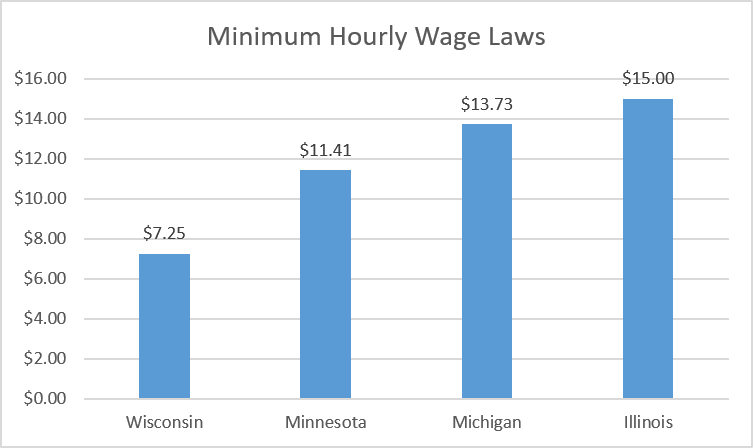
Minimum Hourly Wage Laws
The next graph plots the nominal, or official, level of the four states’ minimum wage since 1990. The nominal, or official, level of Wisconsin’s minimum wage is shown with the yellow line, that of Minnesota with the green line, Michigan’s with the blue line and Illinois’ with the red line.
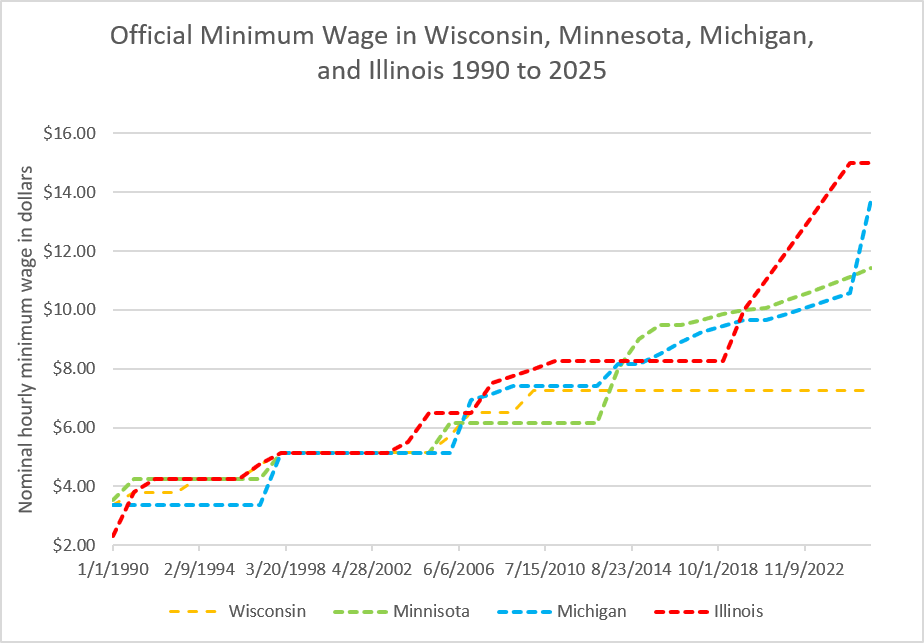
Official Minimum Wage in Wisconsin, Minnesota, Michigan, and Illinois 1990 to 2025
Starting in 2010, the federal government set its minimum wage at $7.25 per hour and has kept it there to the present. Wisconsin opted to set its minimum wage at the federal wage level, as shown on the graph below.
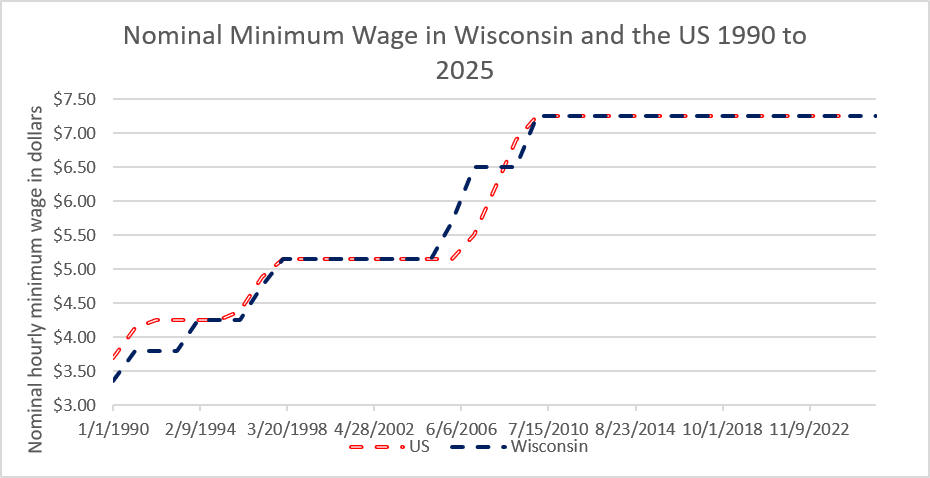
Nominal Minimum Wage in Wisconsin and the US 1990 to 2025
With inflation, minimum wages, if left unchanged, lose their purchasing power over time, as shown on the next graph, unless they are periodically increased. Wisconsin’s nominal minimum wage of $7.25 (shown in orange) illustrates the fate of minimum wages whose values were allowed to decline due to inflation.
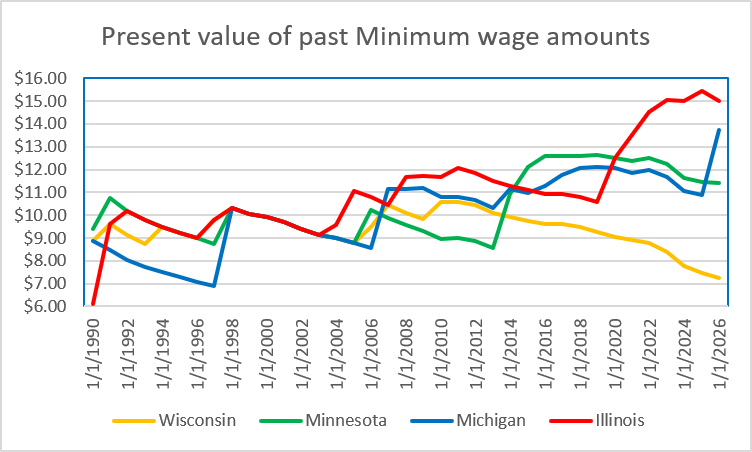
Present value of past Minimum wage amounts
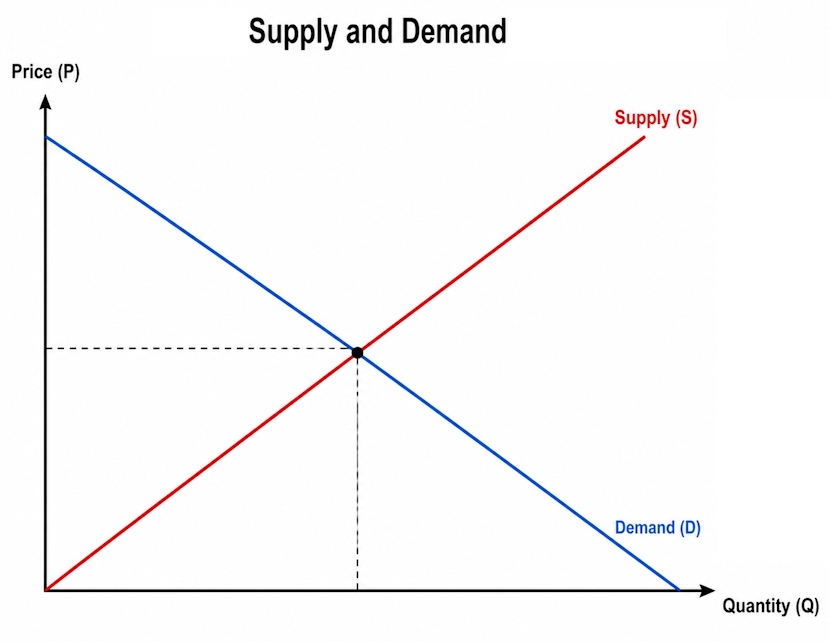
The standard supply-and-demand model is shown in the next graph. By custom, price — in this case the hourly wage — is shown on the vertical axis. The quantity of labor is shown on the horizontal axis. The upward-sloping line, marked S, shows the quantity of labor available at a given wage: The higher a job’s wage, the more people will be attracted to that job. The downward-sloping line, marked D, shows the demand for labor: The higher the wage, the fewer people firms will want to hire.
Where the two lines cross is the equilibrium point, the price point at which the demand for labor exactly equals the quantity available at that wage.
The effect of a minimum wage in this model is to move the price of labor above the equilibrium point, theoretically increasing unemployment. The increase in unemployment has two causes. The first is that a higher wage attracts more workers to the job. The second is that firms in the model hire fewer of the higher-paid workers.
Supply and Demand
For years, the standard model was widely accepted in the economics community until it was challenged in research by David Card and Alan Krueger and their associates. In 1992, the minimum wage in New Jersey increased from $4.25 to $5.05 per hour (an 18.8% increase), while in the adjacent state of Pennsylvania it remained at $4.25. Contrary to the standard model’s prediction, Card and Krueger found that fast-food job growth in the New Jersey suburbs of Philadelphia was just as strong as in Pennsylvania.
Since then, other researchers have also found that raising the minimum wage in one state does not result in reduced employment compared to adjacent states or counties where the minimum wage was unchanged.
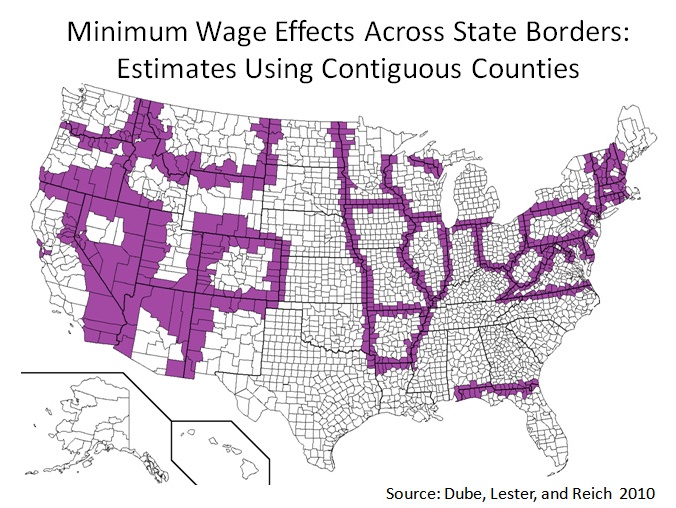
A 2010 study published in the Review of Economics and Statistics compared 288 pairs of contiguous U.S. counties with minimum wage differentials from 1990 to 2006, as shown in purple on the map below. The authors found that minimum wage increases did not negatively affect employment levels in the restaurant industry or other low-wage sectors and that any studies finding a negative impact had incorrectly attributed localized, pre-existing employment trends in specific regions to statewide minimum wage policies.
Minimum Wage Effects Across State Borders: Estimates Using Contiguous Counties
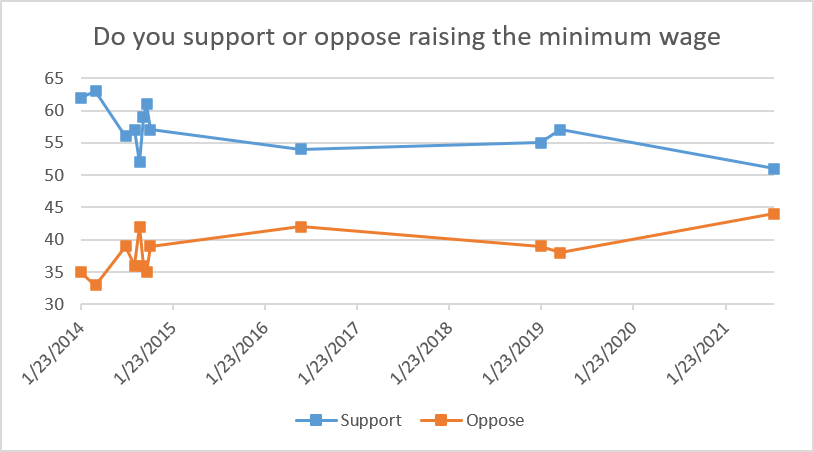
The next graph shows the response of Wisconsin voters when asked by the Marquette Poll whether they support or oppose raising the minimum wage. A majority have consistently supported this. The most recent poll that asked about the minimum wage was run in August 2021; it was also the only time that a numerical wage was specified — $15 per hour.
Do you support or oppose raising the minimum wage
An extensive analysis of the original New Jersey-Pennsylvania fast-food study showing no decrease in employment after a minimum wage was passed noted that most such empirical findings do not survive replication, but those of Card and Krueger in 1994 did. “Thirty years of hostile attempts to overturn the [study] have largely confirmed the original counter-textbook conclusion. Here is the rare empirical-economics result that earned a Nobel Prize the long way.”
Thirty states and Washington, D.C., have raised their minimum wage above the federal level of $7.25. Wisconsin should feel confident it too can raise its minimum wage, with the result being a substantial increase in the standard of living of its poorest members and little impact on employment.
If you think stories like this are important, become a member of Urban Milwaukee and help support real, independent journalism. Plus you get some cool added benefits.


Data Wonk
-
How Did Support For Environment Get So Partisan?
 Jul 15th, 2026 by Bruce Thompson
-
Will Wisconsin’s Gerrymandered Congressional Map Be Overturned?
 Jul 1st, 2026 by Bruce Thompson
-
How Partisan Are Wisconsin’s Members of Congress?
 Jun 24th, 2026 by Bruce Thompson


















Your analysis debunks what economist still believe. They also believe that increasing the minimum wage increases inflation. While I know historically that has not been the case, I would be interested in your analysis on that issue.
The Living Wage in WI for one (1) person is $22.88 per hour.