
MKE GO Pilot Aims To Cut Solo Driving, Not Take Away Cars
City-backed effort targets one or two trips a week, with incentives to try alternatives to driving alone to work.
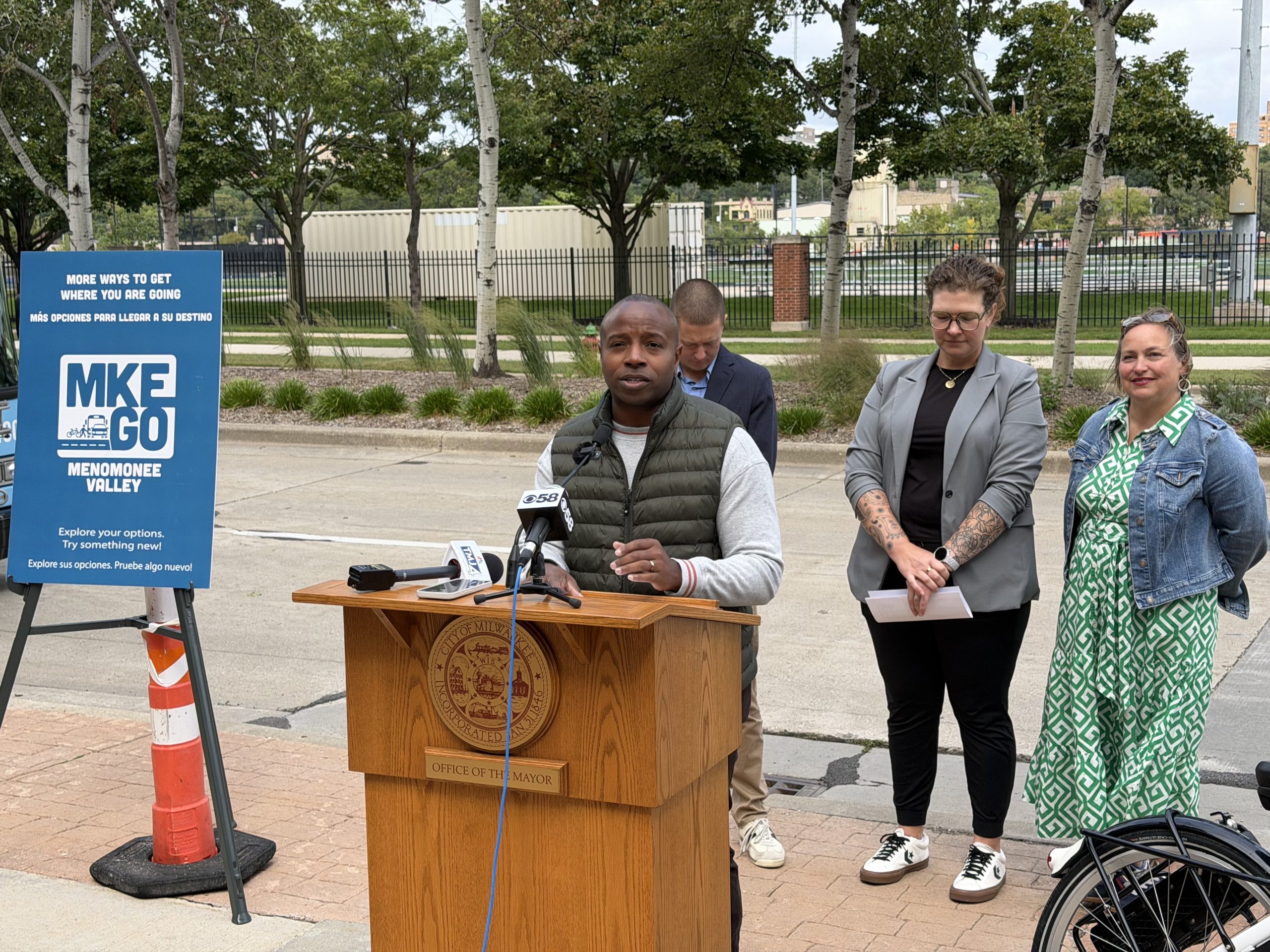
Mayor Cavalier Johnson introduces MKE GO. Photo by Jeramey Jannene.
Milwaukee officials aren’t asking residents to give up their cars. They are asking them to consider leaving them parked once or twice a week.
Ahead of World Car Free Day on Tuesday, the City of Milwaukee launched MKE GO, a new program intended to make it easier for residents and workers to try taking the bus, biking, walking or carpooling instead of driving alone.
“You don’t have to change every single trip. That’s not what we’re asking you,” said Mayor Cavalier Johnson during a press conference Monday morning. “Let’s take some alternative mode of transportation once or twice a week.”
The mayor announced the program at a new Bublr Bikes station outside Potawatomi Casino Hotel, 1721 W. Canal St., in the Menomonee Valley.
Johnson said driving will remain the best transportation option for many trips and people, but said replacing even a small number of car trips could lower transportation costs, reduce congestion and air pollution and add physical activity to someone’s day.
“MKE GO isn’t about telling people to get rid of their cars,” Johnson said. “Instead, it’s about giving people more options; it’s about giving people more choices.”
World Car Free Day is held annually on Sept. 22 and is intended to encourage people to try walking, bicycling, public transportation and other alternatives to driving.
The city’s initial MKE GO effort is focused on the Menomonee Valley and nearby neighborhoods, an area where transportation has long been both a workforce issue and a geographic challenge.
It is an especially complicated place to get around right now.
The 27th Street viaduct is closed while the Wisconsin Department of Transportation reconstructs the bridge over Interstate 94, part of the massive I-94 East-West Freeway project. The closure is expected to last through late 2026.
The James E. Groppi Unity Bridge, also known as the 16th Street Viaduct, is only partially open while the city rehabilitates the structure. The southern portion reopened this summer, but the bridge remains closed between W. Clybourn Street and S. Emmber Lane.
At the same time, the city is reconstructing W. National Avenue. This year’s phase covers S. 39th Street to S. 27th Street, adding another major construction project along a key route into and around the Valley.
“Honestly, the timing couldn’t be better,” said Department of Public Works transportation planning manager Mike Amsden when asked about the overlapping construction projects Monday. “We need to provide better options for more people to get to and through the Valley.”
MKE GO is being funded through a federal Congestion Mitigation and Air Quality grant. The total project budget is $656,000, including $524,800 in federal funding and a $131,200 city match.
The pilot is scheduled to run from 2026 through 2028. The initial project area stretches approximately from N. 6th Street to N. 35th Street and from W. Highland Avenue to W. Mitchell Street. It includes the Menomonee Valley as well as portions of Marquette, Merrill Park, Concordia, Avenues West, Clarke Square, Silver City, Burnham Park and Layton Park.
The program isn’t creating a new transportation service. Instead, it is intended to make existing options easier to understand and try.
Residents and employees can get help planning trips, understanding bus routes, using Bublr Bikes or finding a carpool through CommuteWISE. Participants will also be eligible for incentives, including free MCTS bus passes and Bublr passes, to try a different commute. Employers can receive commute surveys, individualized assistance for employees, carpool matching and an analysis of workplace transportation and parking needs.
“We want to make it easy for people to check out these options for themselves,” Amsden said. Participants, he said, will be able to answer several questions about their transportation needs and receive a free bus or Bublr pass to test another way of traveling.
The Valley was selected in part because of the concentration of jobs and nearby residents — and the difficulty connecting the two.
Menomonee Valley Partners executive director Corey Zetts said her organization regularly hears from employers that transportation is a workforce challenge. More than 60% identify transportation as one of the major factors affecting their workforce, she said.
The Valley can appear well served on a transportation map, Zetts said, but major bus routes often run only on the elevated viaducts. Reaching employers can require navigating highway entrances, railroad tracks, the Menomonee River and other barriers.
“How do we get people that last mile from those neighborhoods down into the Valley jobs and to the employers that are really looking to hire?” Zetts said.
Palermo’s Pizza, headquartered farther west on Canal Street, is one of the employers participating in the initiative.
Rebecca Schimke, Palermo’s director of communications and events, said an estimated 25% of the company’s workforce relies on transportation other than driving alone. The challenge can be particularly significant for employees working second and third shifts, when fewer transportation options are available.
City officials hope the Valley pilot will also show what works — and what doesn’t — before MKE GO potentially expands elsewhere in Milwaukee.
The immediate goal, however, is substantially smaller: convince someone who usually drives five days a week to try something different for one of them.
“Is there just one trip that I can make different?” Johnson said residents should ask themselves as World Car Free Day approaches. “It all starts with one trip.”
More information and enrollment details are available through the city’s MKE GO webpage.
Existing members must be signed in to see the interactive map. Sign in.
If you think stories like this are important, become a member of Urban Milwaukee and help support real, independent journalism. Plus you get some cool added benefits.
Political Contributions Tracker
Displaying political contributions between people mentioned in this story. Learn more.
- November 6, 2025 - Cavalier Johnson received $500 from Corey Zetts


Transportation
-
Mayor’s Budget Proposal Includes Record Amount For Local Streets
 Sep 20th, 2026 by Jeramey Jannene
-
Credit Card Payments at Milwaukee Parking Meters to Stop Oct. 1
 Sep 18th, 2026 by Jeramey Jannene
-
See The Drastic MCTS Redesign Concepts
 Sep 16th, 2026 by Graham Kilmer






Encouraging people to use other modes of transit isn’t about treating the alternatives as bitter medicine they can take only in small doses.
Instead, the key is tapping into transit’s true power, rooted in cities like Milwaukee in pre-automobile-dominated days, when proximity and walkability worked with transit to help people thrive and move between the city’s origins and destinations. Things were close for walking, but a streetcar ride across town or out to a suburb was a handy and very popular alternative. This urban geometry was built on human locomotion aided by transit, not automobile circulation as the default. As a result, homes, businesses, workplaces, schools, churches, and parks were all jostled together. This is not old-fashioned: supporting people using active transit (walking, bicycling) along with public transit (streetcar, bus, rail) to reach their destinations in an integrated and pleasing way.
While cities developed transit naturally more than a century ago, choices later favored low-density, car-dependent cityscapes and settlements. Urban fabrics for walking and transit were ripped out in favor of automobile-dependent fabrics. The result is a metropolitan landscape so car-dependent that its residents can no longer see it. Just like fish in water, they don’t see the environment they depend on, and they see driving as the “best choice” because they can’t see much else. And many have fewer choices: the US Census found that 8.5% of US households have no vehicle available. In my zip code, 53202, 25% of households have no vehicle available. The Wisconsin Department of Transportation estimated, based on an analysis of driver’s license holders, car registrations, and census data, that 31% of Wisconsin’s population are nondrivers.
The key is removing the silos of planning, design, engineering, and construction that separate transit from considerations of land use, housing, businesses, and the simple concepts of proximity and walkability. Well-meaning but car-dependent civic leaders, planners, transit professionals, and engineers can’t see how their work is warped around favoring cars in nearly every possible way. From parking to law enforcement to zoning and land use, car-as-king is the subtle (and overt) thinking behind many decisions, leaving a landscape that mercilessly punishes people trying to use alternatives and coddles drivers.
Of course, funding is crucial for transit. But for transit to be truly successful, its design must go back to its roots as the natural outgrowth of human-centered urban geographies that historically anchored many cities.
While a number of individuals frequently comment on a variety of stories in Urban Milwaukee, John December comments sparingly but always with facts, information, reason and recommendations. His observations here are an excellent example.
There has been a great deal of back-and-forth online and within the community
about removing the freeway. Lots of gnashing and bashing. Much of what Mr. December has to say supports the argument for bringing a portion of the freeway down to grade. But as he writes, “car-as-king is the subtle (and overt) thinking behind many decisions, leaving a landscape that mercilessly punishes people trying to use alternatives and coddles drivers.”