

Program Provides ‘Crash Course’ for Aspiring Arborists
Arborist Certified Pre-Apprenticeship fills a gap in Wisconsin's workforce pipeline.
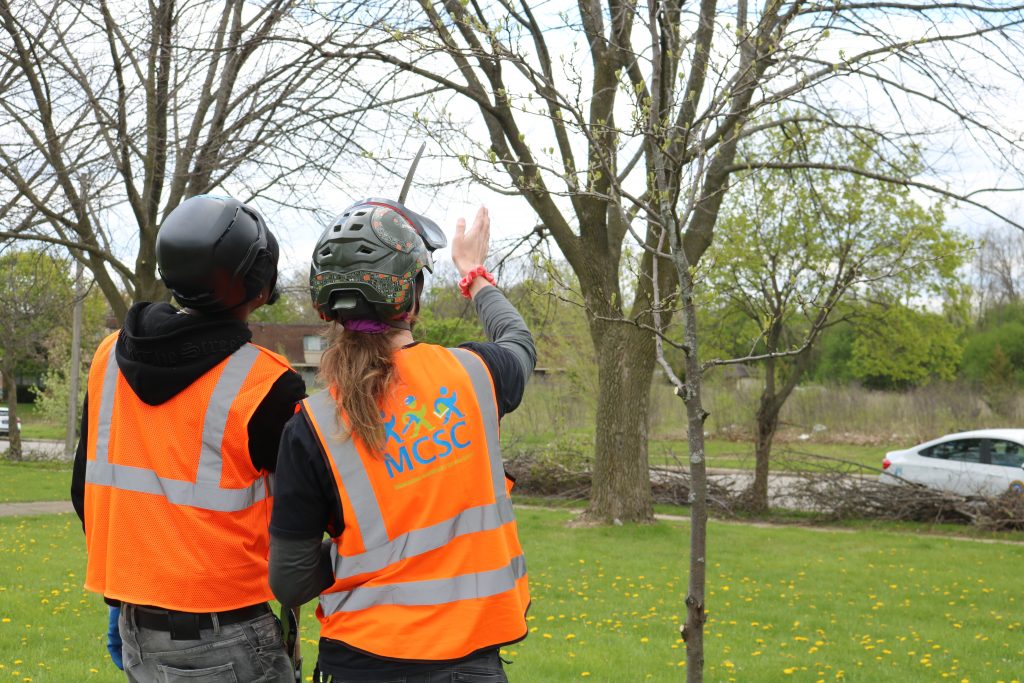
Thaddeus Clay (left) and Joey Puchalski examine a tree during pruning. Photo taken May 6, 2026 by Sophie Bolich.
Jeremiah Sellers squinted against the midday sun as he scanned a tree for wayward branches, saw in hand, ready to prune.
He and the nine other men in his cohort spent a warm, breezy day in early May tending trees on the far Northwest Side as part of their Arborist Certified Pre-Apprenticeship program, a roughly three-month curriculum intended to prepare participants for a career in the industry.
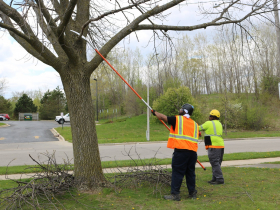
As the hours passed, piles of discarded sticks and branches grew near the curb while supervisors offered tips and guidance from a distance.
“This is completely new to me, the arborist culture,” said Sellers, who was introduced to the program during his time with the Milwaukee Community Service Corps (MCSC). “I wasn’t interested in nature before, but now when I go outside, it’s like my whole brain is just wired by trees — honey locust, Norway maple, elms — I wouldn’t even think about that until now.”
The pre-apprenticeship launched in 2025 and is now in its second cohort. The paid program is funded by Employ Milwaukee through the Wisconsin Department of Workforce Development’s Worker Advancement Initiative and joins existing youth apprenticeship and registered apprenticeship programs to address a gap in the workforce development pipeline.
“It’s a crash course in being an arborist within the industry, so they get a taste of all the types of jobs that they’re going to perform if they’re interested in becoming a professional arborist,” said Erin Stoekl, forestry services manager for the city of Milwaukee. “If you’re interested in a career that supports the environment while still being in an urban center, this is uniquely one that can fulfill both of those requirements and does a lot for the common good.”
MCSC, the program provider, works with the state of Wisconsin and industry partners such as Hoppe Tree Service, M&M Tree Care and Dorshak Tree Specialists to create a curriculum for the pre-apprenticeship that ensures graduates exceed minimum hiring requirements.
“We also throw in wraparound services, making sure that it’s not just about retention and skills gained, but also helpful for those who choose to go into other fields,” said Cole Hager, green jobs coordinator for Milwaukee’s Environmental Collaboration Office.
That includes Occupational Safety and Health Administration, forklift, skid steer and CPR certifications, along with financial literacy courses, Hager said.
Of the 10 members in the inaugural cohort, seven entered the arborist industry, and all who completed the course — eight participants total — are currently employed.
“My major takeaway was the terminology,” said Gabby Arzaga, a pre-apprenticeship graduate who credited the program with making her a top hiring choice. “Having that information allowed me to be more helpful to my crew straight away.”
Another graduate, Rockney Henderson, said the program gave him a better understanding of safety while also providing a “jump start” in the industry.
“I learned the different types of knots used on an everyday basis, hazards to watch for on job sites, the reactionary forces of a chainsaw and how to build a resume suited to the type of work I’m looking for — all while connecting with different companies in the tree industry,” he said.
Both Henderson and Arzaga are scheduled to begin a three-year arborist apprenticeship this fall.
Interest in the program surged during its second installment, with just 10 of 100 people selected for the pre-apprenticeship, according to Aaron Saeugling, operations policy and grants manager for the Department of Public Works. “There is a significant demand,” he said.
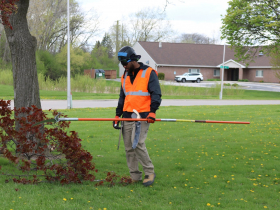
The course begins with a classroom portion covering tree identification and foundational knowledge, followed by hands-on training including tree climbing, knot-tying, pruning and instruction on the use and care of tools such as chainsaws.
The current cohort is set to graduate in mid-June.
“Pre-apprenticeships and registered apprenticeships are an evidence-based, employer-driven workforce model that provides on-the-job skills training while workers earn good wages,” Cindy Anderson, who oversees Employ Milwaukee’s support of the pre-apprenticeship program, said in a statement.
Anderson also praised the programs for their role in equipping workers with “key occupational skills that lead to advancement and quality employment.”
Sellers said he hopes to eventually secure a position with a private company. Participants are also encouraged to seek jobs with the city of Milwaukee; however, the timing of recruitment and onboarding can vary.
“Of course, we would like people to apply and work for the city, but it might mean that there’s a little gap between when we finish this program and when they can actually apply,” Stoekl said.
She added that while trees are a key focus, the city of Milwaukee’s forestry division is also responsible for maintaining turf, annuals and perennials in boulevards throughout the city and managing a nursery in Franklin.
“It’s a pretty unique facility for a municipal operation,” Stoekl said. “Forestry services is a well-established division doing everything we can to help improve the quality of life and aesthetic value of the city.”
Milwaukee maintains an urban forest that includes about 190,000 street and boulevard trees and about 3 million trees when including those on private and public property.
The benefits they provide are multifaceted, Stoekl said. “I could go on and on, but it’s everything we learned in grade school about oxygen and shade, and now there are even more studies coming out about health-related benefits — reduced anxiety, shorter recovery times after surgery and better mental health. It’s our responsibility to ensure that these trees are resilient and healthy so those benefits can continue for all residents.”
More information on the Arborist Certified Pre-Apprenticeship program is available online.
Photos
If you think stories like this are important, become a member of Urban Milwaukee and help support real, independent journalism. Plus you get some cool added benefits.



















this is great!