
Gov. Evers Signs Bills Releasing Funds to Combat PFAS Pollution
Finally $125 million released to protect drinking water from toxic 'forever chemicals.'
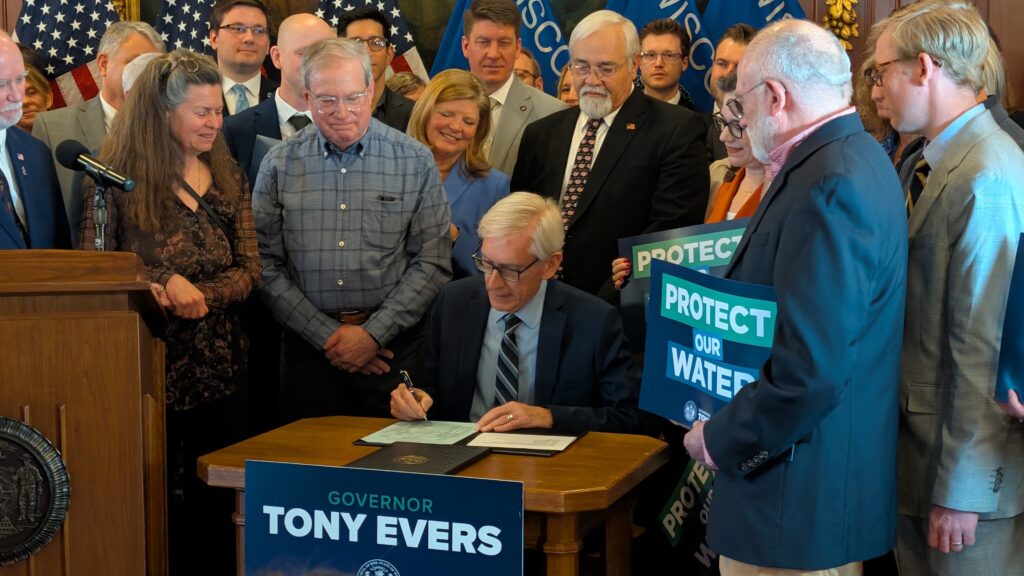
Gov. Tony Evers signed a pair of bills Monday that will release $125 million for communities to fight PFAS water contamination. (Photo by Baylor Spears/Wisconsin Examiner)
Gov. Tony Evers signed a pair of bills Monday that will release $125 million for communities to fight water contamination from per- and polyfluoroalkyl substances (PFAS) in Wisconsin.
The bill signing is the culmination of about three years of debate over the money, which was first set aside in the 2023-25 state budget. The Town of Campbell, Marinette, the town of Stella near Rhinelander and French Island near La Crosse are just some of the communities in Wisconsin that have been managing PFAS pollution in local drinking water for years.
Evers called it a “historic” day for the state.
“Today the people of Wisconsin can begin to have PFAS-free water,” Evers said.
PFAS — also known as “forever chemicals” — are a large group of cancer-causing chemicals that do not break down easily and have been used to make products including nonstick cookware, firefighting foam and fast food wrappers that are resistant to heat, grease, stains and water.
Under the laws, about $80 million will go to a community grant program to assist local governments in combating and remediating PFAS contamination in their communities, a little over $5 million will go to a grant programs for public airports and $35 million will go to expanding the Well Compensation Grant Program to assist homeowners and businesses with private wells to ensure their drinking water is safe from PFAS. The Well Compensation Grant Program will also be expanded to allow non-community water supplies, schools and child care facilities to receive funding.
The Wisconsin Department of Natural Resources will get 10 new positions and $1.3 million to help with managing conservation, fishery resources and trapper education, protecting the state’s water resources and for other agency responsibilities including communications, customer services, aids administration, watershed management and environmental analysis.
The laws also amend the state’s Spills Law to protect farmers, landowners, certain business owners and fire departments from being held responsible for PFAS contamination if it is discovered on their land and they did not cause it.
AB 130, now 2025 Wisconsin Act 200, includes the funding and AB 131, now 2025 Wisconsin Act 201, creates the new programs and requirements related to PFAS.
“This will provide real relief to families and communities tackling the pressing threat of PFAS in local wells, municipal water systems and more,” Evers said, adding that the day has not come without challenges. “It’s been a long road, but this will make a real difference for families living with the challenges of people every day, so today, we’re here to chart a new path forward— one where folks can trust that the water coming from their tap is safe to drink.”
Evers was joined by advocates, Department of Natural Resources Secretary Karen Hyun as well as a bipartisan group of state lawmakers including Sen. Eric Wimberger (R-Gillett), Jeff Mursau (R-Crivitz) and Rep. Renuka Mayadev (D-Madison). He thanked all of them for their work on the issue and emphasized the importance of working together to get it done.
Evers said that it is always “worth the effort” to find a bipartisan way to get work done. Once the money was set aside in 2023, lawmakers and Evers disagreed on the framework for getting the money to communities. Evers vetoed a 2024 Republican bill, saying it limited the enforcement power of the DNR and wouldn’t do enough to combat the PFAS contamination challenges that Wisconsin faces.
Over the last year, lawmakers and Evers worked to get to a compromise that passed the Assembly and Senate unanimously.
“This was a really important two bills, and the only way we were going to do it is that people compromise, give, take and win,” Evers said.
According to a DNR release, it will take time for the agency’s staff to get the programs going, and DNR will be prioritizing grants for sampling of private wells, schools, child care facilities and biosolids. The grants are expected to be available starting in the summer or fall of 2026.
Lee Donahue, the health, education and welfare supervisor for the Town of Campbell, said the laws were critical for the “healing and health” of people in affected communities.
“Sadly, today I can quickly and easily say that per- and polyfluoroalkyl substances are toxic,” Donahue said. “I’ve seen how people’s exposure can devastate a community with kidney, testicular, ovarian, thyroid cancer, Parkinson’s disease, endocrine disruptions like polycystic ovarian syndrome, impacting women’s fertility, and the impacts on child development.”
Donahue said the change in the law represents progress.
“It lays the foundation for future PFAS legislation that will continue to protect Wisconsinites,” Donahue said. “For the 4,500 neighbors of mine and the town of Campbell and all those in Peshtigo, Stella Rib Mountain, and sadly, the list goes on and on, may this legislation accelerate your access to safe water.”
Wimberger, who alongside other Republicans fought for the provision absolving parties they termed “innocent landowners” from responsibility for contamination, celebrated the signing of the bills in a statement.
“At the heart of our reforms is an idea: the state should not treat landowners who discover PFAS contamination on their property like polluters. Through meetings and negotiations, that idea transformed into real policy that will protect innocent victims of PFAS across Wisconsin from unfair state action,” Wimberger said. “From French Island to Marinette and Madison to Stella, we’ll soon begin the important work of identifying and fighting PFAS contamination in lands and waters across our state.”
Gov. Tony Evers signs bills releasing money to combat PFAS contamination was originally published by Wisconsin Examiner.
More about the PFAS Problem
- Gov. Evers, DNR Celebrate PFAS Awareness Week, Highlight Evers Administration’s Efforts to Ensure Safe, Clean Water Statewide - Gov. Tony Evers - Sep 21st, 2026
- $10 Million Released To Tackle PFAS In Marinette, Peshtigo Wells - Danielle Kaeding - Sep 3rd, 2026
- Gov. Evers, DNR Celebrate Release of $10 Million Pfas Settlement Payment to Help Provide Safe Drinking Water to Affected Communities - Gov. Tony Evers - Sep 1st, 2026
- Gov. Evers, Wisconsin DNR Urge Release of $10 Million to Address PFAS - Danielle Kaeding - Aug 20th, 2026
- Baldwin, Colleagues Demand EPA Drop Its Effort to Weaken PFAS Drinking Water Protections for Millions of Americans - U.S. Sen. Tammy Baldwin - Aug 10th, 2026
- DNR Hosting Listening Session to Gather Feedback About Pfas Law Program Development - Wisconsin Department of Natural Resources - Jun 5th, 2026
- Wisconsin DOJ Reaches Settlement With Tyco Fire Products for Alleged PFAS Violations - Wisconsin Department of Justice - Jun 4th, 2026
- EPA PFAS Rollback Puts Wisconsin Drinking Water Limits In Legal Crosshairs - Danielle Kaeding - May 21st, 2026
- Gov. Evers Delivers Radio Address, Celebrates Release of Over $125 Million to Fight Pfas Statewide - Gov. Tony Evers - Apr 10th, 2026
- Wisconsin Conservation Voters Celebrates Double Win - Wisconsin Conservation Voters - Apr 8th, 2026
Read more about PFAS Problem here