CDC Ends Some Disease Tests; WI Lab Leader Says States Can Fill Gaps
The list of 31 tests no longer given includes diseases like COVID-19 and influenza.
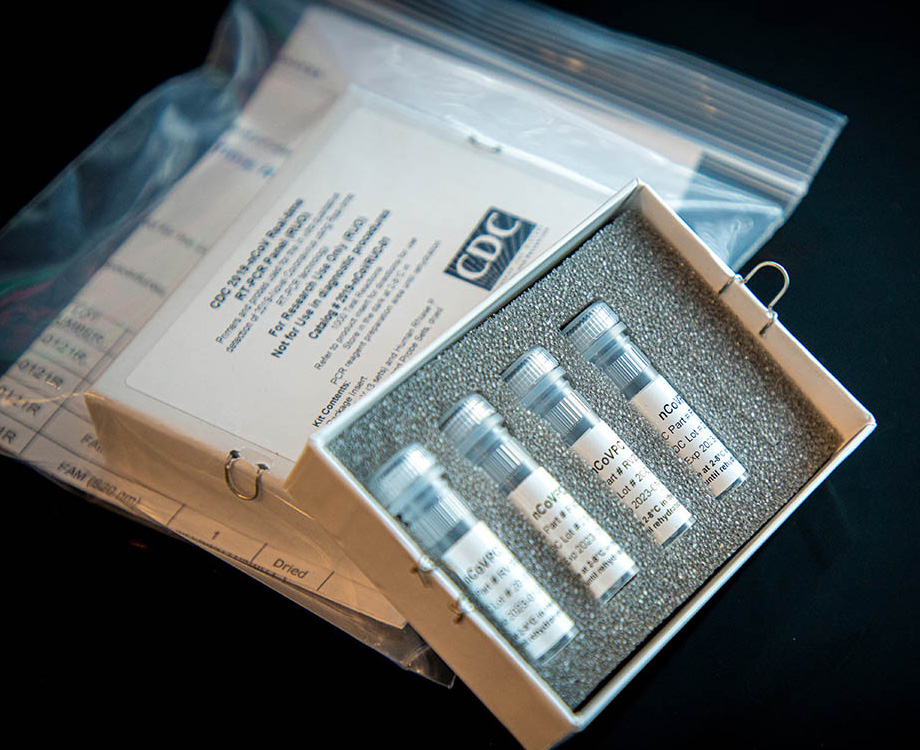
CDC 2019-Novel Coronavirus (2019-nCoV) Real-Time Reverse Transcriptase (RT)-PCR Diagnostic Panel. Photo is the Public Domain.
A leader of Wisconsin’s state disease laboratory says a recent reduction in federal testing won’t immediately impact the state’s ability to test for infectious diseases, including rabies.
This week, the Centers for Disease Control and Prevention released an expanded list of tests the agency has either paused or stopped running permanently at its infectious disease laboratories.
The list of 31 tests includes common diseases like COVID-19 and influenza and rare infections from certain parasites. The latest update added tests to diagnose rabies in humans, catching national news headlines.
But Allen Bateman, director of the communicable disease division at the Wisconsin State Laboratory of Hygiene, said the antemortem, or before death, human test is not typically how rabies cases are diagnosed.
He said standard practice is to test the animal in question, which is done by the state lab. Bateman said they test several thousand animals, mostly bats and dogs, every year for the disease.
“I cannot remember offhand the last time that we sent a specimen for human antemortem rabies testing to CDC,” Bateman said. “Rabies is definitely a very important thing. It’s one of the most important tests that we run. But this particular antemortem human testing is very rare, in my experience.”
If there is the need for the test in Wisconsin, Bateman said state and local health officials still have access to testing through a national network of state labs called the Association of Public Health Laboratories.
He said some larger labs specialize in providing certain tests. As an example, Wisconsin is the go-to testing location for some vaccine-preventable diseases for about a quarter of the country.
The model means there is built-in resiliency in case one lab location is unable to do testing, Bateman said. But he said the CDC has historically been the source for rare and complicated testing in the U.S.
“I think it really is helpful to have that strong national lab, and I really look forward to getting back to that,” he said.
The Wisconsin Department of Health Services said the agency relies on CDC labs to assist with the diagnosis of many diseases.
“Eliminating any tests limits our ability to identify and investigate cases of these diseases and prevents us from being able to intervene with prevention and control measures,” agency leaders said in a statement to WPR. “While testing for certain diseases may be available through partnership with other state public health labs, the testing capacity is often very limited and should not be a long-term solution.”
The DHS statement said the elimination of positions at CDC also mean state public health agencies are seeing “delays in consultation with CDC epidemiology staff for specific situations.”
The review of infectious disease testing at CDC started at the end of 2024.
A CDC spokesperson told industry publication Medscape Medical News in December 2024 that the agency was reviewing its “greater infectious disease diagnostic testing portfolio” of more than 500 tests and deciding whether to discontinue some tests “because similar testing options are available through other sources like state public health laboratories or commercial entities.”
The CDC has also undergone significant downsizing since President Donald Trump took office at the start of last year. The agency lost between a quarter and a third of its staff in 2025, according to reporting by NPR.
A government spokesman told the Associated Press this week that federal health officials anticipate that some of the tests will be available again in the coming weeks.
As CDC pauses some disease testing, Wisconsin lab leader says states are ready to fill the gaps was originally published by Wisconsin Public Radio.
If you think stories like this are important, become a member of Urban Milwaukee and help support real, independent journalism. Plus you get some cool added benefits.