
How Milwaukee’s Absentee Ballots Could Flip the Election
City reports having 59,000 absentee ballots. Here's how they could appear to swing election.
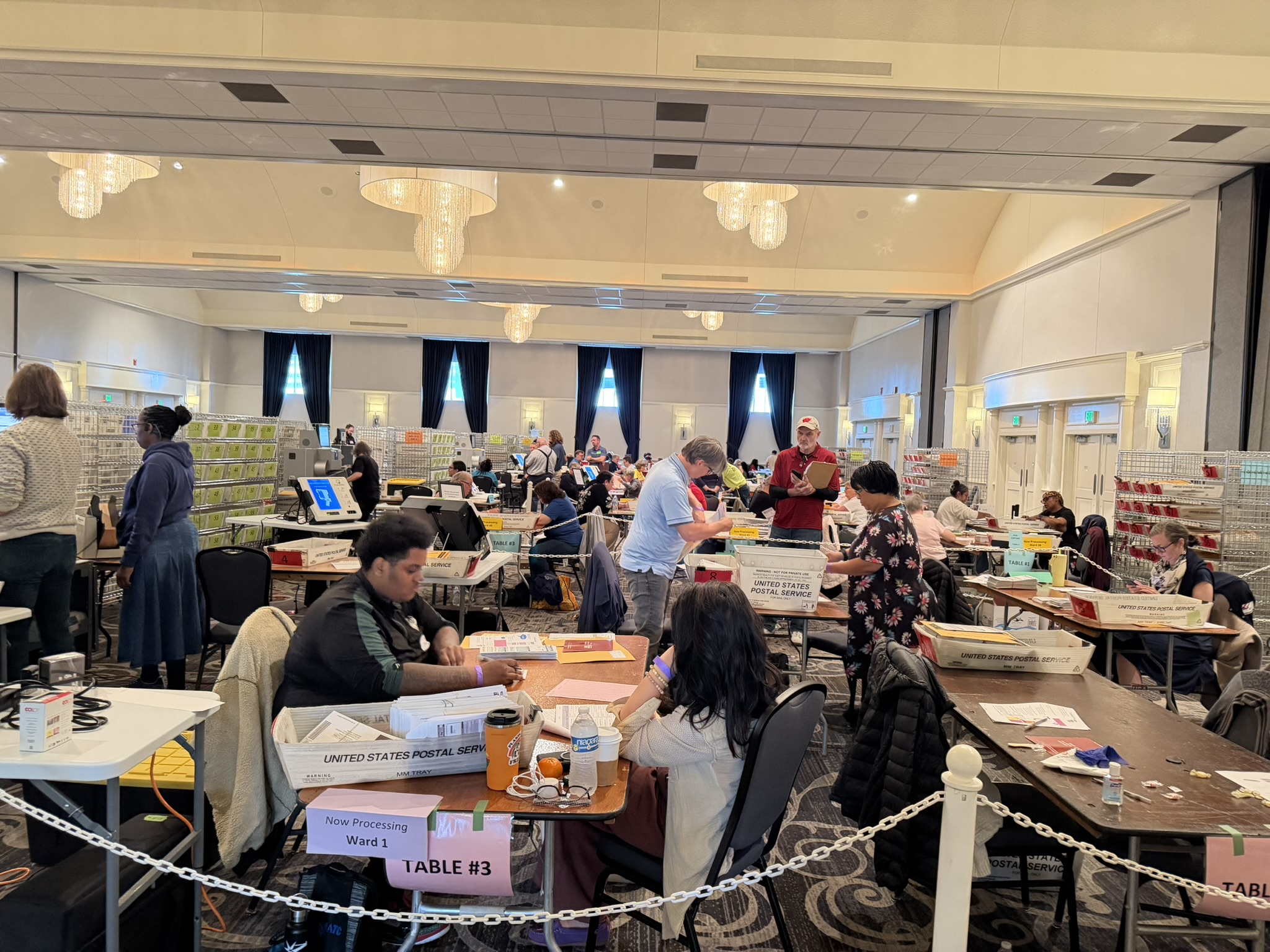
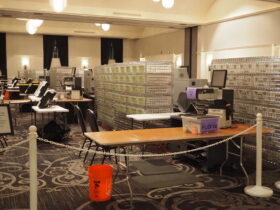
Absentee ballot processing at Milwaukee’s “central count” facility in the 2026 partisan election. Photo by Jeramey Jannene.
Milwaukee’s absentee ballots could appear to decide Wisconsin’s gubernatorial election Tuesday night. That’s because the votes won’t be reported until well after the polls close.
The city has nearly 60,000 absentee ballots to process, and they will be reported together in a large batch, potentially swinging the statewide results to make Democratic candidate David Crowley the winner.
It’s a predictable process, one that has repeatedly been seized upon by election conspiracy theorists as evidence of something nefarious.
But the process is public, the number of outstanding ballots is known and even the partisan breakdown can be reasonably predicted.
This year, the Milwaukee Election Commission (MEC) has a new location for the massive undertaking.
For the first time, Milwaukee’s central count operation is being held at the Italian Community Center, 631 E. Chicago St.
The city is one of 42 Wisconsin municipalities that use a central count facility to process absentee ballots rather than counting them at individual polling places. The approach makes it easier to manage the ballots and allows election observers to monitor the entire operation in one location.
It also means that Milwaukee’s absentee results are reported separately from votes cast in person on Election Day.
MEC typically rents a larger facility for major elections instead of using its warehouse at 1901 S. Kinnickinnic Ave. The additional space accommodates the larger number of election workers and observers.
In recent years, the city has used the Baird Center, most recently in 2024. But the massive convention center proved to be too large, requiring excessive walking as workers moved between different parts of the operation.
The Italian Community Center offers a more compact layout.
Approximately 130 election workers are assigned to the operation. Many were already processing ballots shortly after polls opened at 7 a.m.
How The Count Works
The city issued 64,852 absentee ballots for Tuesday’s election. As of 11:20 a.m., 58,993 had been returned, most through the city’s in-person early voting program.
That number will continue to grow as additional ballots arrive in the mail, ballots are collected from drop boxes and voters deliver their completed ballots directly to the central count facility.
All absentee ballots must be received by 8 p.m. Tuesday, when the polls close. The final number of ballots to be processed will therefore be known shortly after that deadline.
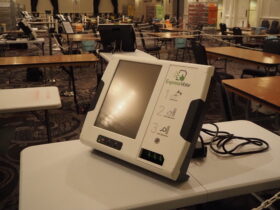
Ballots are reviewed to verify their eligibility, opened, assigned voter numbers and prepared for processing through high-speed tabulators. Wisconsin law prohibits election officials from beginning the counting process before election day.
Once all the ballots have been processed and the polls have closed, the results are downloaded from the tabulators onto secure USB drives.
The drives are transported by election officials under police escort to the Milwaukee County Election Commission at the courthouse, where the results are uploaded to the county’s election reporting website.
Unlike results from individual polling places, which are reported throughout the evening, Milwaukee’s central count results are reported together.
The entire process is open to public observation.
Among those spotted at the Italian Community Center Tuesday were Wisconsin Elections Commission member Ann Jacobs, a Democrat; Milwaukee County Republican Party Chairman Hilario Deleon; and conservative election skeptic Jefferson Davis, who previously led the Ad-Hoc Consortium For Wisconsin’s Full Forensic Physical Cyber Audit.
“I know it’s going to be a super late night. I hope before 1 a.m.,” said MEC Executive Director Paulina Gutiérrez during a walkthrough of the facility Monday evening.
The Expected Late-Night Swing
The late reporting of Milwaukee’s absentee ballots has become a recurring target of election conspiracy theories, particularly when a Republican candidate’s statewide lead suddenly disappears.
The change is sometimes characterized as a mysterious late-night “vote dump.”
But there is little mystery about what will happen.
Milwaukee’s absentee ballots have consistently favored Democrats by substantial margins in recent elections. A reasonable estimate for Tuesday’s election is an 80% Democratic to 20% Republican split.
If the city reports 59,000 absentee votes divided along those lines, the impact on the governor’s race would be substantial.
Crowley would receive approximately 47,200 votes to Republican Tom Tiffany‘s 11,800, a net gain of 35,400 votes for the Democrat.
That means Tiffany could appear to be leading statewide by 30,000 votes late Tuesday night, only to see Crowley move ahead once Milwaukee’s absentee results are added.
The shift would not be evidence of anything improper. It would simply reflect the predictable partisan preferences of voters who chose to cast absentee ballots.
President Donald Trump has repeatedly criticized absentee voting despite voting absentee himself, a stance that has helped politicize a longstanding voting method.
Another source of confusion is how election results are reported.
Election websites can show 99% or even 100% of wards reporting while substantial numbers of absentee votes remain outstanding. That’s because the percentage can reflect the number of polling places that have reported their in-person votes, even though centrally counted absentee ballots have not yet been added.
Milwaukee County’s election reporting website explicitly warns that 100% of reporting units does not necessarily mean all ballots have been counted. A separate section keeps track of central count ballots.
Milwaukee isn’t alone in reporting absentee ballots separately. Green Bay, through Brown County, also reports a large batch of absentee votes, often late in the evening. The city has received at least 9,500 absentee ballots for Tuesday’s election.
The delayed reporting could have significant consequences in a close statewide race.
A similar situation unfolded in 2020 and again in 2022, when Milwaukee processed approximately 60,000 absentee ballots in the U.S. Senate election between Republican incumbent Ron Johnson and Democratic challenger Mandela Barnes.
Those results were reported late at night, but Johnson’s statewide lead was large enough to withstand the expected Democratic advantage from Milwaukee.
A History of Delays
Although Milwaukee’s central count operation has experienced several high-profile problems in recent elections, those errors have not compromised the integrity of the election results.
In November 2024, workers had to restart ballot processing after observers discovered that USB ports on the high-speed tabulators had not been properly sealed before counting began.
The mistake resulted in a substantial delay but did not affect the votes themselves.
More recently, during the August 2026 partisan primary, a senior election employee mistakenly downloaded audit logs from several tabulators rather than the actual election results.
Officials didn’t discover the error until they tried to upload the files at the county courthouse, forcing election workers to return to the central count facility and download the correct data.
MEC has since implemented additional procedures, including visual instructions and a process in which workers verbally confirm each step of the download and reporting process.
Tuesday’s operation has already experienced a smaller hiccup.
A team of two election workers failed to assign voter numbers to approximately 240 absentee ballots from Ward 216 on the city’s South Side. The ward runs from W. Greenfield Avenue south to W. Grant Street between S. Layton Boulevard and S. 31st Street. In the fall 2024 election, Democrats won the ward by an average of almost 50 points.
The ballots and their corresponding envelopes are supposed to be numbered as part of the central count process.
“Like any election, multiple people are monitoring and watching, and our tabulators actually found the issue where one of our table workers mistakenly didn’t put the voter number on the ballots,” said Gutierrez at a Tuesday morning press conference. “We reviewed that. We asked our pod captain to do an audit, and we processed those ballots.”
Gutierrez said the absentee board of canvassers, on which she serves, reviewed the situation and determined the votes should be counted.
“They are legitimate ballots. Those are eligible voters. It was a clerical error,” she said.
The two election workers who made the error were coached and remained on the job.
“Every election we have something that happens,” said Gutierrez, emphasizing the importance of identifying and correcting issues as they arise, whether at central count or at neighborhood polling places. The commission also had to troubleshoot mechanical issues with tabulators at polling places, she said, but was able to resolve the issues by restarting the equipment. The paper ballots provide a backstop should an issue recur.
And regardless of when the final numbers arrive Tuesday night or Wednesday morning, the size and likely partisan impact of Milwaukee’s absentee vote should come as no surprise.
Photos


Existing members must be signed in to see the interactive map. Sign in.
If you think stories like this are important, become a member of Urban Milwaukee and help support real, independent journalism. Plus you get some cool added benefits.
Political Contributions Tracker
Displaying political contributions between people mentioned in this story. Learn more.