

Milwaukee Election Mistake Drew National Attention, Official Says Safeguards Worked
County caught wrong files, outside experts validated logs, and city now plans more visible checks and releases.
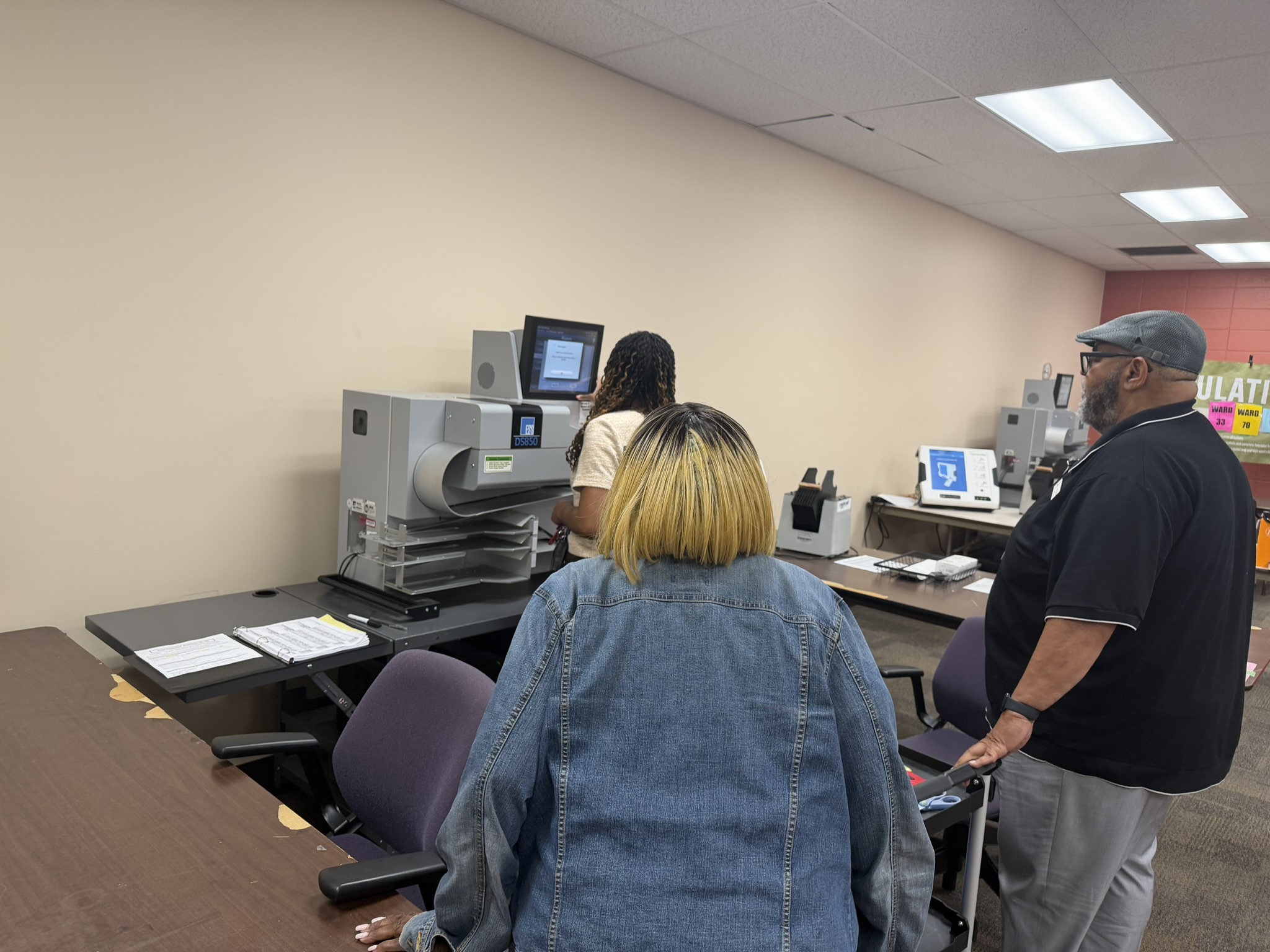
Deputy Director Maricha Harris exports a file during the Aug. 11 election. Photo by Jeramey Jannene.
Milwaukee’s election chief said her office is adding new verification steps before November, after a staff mistake delayed the reporting of thousands of absentee votes during the Aug. 11 primary.
“It was a mistake, and a mistake we take seriously,” Milwaukee Election Commission Executive Director Paulina Gutiérrez told the Common Council’s Judiciary & Legislation Committee Monday. “We understand the frustration and disappointment. I am also frustrated and disappointed.”
The mistake occurred after nearly 28,000 absentee ballots had been processed at Milwaukee’s central count facility, 1901 S. Kinnickinnic Ave.
Election workers were responsible for downloading results from nine high-speed tabulators onto secure flash drives and transporting them to the Milwaukee County Courthouse. But one of three download teams mistakenly selected the option to export an audit log, rather than the election results, on five machines.
The error delayed the release of results by approximately one hour but did not change the vote count or require ballots to be recounted or processed again.
“The most important thing for everyone to know about what happened at the August partisan primary was that it had absolutely no impact on the election results and the accuracy of those results,” Gutiérrez said.
Because the files are encrypted, city workers could not verify their contents before taking the drives to the Milwaukee County Courthouse. County election officials detected the mistake when they attempted to open the files.
After disclosing the mistake in a press conference, city officials then returned to the central count facility with members of the bipartisan Board of Election Commissioners and a Milwaukee Police Department escort. Members of the media were invited to observe as the correct files were downloaded and transported back to the courthouse.
Gutiérrez said the commission is adding images to its written instructions showing employees the correct choices to make on each screen. Observers will have access to versions of the instructions.
Employees will also use what Gutiérrez called a “point-and-call verification process,” under which workers state aloud what they are doing so other members of the team can confirm each step. All download teams will receive another briefing immediately before they perform the work.
Ald. Robert Bauman said election administration requires more than an accurate final count. The public must also see an orderly and competent process, particularly because Milwaukee’s late-reported absentee totals can determine the winner of a close statewide race.
“There cannot be human error in this process because this process is too important,” Bauman said. “It’s not hyperbole to say the future of Wisconsin government depends on this process.”
Bauman also asked whether the employee responsible had been disciplined, arguing that discipline could demonstrate the city takes election mistakes seriously.
Gutiérrez declined to discuss “staff management issues” in a public committee meeting.
“We cannot say we will never make a mistake. We are human beings,” she said. “Elections are run by people, and systems that are run by people need checks and balances.”
Gutiérrez said those safeguards worked in August: the county detected the incorrect files, the results remained unchanged on the tabulators and election officials were able to retrieve the correct information.
“We do after-action reviews, and we are making adjustments and enhancing our process to prevent this from happening again,” she said.
Shortly after the incident, Mayor Cavalier Johnson, responding to a question from Urban Milwaukee, said he did not believe the employee deserved to be fired. Johnson characterized the incident as a mistake and an opportunity for additional training.
Gutiérrez suggested fatigue could have contributed to the error but said that did not diminish its seriousness.
“I can surmise that after a long day, all the cameras are on you. It can be pretty stressful, and there is fatigue,” she said. “And fatigue doesn’t equal incompetence.”
Wisconsin law prevents Milwaukee from opening absentee ballot envelopes before polls open at 7 a.m. on Election Day. Central count employees must then work continuously until every ballot is processed and the results are taken to the county.
Gutiérrez said shifts at central count can last about 15 hours. The commission employed 60 workers for a small election and as many as 300 for a large election. It is planning for the November general election as though it were a presidential election and expects to employ between 150 and 300 central count workers. It is also relocating the operation to the Italian Community Center, 631 E. Chicago St., to handle the larger number of workers and observers.
In November 2024, the city issued approximately 113,000 absentee ballots and received approximately 109,000 to process, she said.
“We are the only first-class city in the state of Wisconsin, and no one comes close to us,” Gutiérrez said of Milwaukee’s election operation.
Ald. Peter Burgelis asked why the city could not begin the work sooner. Gutiérrez said Wisconsin is one of only a small number of states that prohibit election officials from beginning absentee ballot processing before Election Day.
Allowing preprocessing on Monday would shorten the delay between the reporting of polling-place results and Milwaukee’s central count totals, she said. It could also give central count workers more time to rest.
The city has repeatedly lobbied state lawmakers to permit earlier processing.
The commission has also released the audit logs from all nine tabulators and the EL-104 inspector statements for each ward processed at central count.
“The audit log is basically a report that shows all the activities that occurred on Election Day,” Gutiérrez said. She said the commission is considering releasing the logs after every election, though doing so would follow other mandatory post-election work.
According to a report by Alexander Shur of Votebeat, independent election specialists who reviewed the August logs found they supported the city’s account. The records showed no ballots being scanned, votes being deleted or results being altered between the incorrect and correct downloads, according to Votebeat.
Ald. Andrea Pratt, who sponsored the council file with alderwomen Sharlen Moore, Milele A. Coggs and Larresa Taylor, said she called for the hearing so the public could understand what happened and what would change.
The incident is, however, at least the third high-profile incident to occur since 2024, when Gutiérrez was promoted to the lead role. In 2024, the tabulators were not properly sealed, requiring processing to restart. In 2025, a surge in turnout resulted in ballot shortages at several polling places. And now, the audit log issue. Deputy director Bonnie Chang resigned after the 2024 election. Maricha Harris is now the deputy director and leads one of the teams that exports results.
If you think stories like this are important, become a member of Urban Milwaukee and help support real, independent journalism. Plus you get some cool added benefits.
Political Contributions Tracker
Displaying political contributions between people mentioned in this story. Learn more.
- March 4, 2016 - Cavalier Johnson received $35 from Sharlen P. Moore
- February 20, 2016 - Cavalier Johnson received $250 from Robert Bauman
- February 13, 2016 - Milele A. Coggs received $10 from Larresa Taylor






















Paulina Gutiérrez is a wonderful public servant – we are lucky to have her. As we were lucky to have Claire Woodall. Shit happens, and this shit was a minor issue, and is only being beat to death because it comes after 5 years of election conspiracy nonsense (of course Bob Bauman chimes in because – cameras).