
Is This a New Era for Wisconsin Politics?
Does a new Democratic trifecta signal the end of Wisconsin's divisive politics?
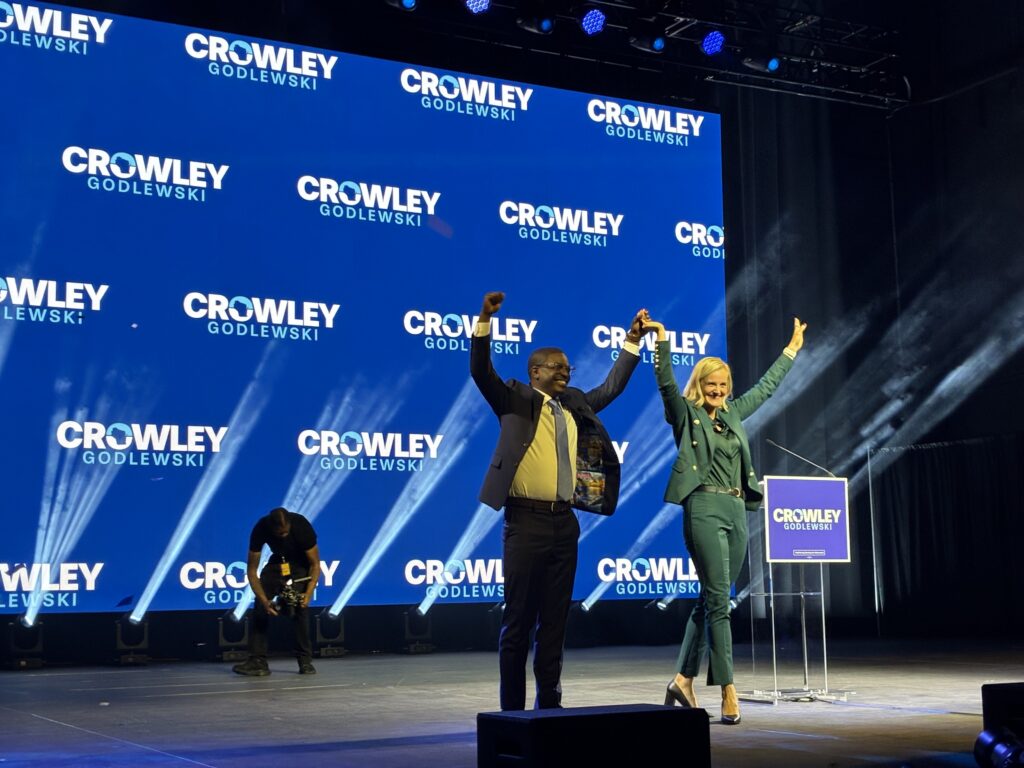
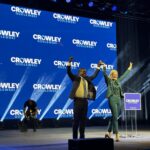
Governor-elect David Crowley and Lt. Gov.-elect Sarah Godlewski. Photo taken Nov. 3, 2026 by Graham Kilmer.
A new era of politics in Wisconsin has begun. Whether it will last remains an open question.
The midterm elections left Democrats controlling both chambers in the state Legislature. Milwaukee County Executive David Crowley was elected governor. Democrats won across the country, defeating Republican incumbents in states like Texas and Mississippi, where victory was long unthinkable.
Now, political observers from both sides of the aisle say the way Crowley and Democrats govern, and whether they remain in power over the next two to four years, will largely depend on how they interpret the message voters sent in the midterm election.
Republicans and Democrats alike have described Democrats’ historic sweep of the midterm elections as a repudiation of President Donald Trump and his policies. In Wisconsin, it also marks a final victory over efforts by former Gov. Scott Walker and Republican legislators to entrench their power in state government through a 2011 gerrymander, considered among the most partisan in the nation.
“[The election was] both a repudiation of Trump and an endorsement of the person, the leader, the character that David Crowley is and has,” said Sachin Chheda, a Democratic strategist who has worked with Crowley in the past.
Crowley promised to govern for all of Wisconsin and overcome the state’s deep political divisions, saying in his victory speech, “We are not defined by rural and urban. We are one people, one Wisconsin.”
Crowley is regarded by Republicans across the state as someone they can deal with, according to Chheda. During the campaign, Crowley said Democrats do not have “a monopoly on good ideas.” As county executive, he worked with legislative Republicans on Wisconsin Act 12, which increased funding for local governments, and on a public funding deal for American Family Field.
Milwaukee County Sup. Steve Taylor is one of the few Republicans serving on the county board. He called Crowley a “really outstanding human being,” and said, “I’ve worked well with him.”
But Crowley’s governing style has always been influenced by the constraints created by Republican domination of the state Legislature, Taylor said. Crowley served in the minority in the Assembly and was forced to work with Republicans on Act 12.
“Now he has complete Democratic majorities,” Taylor said. “We’re going to see how he will govern when he has no restrictions.”
Polling has consistently shown voters’ primary concerns in the election were cost-of-living issues such as inflation and the price of gas and groceries. Health insurance was also a top issue.
“If you look at polling, people agree we should make health care more affordable. We should make child care more accessible,” Chheda said. “So if you look at the things that Democrats campaigned on, they are not hardcore partisan issues that only 50% of the electorate supports. A lot of these are 70%, 80%, 90% issues that people agree on.”
Taylor said Democrats should not interpret the blue wave election as an endorsement of their party or even their policy priorities if they want to hang on to power.
“People made it pretty clear what they wanted: affordability,” Taylor said, adding that there are seats in the Legislature that could easily flip back in two years. “It was not transgender stuff. It was not far-left-leaning policies.”
Democratic candidates performed well in traditionally Republican communities, like the city of Franklin, which Taylor represents on the county board. Voters there were rejecting Trump and the leadership at the national level, Taylor said.
“This is not a red state. This is not a blue state. It really is more of a purple state,” Taylor said. “So when Walker got there, he governed like it was a red state and really pushed the pendulum right, and eventually, it swings back… if [Democrats] push too far, it’s gonna swing back.”
Is Political Divisiveness Waning?
While Crowley pledged to overcome the urban-rural divide, his opponent U.S. Rep. Tom Tiffany sought to exploit it on the campaign trail. Tiffany and Republicans used Milwaukee as a punching bag, saying “Don’t Milwaukee our Wisconsin.” It echoed a line Walker deployed while facing a recall election: “We don’t want Wisconsin to become Milwaukee.”
“Scott Walker wasn’t elected as a divider, but he governed as a divider,” Cheda said.
The Walker era of Wisconsin politics was marked by hyperpartisanship, and it continued under Gov. Tony Evers. After defeating Walker in 2018, the Republican-controlled Legislature convened a lame-duck session to strip powers from the executive branch.
On the campaign trail, Crowley committed to governing differently. But divisiveness and the political divide between urban and rural communities will continue to be a factor in state politics, Cheda predicted.
“Crowley traveled all over the state talking to people and trying to bridge that divide,” Chheda said. “I think it’s a natural part of his character, of his persona, of his leadership style, to be a uniter more than to be a divider.”
Crowley’s campaign manager Garren Randolph told Urban Milwaukee that the new Crowley administration plans to govern in a way that cools the state’s political divisiveness, both partisan and geographic. That means delivering on campaign promises around affordability.
“I think that what happened in this campaign is David spent a year talking about the things that affected people’s lives,” Randolph said. “I think people want to elect people that are going to deliver for them.”
The midterm election proved “there’s a refusal for areas to be pitted against each other because of geography or because of small demographic differences,” said progressive state Sen. Chris Larson (D-Milwaukee).
On the campaign trail and in his victory speech, Crowley said Republican and Democratic voters are largely worried about the same issues. Larson largely agrees with this sentiment, and believes there will be opportunities for Democrats and Republicans to work together in the coming legislative session. But he said the nature of Republican politics over the past decade cannot be overlooked.
“This is not like your grandfather’s Republican Party,” he said. “This is one that embraced the extreme racism, xenophobia, and corruption that was implemented at a systemic level by the Trump administration.”
Peter Rickman, president of the Milwaukee Area Service and Hospitality Workers Organization (MASH), told Urban Milwaukee the Democratic blowout is only the latest expression of voters’ rejection of the increasing concentration of wealth and economic power in the hands of a small number of people and corporations.
“Ultimately, I don’t think that we are in any fundamentally different place than we were a month ago, politically, in the grand scheme of things,” he said. “We’re in this period where people are demanding and searching for a new direction. They’re expressing it by rejecting more of the same.”
Where do Democrats Go From Here?
In the days after the election, Crowley declined to spell out what specific policies or pieces of legislation he wanted to see on his desk. However, legislative Democrats quickly announced affordability policies such as capping prescription drug costs and expanding tax credits for low-income renters. They also signaled their intention to change how Wisconsin awards its Electoral College votes and redraw the state’s congressional districts.
In his first week as governor-elect, Crowley said he would sign new congressional maps drawn by Democrats in the state Legislature. Typically, new maps are drawn every 10 years following the decennial census. Trump has encouraged Republican state legislatures to gerrymander congressional maps mid-cycle to add Republican seats to Congress.
Larson previously supported moving to an independent redistricting model. Now, he wonders, “Is it worth unilaterally disarming when you have a president and an entire party that was deliberately trying to rig maps against not just Democrats but against minority voters?”
Crowley and legislative Democrats are already looking at reversing Act 10, the controversial Republican-passed law that curtailed collective bargaining rights for public sector unions, excluding police and firefighters. The law hasn’t only weakened the power of public sector unions, Larson said, it has weakened the political and economic power of working people and “affected the long term outlook of who can become a teacher and remain in public service.”
Rickman said he thinks Democrats need to confront the imbalance in political and economic power that is driving the affordability crisis they have pledged to tackle. In the months leading up to the midterm election, he crisscrossed the state holding town halls with the Living Wage Coalition promoting increasing the minimum wage to $20, which he said would mark a first step toward rebalancing political and economic power in Wisconsin.
Democrats have already drafted legislation to raise the minimum wage to $20. On the campaign trail, Crowley committed to signing such a bill.
“I take it as a really pregnant moment for the possibility of how our state government can be a leading force in combating the concentration of wealth and economic power,” Rickman said.
If you think stories like this are important, become a member of Urban Milwaukee and help support real, independent journalism. Plus you get some cool added benefits.
Political Contributions Tracker
Displaying political contributions between people mentioned in this story. Learn more.