City Budget Boosts Police, Fire and Violence Prevention, But At A Price
Mayor's budget proposal relies on heavy reserve withdrawals, big parking cost increases and small tax and fee increases.
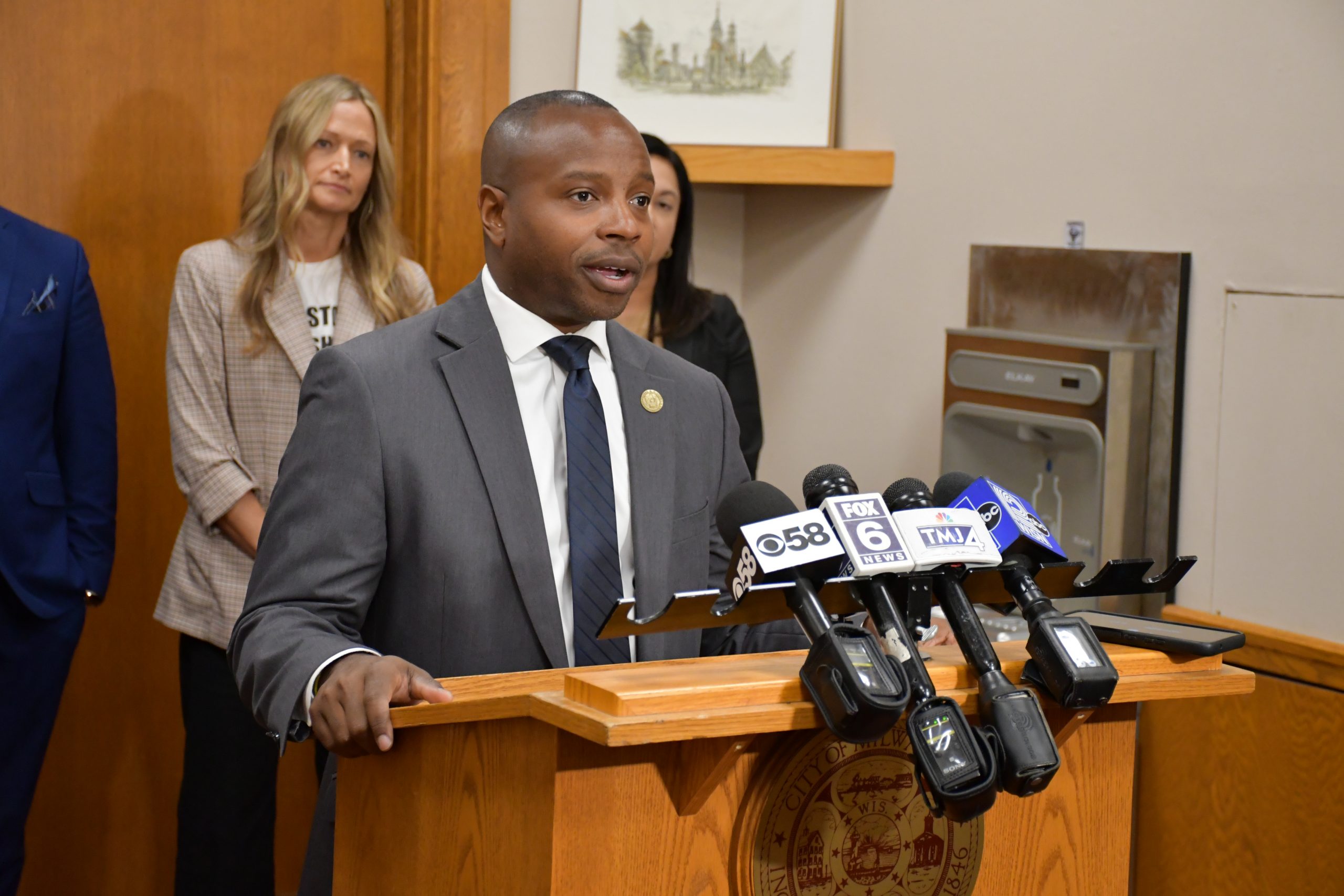
Mayor Cavalier Johnson speaks at an August 2025 press conference. Photo by Jeramey Jannene.
Mayor Cavalier Johnson will present a $2.26 billion budget Tuesday that increases police and fire staffing, puts a record amount of local money into Milwaukee’s streets and avoids layoffs.
But doing so will require the city to reach deeply into its reserves.
Johnson’s proposed 2027 budget started with a $96.8 million structural gap, the difference between what city departments said it would cost to maintain services and the revenue the city expected to collect. The gap is slightly smaller than the $100.9 million hole the administration faced a year ago, but remains far larger than the deficits Milwaukee routinely confronted before the COVID-19 pandemic.
The administration proposes closing the $96.8 million gap with about $42.8 million in reserve withdrawals, $20.5 million in revenue increases and $33.5 million in reductions from departments’ requested spending.
“I want to protect people’s pocketbooks but also want to make sure they get the services that they need,” said Johnson in a budget briefing with Urban Milwaukee.
And while Johnson’s budget holds steady for 2027 with minimal cuts and tax and fee increases, the city still faces a substantial fiscal straightjacket, where its ability to raise revenue is far outpaced by the growing cost of providing services.
“This stability is a mirage,” Budget and Management Director Nik Kovac said while explaining the city’s recent budget picture. The city has repeatedly reduced its cost-to-continue spending, raised revenue and tapped reserves, creating a new baseline each year but not eliminating the underlying imbalance.
Johnson and Kovac see it as a structural issue the city will need to solve with the help of the state. They point to the state’s decision to effectively freeze shared revenue in 1996. If it were indexed to inflation, the city would receive an extra $207 million in 2027 and $3.6 billion since 1995.
“That’s money that I could be investing into roads without having to jack up some other fee on our citizens here,” said Johnson.
In addition to holding down shared revenue, the state has also blocked the city from raising other revenue. A 2% sales tax was only approved in 2023 with the addition of requirements on police and fire spending and a host of unrelated policy provisions.
“Our ability to raise revenue to take care of our services is put in a box by Madison,” said Johnson. “I would like more shared revenue. I would like the state to allow us to diversify our revenues as well.” He cited legalized marijuana as one example.
Taxes Up, Tax Rate Down
The total city property tax levy would rise approximately 2%, from $336.8 million to $343.6 million.
Because assessed values are also growing, the city’s projected tax rate would fall from $7.61 to $7.29 per $1,000 of assessed value.
That does not mean the typical homeowner’s city tax bill will fall. Kovac said the Budget Office currently estimates an approximately 3.1% increase for the average homeowner, though the figure can change as assessments are finalized. The gap between the tax levy and the homeowner increase is in large part due to the change in value of residential properties versus commercial properties.
User fees, on average, would increase about 3%.
The average Milwaukee homeowner, with an assessment of $207,400, would see the city share of their property tax bill climb to $1,512, a $45.50 increase, and their fees climb by $16.54 to $622.62.
Unlike last year, there would be no increase in the city’s vehicle registration fee. The wheel tax would remain $41.
There is one conspicuous exception to the relatively modest fee increases: parking.
As Urban Milwaukee previously reported, the annual overnight parking permit would double from $55 to $110, parking citations would increase by $10 and downtown meter rates would rise from a minimum of $2.25 an hour to $3.
The administration expects the changes to generate $6 million that would be transferred from the Transportation Fund into the capital budget for street work.
The resulting $19.2 million local-road program is the largest in city history and includes $12 million for high-impact paving and $7.2 million for local street reconstruction. It would be added to existing state and federal aid. The budget also includes another pothole patching vehicle and an additional asphalt hot box.
More Police And Firefighters
State law makes it difficult to cut the city’s largest departments to balance the budget.
Act 12, the 2023 sales tax legislation, established minimum police and fire staffing requirements. Police and fire are also the city’s two largest levy-supported departments. The Department of Public Works, the third largest, receives much of its funding from user charges, meaning cutting services can simultaneously eliminate revenue.
Johnson’s proposal funds three Milwaukee Police Department recruit classes of up to 65 people each, the maximum possible.
But funding academy classes and actually adding officers have increasingly become two different things.
The administration expects MPD’s average sworn strength to increase by only 14 officers, from 1,565 in 2026 to 1,579 in 2027, after accounting for retirements and other attrition.
Despite funding the recruiting classes at their max capacity for multiple years in a row, the city has struggled to find qualified applicants to fill the roles. According to data presented last week by MPD to the Public Safety & Health Committee, the next recruiting class graduation will include a max of 29 members, less than 50% of its capacity.
The Milwaukee Fire Department would fare somewhat better in translating additional positions into daily staffing.
Johnson proposes adding 15 firefighter positions, enough to increase MFD’s daily minimum staffing level from 207 to 211 and put one additional heavy apparatus in service each day.
MFD had requested enough staffing for two additional apparatus groups. Funding one rather than two saves more than $1 million compared with the department’s request, Kovac said.
Exactly where the additional apparatus would operate would be a decision for Fire Chief Aaron Lipski.
Reserves Do Heavy Lifting
The largest single tool for balancing the 2027 budget is money the city has already saved.
The Tax Stabilization Fund finished 2025 with $79.6 million. Johnson proposes withdrawing half, $39.8 million, to maintain services.
The city would also withdraw $6 million from its Public Debt Amortization Fund, twice the $3 million assumed when departments submitted their budget requests. Because that initial $3 million was already factored into the starting projections, the two reserve moves together close $42.8 million of the original $96.8 million gap.
“I don’t want to have to tap into our reserves that deeply in order to balance our budget,” said Johnson.
The city has been able to repeatedly use substantial reserves without exhausting them because its financial results have recently beaten budgeted assumptions. Sales tax collections came in above initial estimates and high vacancy rates produced savings on wages and health insurance.
Kovac does not expect those benefits to continue at the same scale.
“We took out $32.3 [million] the last two years, and the fund has grown while doing that,” he said. But the city now has enough sales-tax history to make more accurate projections, while vacancy rates have fallen. “Eventually the pessimists will be right.”
Kovac warned the Common Council in August that reserve withdrawals would likely again be the biggest budget-balancing mechanism in 2027, but said there were “many reasons to believe” that would not be sustainable in 2028 and beyond.
Violence Prevention Gets More City Money
The budget would also use property tax dollars to maintain violence-prevention work that had previously benefited from the city’s $394 million American Rescue Plan Act allocation, which expires at the end of 20226.
The special-purpose account supporting contractors working with the Department of Community Wellness and Safety would increase from $750,000 to $1.75 million.
Kovac said the $1 million increase is intended to preserve the current level of violence-interruption work now that ARPA funding is gone.
No Layoffs, But Vacancies And Library Hours Cut
The $33.5 million in expenditure reductions would not produce layoffs, according to the administration.
Instead, departments across city government will see positions that were funded but vacant in 2026 become unfunded in 2027. DPW, because of its size, accounts for a substantial share, but Kovac said the approach was used throughout city government.
The administration says it does not anticipate major service reductions as a result.
One visible exception involves libraries.
The Common Council expanded Sunday service this year from Central Library and two branches to Central and four branches. Johnson’s budget would not fully continue the expansion, returning to Central plus two branches and saving approximately $500,000 compared with the requested budget. The Milwaukee Public Library board would determine which libraries to operate.
“I’m just saying we should have Central plus two [more],” said Johnson.
The proposal would also eliminate staffed drive-up service at Central Library, though patrons would retain a way to return materials when the building is closed.
General city workers would receive a 2% pay increase beginning during the second quarter. Kovac said the delayed implementation is tied in part to the city’s transition to its new enterprise resource planning and payroll system at the start of the year. It also reduces the cost.
State Aid Gap
Johnson and Kovac continue to argue that Milwaukee’s structural problem cannot ultimately be resolved at City Hall alone.
The administration’s budget documents show Milwaukee receiving $260 million in state shared revenue in 2027. Had the $224.4 million it received in 1995 simply grown with inflation, the city calculates it would receive $467.4 million.
Johnson said he would prefer additional state aid to raising local taxes and fees.
“If shared revenue just kept pace with inflation from ’96 when they froze it,” he said, the city would have substantially more money available for roads and other services.
Act 12 partially reversed that trend. The sales tax produced more than $200 million in its first year and the law increased shared revenue, but it also imposed public safety spending requirements and coincided with the transition of new employees into the Wisconsin Retirement System.
The result, according to Kovac, is that recent budgets appear more stable than the crisis budgets of 2023 and 2024, but the remaining gap is difficult to eliminate.
Big Capital Projects Continue
Johnson would maintain $116 million in new general-purpose borrowing, the third and final year of what his administration has described as a temporary capital spending surge.
The Common Council increased that figure to approximately $120 million in each of the past two budgets.
The city has used the additional borrowing capacity for several major projects, including new public-safety radios, replacement financial and human-resources software and city contributions to the Port Milwaukee cruise ship terminal.
For 2027, the capital budget begins funding a new Midtown library branch and continues funding for a new DPW municipal services facility in the 30th Street corridor.
The latter project would ultimately allow the city to leave its aging riverfront facility in the Menomonee Valley, which costs up to $2 million annually to maintain. Johnson said moving those operations would also free valuable riverfront property for private development.
The proposal comes before the Common Council Tuesday morning. The council’s Finance & Personnel Committee will spend October reviewing individual departmental budgets and proposed amendments. It is scheduled to review amendments on Oct. 30, with the council adopting its budget on Nov. 6. Johnson could then veto any provisions, sending them back to the council for a potential override.
A $2.26 Billion Budget
On paper, total city spending rises substantially.
Budget authority would increase approximately $185.4 million, or 8.9%, from $2.076 billion in 2026 to $2.261 billion in 2027.
Much of that increase, however, is not additional day-to-day departmental spending.
Capital improvement authority rises by approximately $79.9 million, city debt spending increases $54.4 million and employee retirement spending increases $12.2 million. Spending categorized as general city purposes rises by approximately $31.1 million.
The city’s pension and retirement costs have become a major piece of its long-term financial challenge. The proposed employee retirement budget totals approximately $273.4 million.
UPDATE: An earlier version of the article had the wrong amount for the parking citation increase.
If you think stories like this are important, become a member of Urban Milwaukee and help support real, independent journalism. Plus you get some cool added benefits.
More about the 2027 City of Milwaukee Budget
- Milwaukee’s Financial Strains Growing, Warns Policy Forum - Jeramey Jannene - Oct 9th, 2026
- City Budget Boosts Police, Fire and Violence Prevention, But At A Price - Jeramey Jannene - Sep 22nd, 2026
- Mayor’s Budget Proposal Includes Record Amount For Local Streets - Jeramey Jannene - Sep 20th, 2026
Read more about 2027 City of Milwaukee Budget here
Political Contributions Tracker
Displaying political contributions between people mentioned in this story. Learn more.
- June 23, 2025 - Cavalier Johnson received $250 from Aaron Lipski
- September 20, 2023 - Cavalier Johnson received $250 from Aaron Lipski
- May 7, 2015 - Nik Kovac received $10 from Cavalier Johnson