

Mayor’s Budget Proposal Includes Record Amount For Local Streets
Will the council and public demand even more?
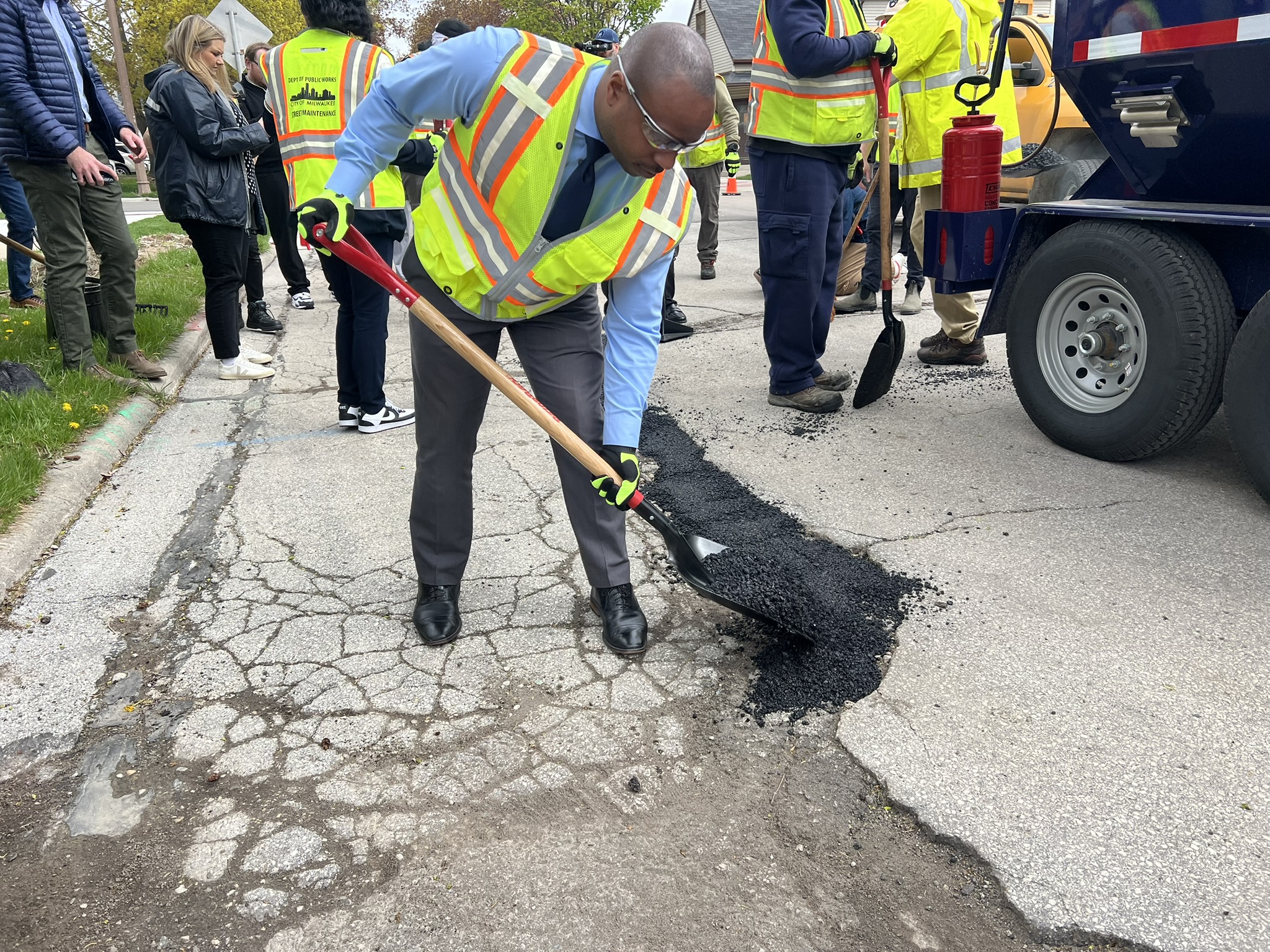
Mayor Cavalier Johnson fills a pothole in the Johnson’s Woods neighborhood. Photo by Jeramey Jannene.
Everyone wants to talk to Mayor Cavalier Johnson about roads.
Heavy April rains and a challenging freeze-thaw cycle created a record number of potholes, straining the city’s aging street network.
As Johnson made the rounds at community events, knocked on doors or marched in parades, residents let him know.
“That’s one of the consistent things I heard, no matter where I went in Milwaukee: roads, roads, roads, roads, roads,” Johnson said in previewing his 2027 budget with Urban Milwaukee.
And he’s listening.
“We’re going to make a pretty significant investment in roads,” said Johnson.
Johnson’s proposed budget, which he will unveil Sept. 22, includes a record amount of local funding to address the issue.
The capital budget will include $19.2 million for local road construction, plus additional funding to buy more equipment to improve the city’s pothole-filling operation. The total eclipses the 2025 high of $18 million, when the council overrode two mayoral vetoes to add $6 million primarily via borrowing. The city also receives millions annually from the state and federal government to repave arterial streets and highways, like National Avenue.
A total of $12 million would be allocated to the Department of Public Works high-impact paving program, which replaces the top layer of asphalt to extend the life of a street by a decade or more. At a cost of $175,000 per lane mile, and with four lane miles in a standard street (two parking lanes and two driving lanes), DPW could repave 17 miles of side streets using the asphalt overlay technique in 2027.
The 2027 budget would also include $7.2 million for local street reconstruction. That’s down from $8.7 million in 2026, but still above the decade average. Full reconstruction of local streets costs about $1 million a lane mile.
According to DPW’s 2026 budget presentation, the city is responsible for 4,642 lane miles of streets. More than 75% are local streets, not generally eligible for state or federal reconstruction funding.
A 2022 analysis found that a quarter of all roads were in “poor” condition. The city has struggled for years to find a sustainable way to address the issue.
The latest funding surge would be sustainable, but it would come at a cost for residents and visitors who park on the city’s streets.
The cost of overnight parking permits, required to leave a vehicle on a city street overnight, would double from $55 a year to $110.
The cost of all parking citations would also increase by $10.
Downtown parking meters would increase from a minimum of $2.25 per hour to $3.
A budget office analysis estimates that the three changes would yield $6 million a year for the high-impact paving program, enough to rebuild 34 lane miles.
It would also, said budget director Nik Kovac, allow the city to continue to borrow for other capital needs.
Pothole process improvements
“We’ll also make investments in some equipment to maintain roads,” said Johnson.
Urban Milwaukee broke the news in February that the Milwaukee Brewers would partner with the city to purchase an asphalt hot box for $27,500. The equipment allows the city to store and reclaim otherwise wasted hot asphalt, which lasts longer when it is used to patch potholes.
The city, said Johnson, would purchase an additional box, bringing its total to three.
The city would also purchase another pothole patching vehicle, which requires only a single operator.
“Those can fill, it’s my understanding, 1,800 potholes a year,” said Johnson. The city is on track, by the end of August, to have filled more than 16,000 potholes.
After the purchase, the city would have five of the vehicles in its fleet. Each machine costs about $300,000.
“This is a big concern that folks have,” said Johnson of the thousands of outstanding pothole reports. “I want to listen to where the electorate is on this and where the voters are, where the citizens are and make that investment.”
After Johnson presents his budget on Sept. 22, the Common Council will spend the next month reviewing it and potential amendments. The full council will adopt the budget in November.
Look for coverage on the full proposal on Tuesday.
UPDATE: An earlier version of the article had the wrong amount for the parking citation increase.
If you think stories like this are important, become a member of Urban Milwaukee and help support real, independent journalism. Plus you get some cool added benefits.
More about the 2027 City of Milwaukee Budget
- Milwaukee’s Financial Strains Growing, Warns Policy Forum - Jeramey Jannene - Oct 9th, 2026
- City Budget Boosts Police, Fire and Violence Prevention, But At A Price - Jeramey Jannene - Sep 22nd, 2026
- Mayor’s Budget Proposal Includes Record Amount For Local Streets - Jeramey Jannene - Sep 20th, 2026
Read more about 2027 City of Milwaukee Budget here
Political Contributions Tracker
Displaying political contributions between people mentioned in this story. Learn more.
- May 7, 2015 - Nik Kovac received $10 from Cavalier Johnson


Transportation
-
MKE GO Pilot Aims To Cut Solo Driving, Not Take Away Cars
 Sep 21st, 2026 by Jeramey Jannene
-
Credit Card Payments at Milwaukee Parking Meters to Stop Oct. 1
 Sep 18th, 2026 by Jeramey Jannene
-
See The Drastic MCTS Redesign Concepts
 Sep 16th, 2026 by Graham Kilmer













Meanwhile the MCTS budget and routes are stripped down to nothing, year over year, decade over decade.
If this mayor wants the streets to be less messed up, how about we get fewer vehicles on the road? How about we incentivize alternative modes of transportation? Everyone has to use cars to do everything due to this exact disinvestment.
https://www.mercurynews.com/2026/08/07/los-angeles-drivers-paid-to-go-carless/