

After 81 Days In ICE Detention, Salah Sarsour Fights To Stay In Milwaukee
Immigration judge in Chicago hears conflicting stories of torture, terrorism and due process in high-profile case.
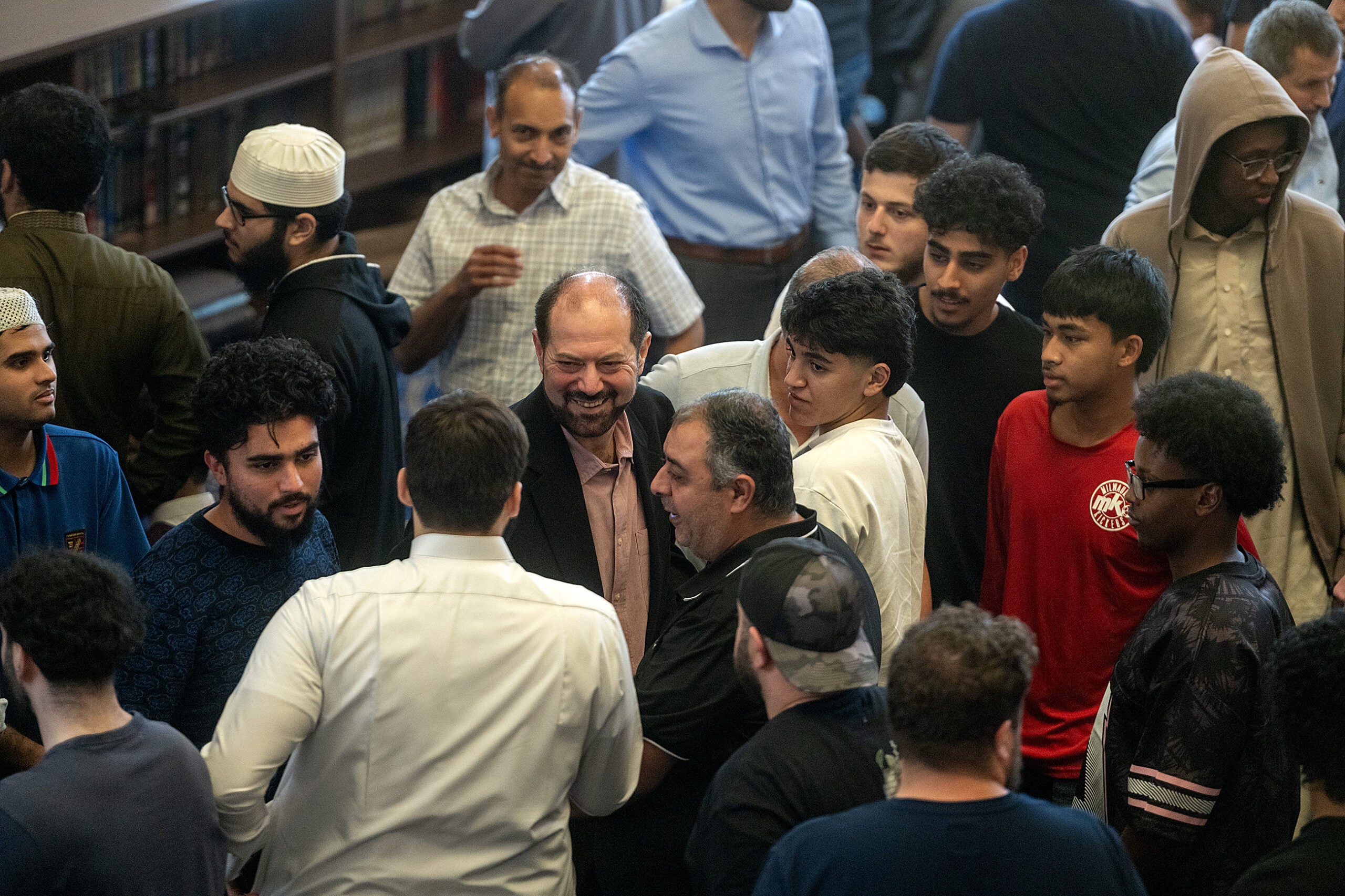
Salah Sarsour is greeted by members of his community Friday, June 19, 2026, at the Islamic Society of Milwaukee in Milwaukee, Wis. Angela Major/WPR
An immigration judge took testimony all day Wednesday in the U.S. government’s prosecution of Salah Sarsour, the leader of Wisconsin’s largest mosque who was detained by immigration officials in March.
Sarsour, who leads the Islamic Society of Milwaukee, was released from federal detention in June, amid concerns from his lawyers about his declining health. He appeared in immigration court in Chicago Wednesday, alongside his lawyers, before Assistant Chief Immigration Judge Jayme Salinardi.
Scott Jebson represented the U.S. Department of Homeland Security, which has alleged that Sarsour lied about his criminal history on his green card application after he left Ramallah, in the West Bank, and settled in Wisconsin.
The government has called Sarsour a “terrorist” who was convicted of throwing an explosive device at Israeli soldiers as a young man. Throughout Wednesday’s hearing, Sarsour’s team sought to paint that conviction as dependent on a coerced confession. They maintain that the government has known about Sarsour’s conviction for years, and that Sarsour is being targeted for his pro-Palestinian activism.
“Why should people care about this case? Because targeting Mr. Sarsour is all about sending a signal, not to speak up for Palestinian rights,” said Patrick Taurel, Sarsour’s lead immigration attorney.
Sarsour was incarcerated in Israeli prisons twice, once as a teenager in the late 1980s, and again at the age of 22 in 1994, after he had been approved for a visa and moved to the United States. His team alleges that he returned to visit family, was arrested trying to return to America, and tortured during that detention. They said he was forced to sign documents confessing to crimes he didn’t understand.
Sarsour was granted a green card in 1998.
Throughout the eight-hour hearing Wednesday, Sarsour’s team brought up his brother, Mohammad, to testify through an Arabic language interpreter that Sarsour was pale, dirty and in pain when he was released from Israeli detention in 1994.
They also consulted Alan Hirsch as an expert on coerced confessions, and Sari Bashi, a human rights lawyer based in Israel.
After the hearing, Sarsour spoke briefly with reporters, saying that he is being targeted for free speech.
“My family has been through a nightmare experience with my unjust arrest, with 81 days of detention by ICE, as you know, and that continues with this hearing,” he said.
Hearing focused on alleged coercion of confessions
Throughout Wednesday’s hearing, Jebson, the DHS lawyer, attempted to discredit the three witnesses. He pointed to discrepancies in Mohammad Sarsour’s description of the events of 1994, such as saying that he was not allowed to visit his brother in jail, but was also told by Israeli police to encourage his brother to sign the documents.
Jebson asked Mohammad Sarsour how he could claim he was being denied access, if he was also being told to speak to his brother.
“They can do whatever they want,” Mohammad Sarsour said through the interpreter.
Hirsch, a retired professor at Williams College, testified that Sarsour’s confession was likely “unreliable” because of the conditions of his incarceration and how young he was while detained.
Jebson again pointed to discrepancies in Sarsour’s account, such as stating that he was in solitary confinement for 78 days before signing the confession, whereas the date of the confession was two weeks after he was arrested.
Bashi, the executive director of the Public Committee Against Torture in Israel, spoke about the conditions under which Sarsour was detained and what he might have faced in Israeli jails. She said that during the First Intifada — a period of Palestinian unrest and both violent and nonviolent protest between 1987 and 1993 — tens of thousands of young men were arrested.
She testified that the Israeli government maintained a very high conviction rate, which she argued is partly a result of coercion, such as sleep deprivation, placing prisoners in stress positions or threatening their families with physical and sexual violence. She said that it’s not unusual for detainees to sign confessions written out in Hebrew, whether or not they could read that language, and said that the Moscovia Detention Centre, where Sarsour was held, was and is notorious for its treatment of prisoners.
Jebson pointed out that Bashi was an undergraduate student in the United States at the end of the first Intifada, and would not have firsthand knowledge of the conditions that Palestinian prisoners faced in Israel during that time.
Sarsour’s team has repeatedly argued that Sarsour is being denied due process, in part because of the speed of the case against him. Sam Cole, a former immigration judge now working as chief immigration litigation counsel at the ACLU of Illinois, argued that, because he is no longer being held in detention, the case is going too quickly.
“We asked that this case be slowed down, put on a normal time frame, just like other cases for individuals who are not in detention. And the judge denied our request, and that’s extremely concerning,” Cole said.
Sarsour was arrested on March 30, and held in the Clay County Jail in Indiana for almost three months. His immigration proceedings will continue next Wednesday, and Sarsour’s attorney said they expect at least one more hearing after that, at which Sarsour is likely to testify himself.
Deportation hearing begins for Milwaukee Muslim leader Salah Sarsour was originally published by Wisconsin Public Radio.
If you think stories like this are important, become a member of Urban Milwaukee and help support real, independent journalism. Plus you get some cool added benefits.
More about the Arrest of Salah Sarsour
- Immigration Judge Orders Deportation of Milwaukee Muslim Leader - Graham Kilmer - Sep 30th, 2026
- Deportation Trial for Milwaukee Muslim Leader Wraps Up - Graham Kilmer - Sep 15th, 2026
- PTSD and Torture Claims by Salah Sarsour Contested in Federal Hearing - Isiah Holmes - Jul 30th, 2026
- Palestinian Community Leader Salah Sarsour Continues to Face Accelerated Deportation Proceedings in Immigration Court - Press Release - Jul 29th, 2026
- After 81 Days In ICE Detention, Salah Sarsour Fights To Stay In Milwaukee - Anya van Wagtendonk - Jul 23rd, 2026
- Libertarian Party of Wisconsin Calls ICE Detention of Milwaukee Mosque Leader a Threat to Free Speech - Libertarian Party of Wisconsin - Jun 23rd, 2026
- Judge Orders Release of Milwaukee Islamic Leader - Graham Kilmer - Jun 18th, 2026
- Congresswoman Gwen Moore Applauds Court Order Requiring Release of Salah Sarsour From ICE Detention - U.S. Rep. Gwen Moore - Jun 18th, 2026
- Congresswoman Gwen Moore Statement on Second Visit to Conduct Wellness Check on Salah Sarsour - U.S. Rep. Gwen Moore - Jun 15th, 2026
- Muslim Leader’s Health Deteriorating in Immigration Lockup - Graham Kilmer - Jun 9th, 2026
Read more about Arrest of Salah Sarsour here



















Unrelated but illustrates how the current government of Israel works. A 20 year old Palestinian American citizen born in the US named Sama Safi was kidnapped by the Israeli army on June 2nd.
“The young woman informed the soldiers of her status as a U.S. citizen, but they ignored her claims, Sen. Chris Van Hollen, D-Md., said in a video posted on his Twitter account. Van Hollen said he communicated with Safi’s mother.
According to an Israeli military spokesperson quoted by The Guardian via the Jerusalem Post, Safi, together with three other female students of Birzeit University, was detained for the promotion of hostile terrorist activity and other similar offenses”.
“By June 2026, Israel was detaining more than 3,300 Palestinians in administrative detention without charge or trial, as part of about 9,000 Palestinians detained as security prisoners”.
Scary part is that our current government is trying to emulate these Israeli tactics. Accuse someone of being a terrorist, detain or arrest them indefinitely, story over, good day sir, thank you for your attention to this matter. Media silence.
I am ashamed of my government and pray that this national nightmare will soon end.