

Wisconsin Senate Sinks Bipartisan Tax And School Funding Deal
Evers, Vos and LeMahieu’s retirement-year compromise unravels amid revolt and 2026 politics.
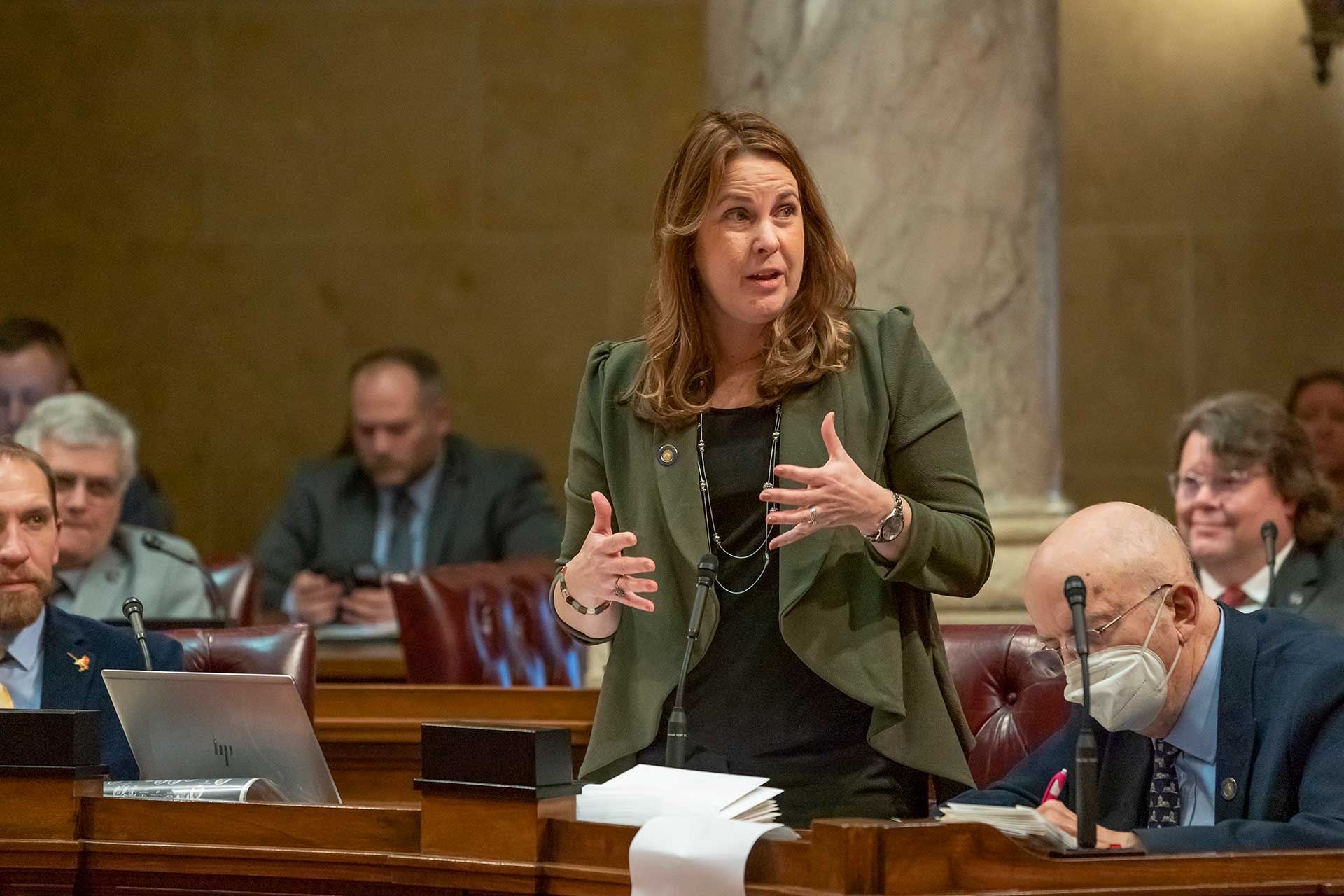
Sen. Dianne Hesselbein (D-Middleton) speaking on the Senate floor. Hesselbein was named Senate minority leader in December of 2023 and was reelected to that position in November of 2024. Photo courtesy of Sen. Dianne Hesselbein’s office
A bipartisan deal between Democratic Gov. Tony Evers and GOP leaders blew up Wednesday night in the Wisconsin Legislature, following days of attacks from lawmakers and gubernatorial candidates from both parties.
The measure, which would have spent $1.8 billion on a combination of tax cuts and special education funding, was the product of months of talks between Evers, Assembly Speaker Robin Vos, R-Rochester and Senate Majority Leader Devin LeMahieu, R-Oostburg. All three are set to retire after this term, a status that gave them more leeway to negotiate.
But rank-and-file members of the Legislature were less willing to go along with the plan, particularly in the Senate, where Democrats were openly frustrated that they were frozen out of negotiations.
Most of the candidates for governor also came out against the deal, including U.S. Rep. Tom Tiffany, the GOP frontrunner. Tiffany was in contact with Senate Republicans, WisPolitics reported, voicing his opposition to the bipartisan deal.
The bill initially proceeded as planned in the state Assembly, where lawmakers met to debate in the morning before breaking for roughly eight hours.
It would have reduced the state’s projected $2.5 billion surplus by about $1.8 billion, with the bulk of it going to tax relief.
In a speech Wednesday morning, Vos said that at a fundamental level, lawmakers had three ways to use the surplus: save it, spend it or give it back to taxpayers.
“We want to give it back,” Vos said. “Some Democrats want to keep it. Luckily, Tony Evers isn’t one of those.”
Vos noted that 80 percent of the bill — nearly $1.5 billion — would go toward tax relief.
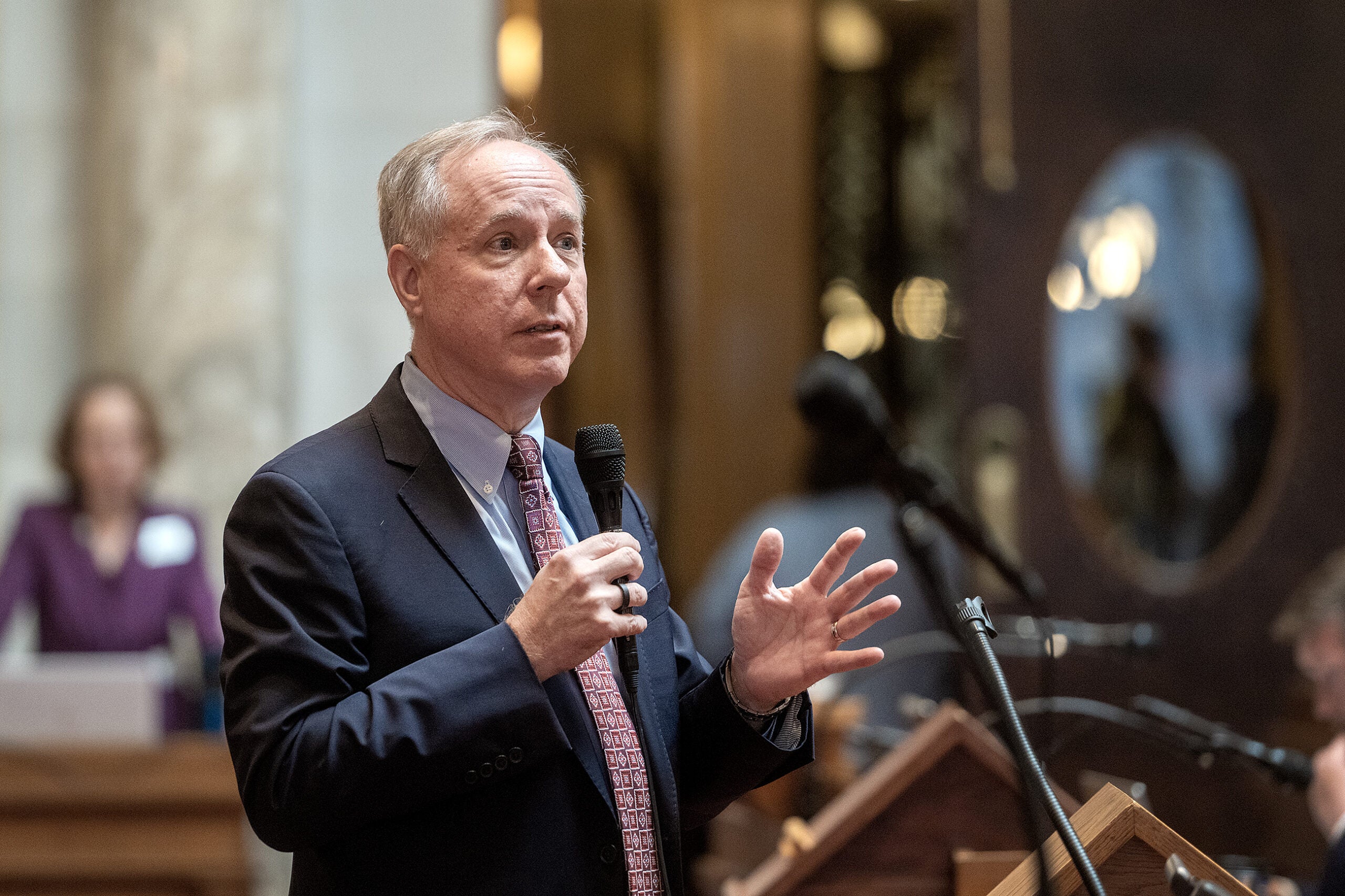
Republican Assembly Speaker Robin Vos speaks during a special session Wednesday, May 13, 2026, at the Wisconsin State Capitol in Madison, Wis. Angela Major/WPR
The measure passed the Assembly on a bipartisan 61-32 vote.
But in the Senate, the votes simply were not there. All Democrats voted against the bill, along with three Republicans — Sens. Steve Nass of Whitewater, Chris Kapenga of Delafield and Rob Hutton of Brookfield. It failed 15-18.
Senate Minority Leader Dianne Hesselbein, D-Middleton, blasted the bill and the process by which it was created. She said Evers, Vos and LeMahieu had left Senate Democrats completely out of discussions, and the final product would leave a structural budget deficit next session.
“This is a completely reckless proposal stitched together in a backroom deal by three people who will not be running (again) and won’t be here when the consequences of a multi-billion dollar deficit comes home to roost,” said Hesselbein. “It’s simply something I can’t support.”
Hesselbein, who could be majority leader in 2027 if Democrats flip the Senate, said her members had ideas for how to amend this bill, and she presented them to Republicans.
“I was told nobody was interested in what we had to say,” Hesselbein said. “So, here we are.”
Nass, who had said in the runup to the vote that he would “stand with Tom Tiffany,” also blasted the bill’s spending.
“What we’re doing now is mortgaging our future and our children’s future, to some extent, for the temporary convenience of the present,” said Nass.
Both Nass and Hutton have announced they won’t seek reelection.
After bill’s failure, blame game begins
In the immediate aftermath of the bill’s failure, a furious blame game began.
LeMahieu attacked Democrats, arguing they had voted to “leave $2.5 billion sitting in a Madison bank account” instead of helping schools and providing tax relief.
“Today, we’ve seen the worst of Madison politics,” LeMahieu said in a written statement.
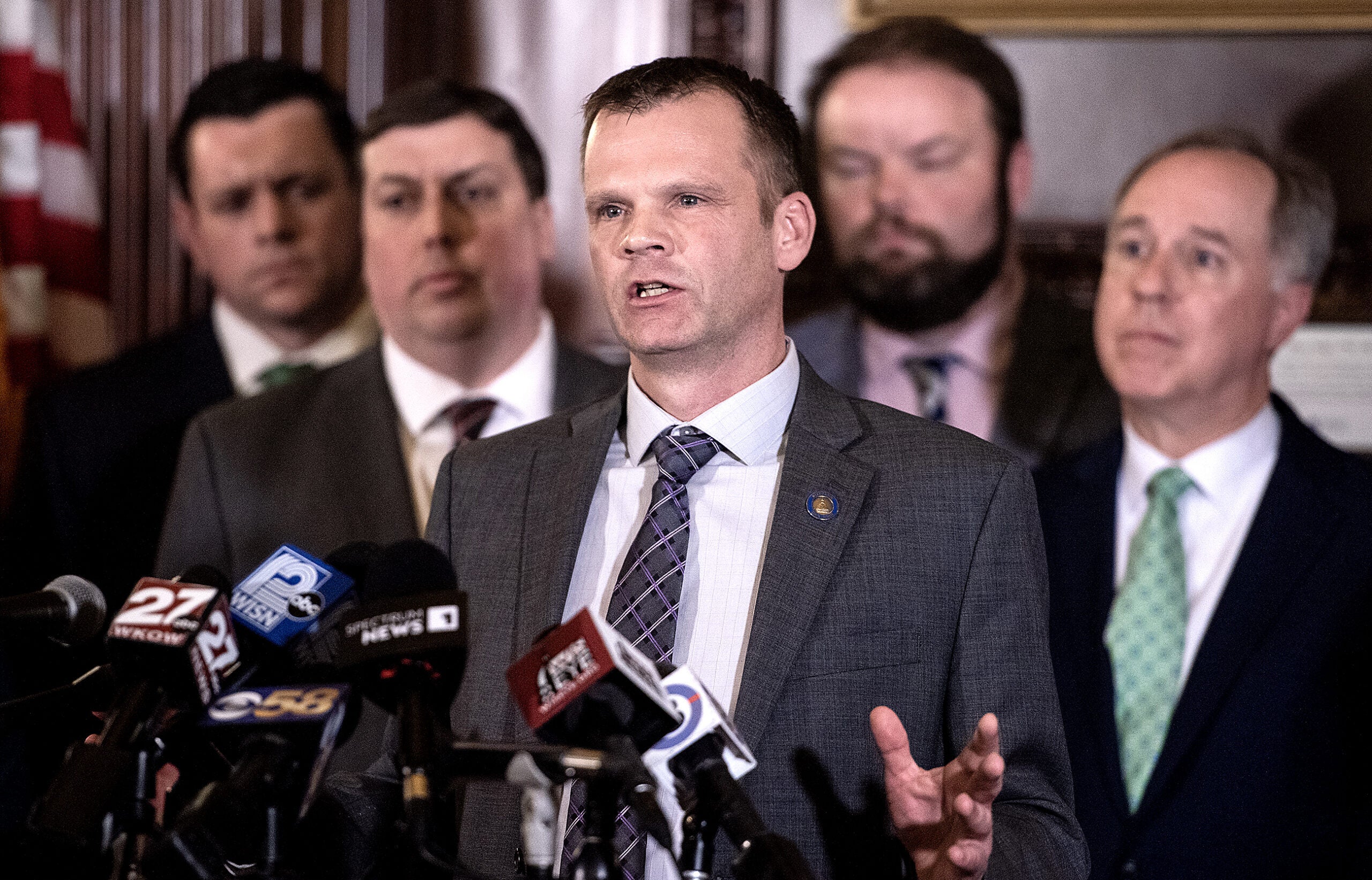
Senator Devin LeMahieu speaks to reporters after an address by Gov. Tony Evers on Wednesday, Feb. 15, 2023, at the Wisconsin State Capitol in Madison, Wis. (Angela Major/WPR)
Evers attacked Tiffany, and Democratic lawmakers, for blowing up the deal.
“Wisconsin’s kids and schools aren’t going to get the investments they desperately need this year because Tom Tiffany and a few Republican and Democratic lawmakers chose to blow up a bipartisan plan,” Evers said in a written statement. “All because they’d rather do what’s best for the next election than what’s right for the people of our state.”
“So many Wisconsinites feel left behind, frustrated, and disillusioned by politics these days because they think a lot of politicians in the Capitol are only here to serve themselves,” Evers continued. “And, today, they’re right.”

Gov. Tony Evers takes questions from eighth-graders Monday, May 11, 2026, in Barneveld, Wis. Angela Major/WPR
What happened at the state Capitol Wednesday is exceedingly rare in the Wisconsin Legislature, where surprises are few and far between.
Usually when bills get put on the agenda, it means leaders have already secured the votes to pass them. Any debate is more about messaging than it is about changing minds.
There was thought that some of the bipartisan votes in the Senate earlier this session, on everything from the budget to bills on online gaming, could carry over to this deal. Senate Democrats played a big role in those discussions, in concert with Evers.
The content of this bill was also reminiscent of election years past. It would have sent most Wisconsin income taxpayers up to $300 payments, with the money to arrive before November. And it would have cut income taxes on tips and overtime and devoted about $350 million to reducing property taxes.
Notably, it would have also spent $315 million on special education, which was Evers’ top priority, and the reason he agreed to many of the tax cuts.
Lawmakers from swing districts who voted for the plan will be able to tell constituents they worked with the other side to try to achieve those goals. But, barring the unexpected, it will be up to the next Legislature and governor to decide how this money gets spent.
Deal to cut taxes, boost special ed funds, dies in Wisconsin Senate was originally published by Wisconsin Public Radio.
If you think stories like this are important, become a member of Urban Milwaukee and help support real, independent journalism. Plus you get some cool added benefits.




















If Evers froze out the Senate Dems, this is largely his fault.
I don’t get it.
Democrats are supposed to be pro-education. Republicans are supposed to want to give money back to the people. Here we have both and . . .
The people of Wisconsin suffer because . . . the children of Wisconsin suffer . . .
Why do we keep voting for people who can’t work together to improve the situation for the people of Wisconsin?