

Wisconsin Data Center Tax Break Will Cost Taxpayers More Than $2 Billion
A loss of $1.5 billion during construction and $369 million annually after that.
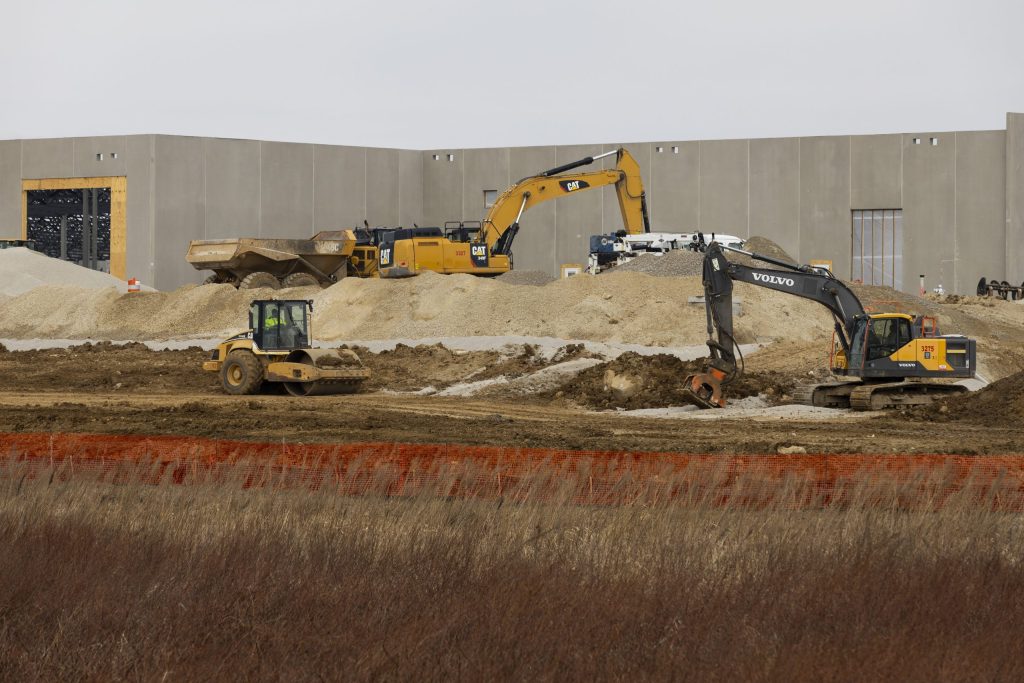
Construction continues at the Beaver Dam Commerce Park where a new Meta data center is being built, March 31, 2026, in Beaver Dam, Wis. (Joe Timmerman / Wisconsin Watch)
Wisconsin is poised to forgo more than $2 billion in sales tax revenue to subsidize hyperscale data centers built by trillion-dollar companies such as Microsoft and Meta.
Data centers were granted a sales tax exemption in the 2023-25 state budget, which was approved by the Republican-controlled Legislature and Democratic Gov. Tony Evers as a way to attract economic development to the state.
That means the $1 billion data center in Beaver Dam, a $20 billion complex in Mount Pleasant and a $15 billion facility in Port Washington don’t have to pay the 5% state sales tax, or local sales taxes, on purchases for constructing and equipping their facilities.
When the budget passed in July 2023, the scale of the data center boom was so uncertain that the nonpartisan Legislative Fiscal Bureau did not estimate how much state revenue would be “forgone” under the exemption, aside from a hypothetical example.
But now a fiscal bureau projection is in:
The state will be out $1.5 billion in forgone state sales tax revenue during construction, which can take years, plus $369 million annually once the facilities are built.
The estimates apply to the hyperscale data centers under construction in Beaver Dam and Port Washington and the facilities under construction or planned in Mount Pleasant. A much smaller Epic project in Verona is also part of the estimate.
It’s unclear whether the data centers would have been built in Wisconsin without the tax incentive.
“Obviously it’s a big number, but it’s right to think that this is not really revenue that the state realistically could have ever captured,” said economist Ross Milton, a state government tax expert at the University of Wisconsin-Madison.
“It seems quite likely that if Wisconsin wasn’t providing incentives of these kinds, we wouldn’t be seeing these data centers being built here.”
Highlighting the fierce competition for development, 38 states offer data center sales tax exemptions or other tax breaks, according to the National Conference of State Legislatures.
Wisconsin offers sales tax exemptions for a wide array of products and services. One of the largest exempts food bought at the grocery store, which reduced state revenue by about $920 million in 2024.
Tricia Braun, executive director of the Wisconsin Data Center Coalition, a business group that supports data center development, pointed out that the fiscal bureau projection does not include economic benefits from data centers, including taxes paid by data center suppliers.
Wisconsin Watch reported in March that just three Wisconsin companies have done more than $1 billion in business supplying data centers.
Jason Stein, president of the Wisconsin Policy Forum, a nonpartisan think tank, said “the state has good possibilities for recovering” the forgone revenue. That could come from spending by construction workers and income taxes paid by those workers, their employers and permanent data center employees, as well as corporate income taxes and utility taxes, he said.
The unexpectedly large amount of forgone revenue has helped fuel efforts for data center regulation.
State Sen. Jodi Habush Sinykin, D-Whitefish Bay, who requested the estimate, said lawmakers should discuss what the state can get in return for the exemption. She said the exemption could be tied to, for example, requirements to protect the environment.
Habush Sinykin wants the Legislature, which Republicans control, to convene what is known as an extraordinary session to discuss a variety of data center bills, rather than waiting until the next regular session in January.
Sen. Romaine Quinn, R-Birchwood, and Rep. Shannon Zimmerman, R-River Falls, introduced legislation in 2023 that led to the exemption and have proposed expanding it. They did not respond to requests for comment.
Their original legislation received more than 200 hours of lobbying support from Microsoft, power companies such as We Energies and Alliant Energy, and business groups. No one registered to lobby against the bill.
Nationally, state data center legislation has shifted from incentives to regulation.
In 2021 and 2022, 44 of the 45 data center bills introduced in states across the U.S. offered tax and economic incentives, according to an analysis released April 22. Since then, many other types of legislation have emerged. In 2026, only 61 of the 262 state data center bills covered incentives. The vast majority dealt with regulation of energy, environment and transparency.
Some states, including Minnesota, have taken steps to restrict or roll back data center sales tax exemptions.
Data center opponent Shawn Haney, a former elected town board member in Dane County, said he understands that Wisconsin created its sales tax exemption to attract economic development. But he thinks it should be modified so that the state can collect some sales tax revenue from data centers.
“I don’t think anybody could have forecasted the size and magnitude of these massive data centers,” Haney said.
“You could do some good things with” the revenue, he said, tossing out a few ideas. “Look at all the roads we have to repair.”
This article first appeared on Wisconsin Watch and is republished here under a Creative Commons Attribution-NoDerivatives 4.0 International License.





















I wonder if anyone has taken the time to figure the total dollar amount of tax breaks data centers are being given nationwide. (I would guess it easily exceeds $10B). Small price to pay for the illusion of a strong economy we are being given due to the fact that AI will solve all the nation’s problems overnight. Somehow I get get the sneaking suspicion that the real world economy is leaving the US in the rear view mirror while we chase the easy money of AI and SpaceX. (I can’t even wrap my head around the fact that we spend $1T on the national defense yet our missile stockpile is being rapidly depleted. Apparently interceptor missiles are some kind of “boutique” handmade item that can only made in miniscule amounts annually).
Texas is reconsidering its data center tax break (https://www.texastribune.org/2026/04/08/texas-data-centers-sales-tax-break-billion-dollars/), and Wisconsin would be wise to do so, too. Giving the benefit of the doubt, both tax incentives were granted for the smaller-scale cloud hosting data centers. Those require a fraction of the land, power, and water the AI data centers do. The AI data center builders are taking advantage of the giant loophole that was created, though, and nothing says incentives can’t be reevaluated.
”
Jason Stein, president of the Wisconsin Policy Forum, a nonpartisan think tank, said “the state has good possibilities for recovering” the forgone revenue. That could come from spending by construction workers and income taxes paid by those workers, their employers and permanent data center employees, as well as corporate income taxes and utility taxes, he said.
”
A followup analysis of these side effects would help shed light. It seems highly unlikely the taxes on construction jobs will come anywhere near the revenue lost to sales taxes on construction materials. Data centers rarely employ more than a handful of operations employees, and likely most of those meager few will be remote anyway.
Frankly, if AI is inevitable, as its promoters like to say, that certainty should rest upon a steady, predicted, well-considered revenue model that would allow these data centers to pay for themselves without the need for incentives. Otherwise, it’s just another wild gamble that leaves the state, and Wisconsinites, holding the bag if it fails.
Did our state government learn nothing from the Foxconn (or as I prefer to call it Fox Con) fiasco?!? This AI data center trend will do nothing to improve the economies of the regions in which they operate once construction is completed and they are up and running, since they don’t require many employees to manage them.
I believe the foreseeable future will be filled with regret that these monstrosities were allowed without an annual tax bill being owed by them.
For profit companies being given more corporate welfare, all on the taxpayer dime. Talk it up, Wisconsin.
Tell us again…what does the average resident get from these data centers…in return?