

The Bermuda Triangle of Milwaukee’s Northwest Side
Intersection of 51st St., Capitol and Fond du Lac is a nightmare. Can it be fixed?
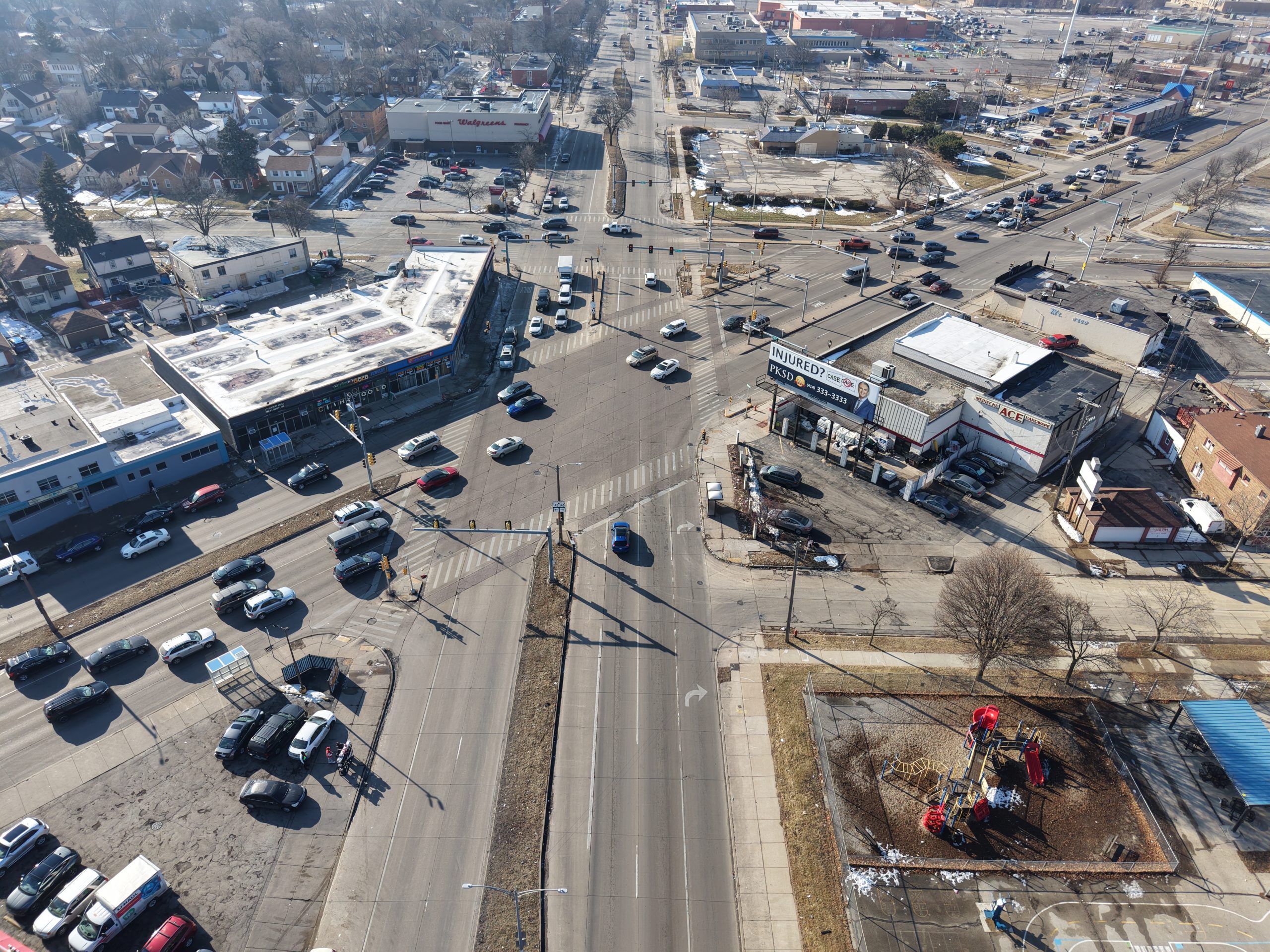
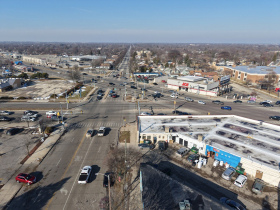
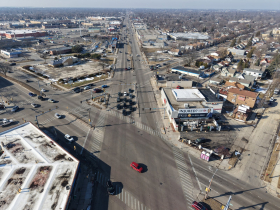
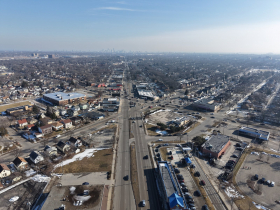
Looking west at the intersection of W. Capitol Drive, W. Fond du Lac Avenue and N. 51st Boulevard. Photo by Urban Milwaukee staff.
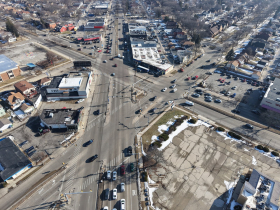
In the heart of Milwaukee’s Capitol Heights neighborhood is a sprawling concrete and asphalt expanse where three of the city’s critical arterials meet.
The intersection of 51st Boulevard, West Capitol Drive, and West Fond du Lac Avenue is a complicated and dangerous junction of streets. According to the Milwaukee Fire Department, the intersection consistently ranks as one of the three most dangerous intersections in the city, along with 35th and Burleigh and 27th and Center. According to the Wisconsin Department of Transportation (WisDOT), in 2025 there were 70 crashes at the intersection, 12 of which resulted in serious injuries.
The problem is complex due to a range of reasons, including governmental overlap, vehicle volumes and geometry. Fond du Lac Avenue and Capitol Drive serve as State Trunk Highways (145 and 190, respectively), meaning they are the responsibility of the WisDOT. 51st Boulevard belongs to the City of Milwaukee and is under the jurisdiction of the Department of Public Works (DPW). DPW has made admirable efforts to try to address safety issues by installing some curb extensions on the areas they maintain, but these need to be further scaled up.
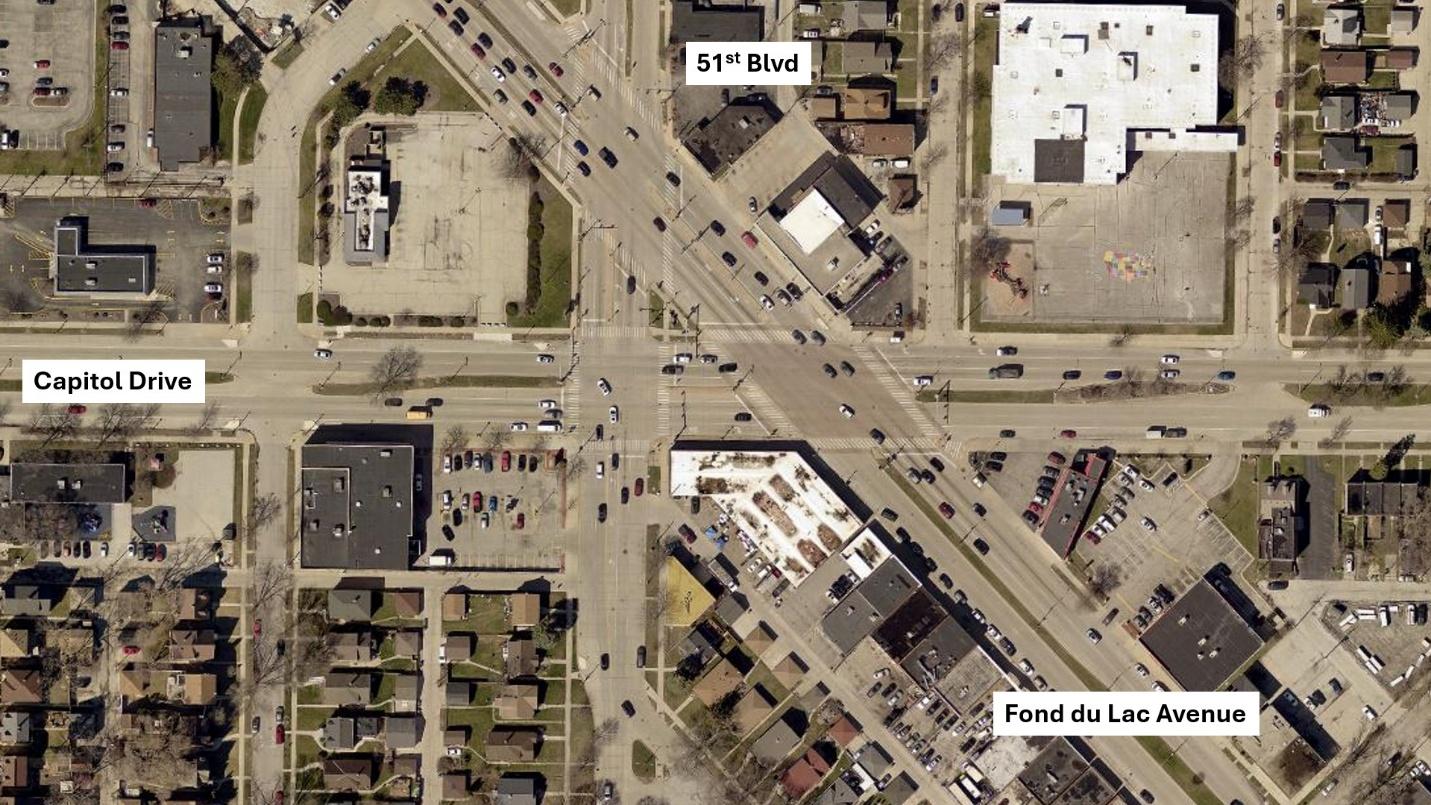
Aerial image of the intersection (source: Milwaukee County GIS)
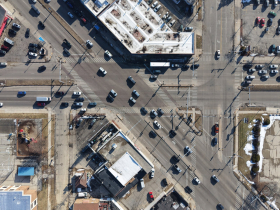
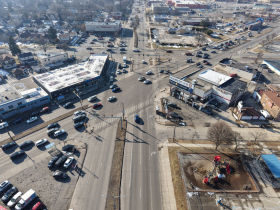
The intersection handles a combined daily volume exceeding 70,000 vehicle trips, with approximately 30,000 daily trips happening on Capitol and Fond du Lac respectively. These vehicle volumes make the intersection one of the busiest in Milwaukee, meaning that closing any one of these streets is out of the question. 51st Boulevard is a critical pathway for drivers going to St. Joseph’s Hospital and Fond du Lac and Capitol are vital freight corridors. Fond du Lac is 97 feet wide, Capitol is 90 feet and 51st Boulevard is a comparatively narrow 66 feet wide curb to curb. The large widths are due to the presence of slip lanes (designated right-turn lanes), curbside auxiliary lanes, and redundant left-turn lanes. The resultant intersection is confusing, stressful, excessively wide and dangerous.
It’s important to understand the history and surrounding land use of the intersection when examining it.In 1930, the area was farmland on the periphery of the city. The transformation began with the widening of Capitol Drive. A postwar housing boom resulted in the neighborhood being filled with single-family homes. In 1956, Capitol Court opened and became the second open-air, suburban-style shopping mall in the region. To accommodate the thousands of shoppers arriving by car, engineers further widened 51st Boulevard and Fond du Lac Avenue. While Capitol Court has closed, the area remains densely populated, a busy retail area with Midtown Cente and a heavily trafficked intersection.
The danger of this intersection is rooted in its irregular configuration and width. When three arterials meet at non-orthogonal angles, it creates poor sightlines and excessively long pedestrian crossings. A pedestrian crossing Fond du Lac Avenue faces a staggering 131-foot trek across active traffic lanes. This width is at least in part due to the presence of curbside auxiliary lanes and slip lanes. These auxiliary lanes are neither definitively parking lanes nor travel lanes. They are often narrower than a traditional travel lane and are used by reckless drivers. In addition, 51st Boulevard between Capitol Drive and Medford Avenue narrows from 66 feet to 38 feet. This creates a funnel effect which causes unsafe merging and racing conditions.
My proposal to improve safety at this intersection is rooted in the belief that safe design centers on reducing excess width, removing uncertainty, improving sightlines and eliminating redundant vehicle movements. I propose the following:
1. Identify and Eliminate Unnecessary Right Turn Lanes:
There are slip lanes on southbound 51st Boulevard at Fond du Lac Drive and northbound Fond du Lac Drive at Capitol Drive. Slip lanes are considered dangerous because their wide, sweeping geometry encourages drivers to turn at high speeds while looking away from the crosswalk to check for merging traffic. This makes it difficult for drivers to see pedestrians, significantly increasing the risk and severity of collisions. There are also designated right-turn lanes on southbound Fond du Lac Avenue to southbound 51st Boulevard and westbound Capitol Drive to northbound Fond du Lac Avenue. These lanes should be removed to reduce the width of the roadways. Right turns can safely be made from the existing travel lanes; a designated lane is duplicative.
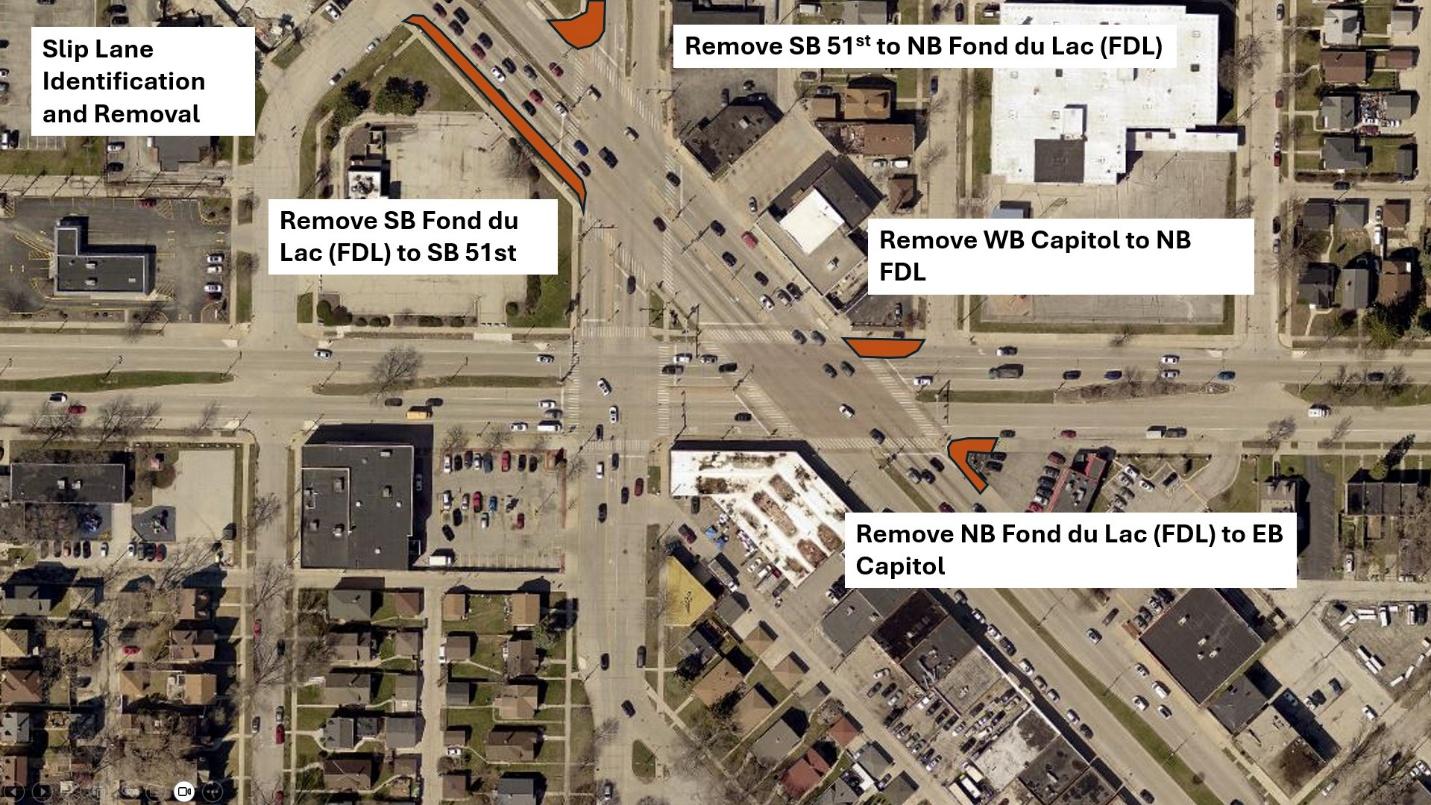
Identification and removal of right turn slip and auxiliary lanes
2. Eliminate unnecessary curbside auxiliary lanes
Auxiliary lanes are abundant at this intersection. They are of substandard width for travel, but routinely used by reckless and impatient drivers trying to make fast turns and to pass the traffic. The first step would be to remove the auxiliary lanes that bound the central triangle. By removing the auxiliary lanes on 51st Boulevard, Capitol and Fond du Lac, the planted triangle could be expanded by 10 feet in each direction. This would create a more inviting and safer place to wait to cross the intersection and reduce speed on the neighborhood avenues. The simple change would also reduce the width of the pedestrian crossing for all three arterials.
Additional auxiliary lane conditions could be removed on Capitol Drive west of 51st Boulevard and at the northeast corner of Fond du Lac Avenue and 51st Boulevard. In the instances of these two conditions, I recommend concrete or planted bump-outs. On northbound Fond du Lac Avenue and eastbound Capitol Drive there are bus stops. At these bus stops, I recommend applying a surface treatment denoting these as Bus Only and prohibiting vehicles from turning right within the colored pavement. The Bus Only areas could be paired with bus priority signals, which would allow them to bypass traffic.
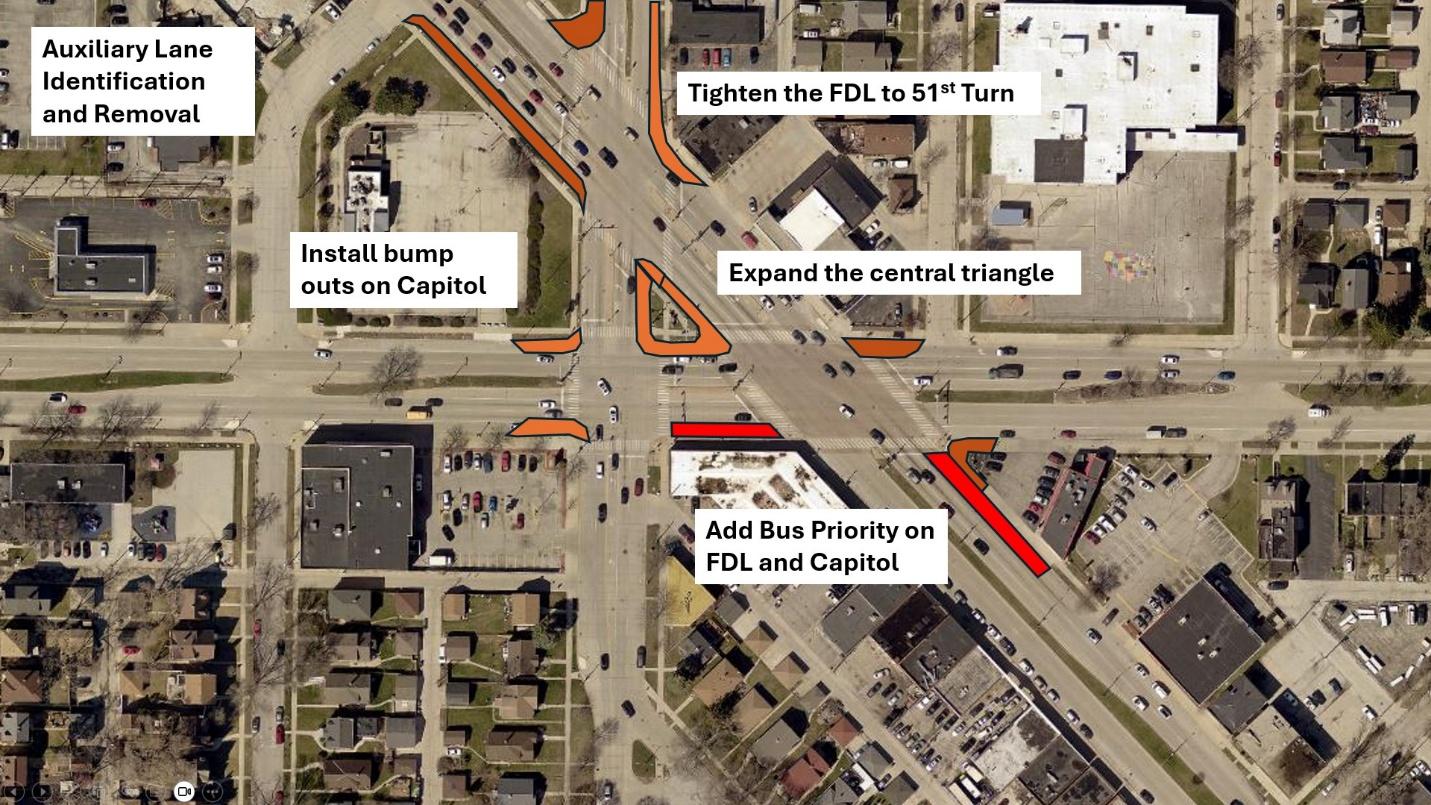
Removal of auxiliary lanes and implementation of bus priority lanes
3. Eliminate Duplicative Left Turn Lanes
Drivers on Capitol Drive have two opportunities to make a left onto the northbound Fond du Lac Avenue and 51st Boulevard. The left turn on Fond du Lac is duplicative, as turns can be facilitated by making a left onto 51st Boulevard and then left onto Fond du Lac Avenue. This pulls vehicles away from the busiest part of the junction. By removing the duplicative left-turn condition on the eastbound Capitol, the median can be widened to create a safer island for pedestrians.
There is also a through lane that feeds a left turn lane on southbound Fond du Lac Avenue upon approach to 51st Boulevard. This lane becomes a left-turn-only lane when southbound Fond du Lac approaches Capitol. Maintaining this left is important, but the length of the feeder lane is excessive. Closing that feeder lane would enable the widening of the pedestrian island on Fond du Lac, allowing for safer and shorter crossings.
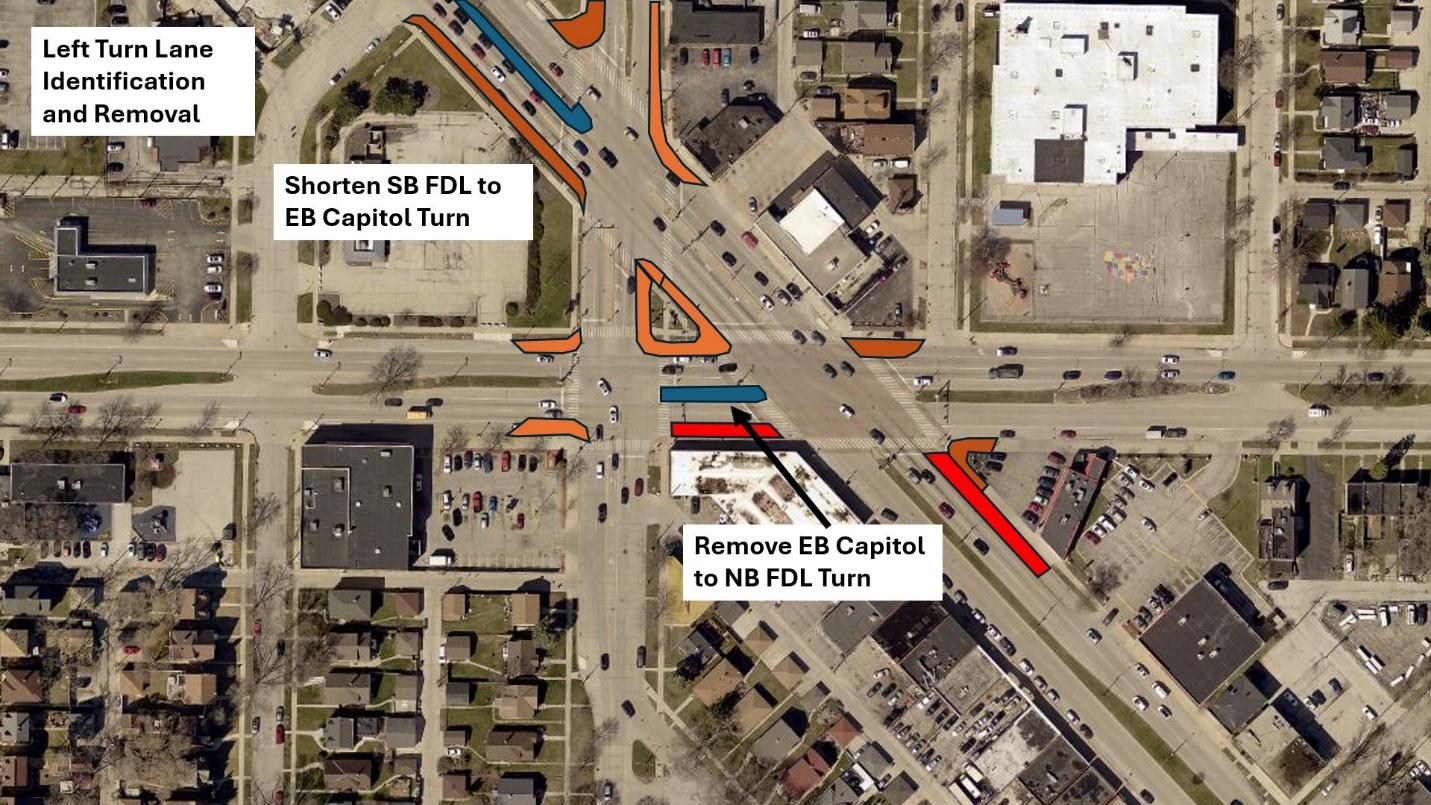
Remove excess left turn lanes
4. 51st Boulevard Road Diet – Remove excess pavement on 51st Boulevard and address the unsafe merge condition
Narrowing 51st Boulevard from 66 feet to 40 feet at Capitol Drive would eliminate the confusing auxiliary lanes. This redesign would provide one dedicated southbound lane, one northbound through lane and one left-turn lane. This narrower profile forces drivers to slow down, matching the residential character of the street further south while maintaining essential access for ambulances heading to St. Joseph’s.
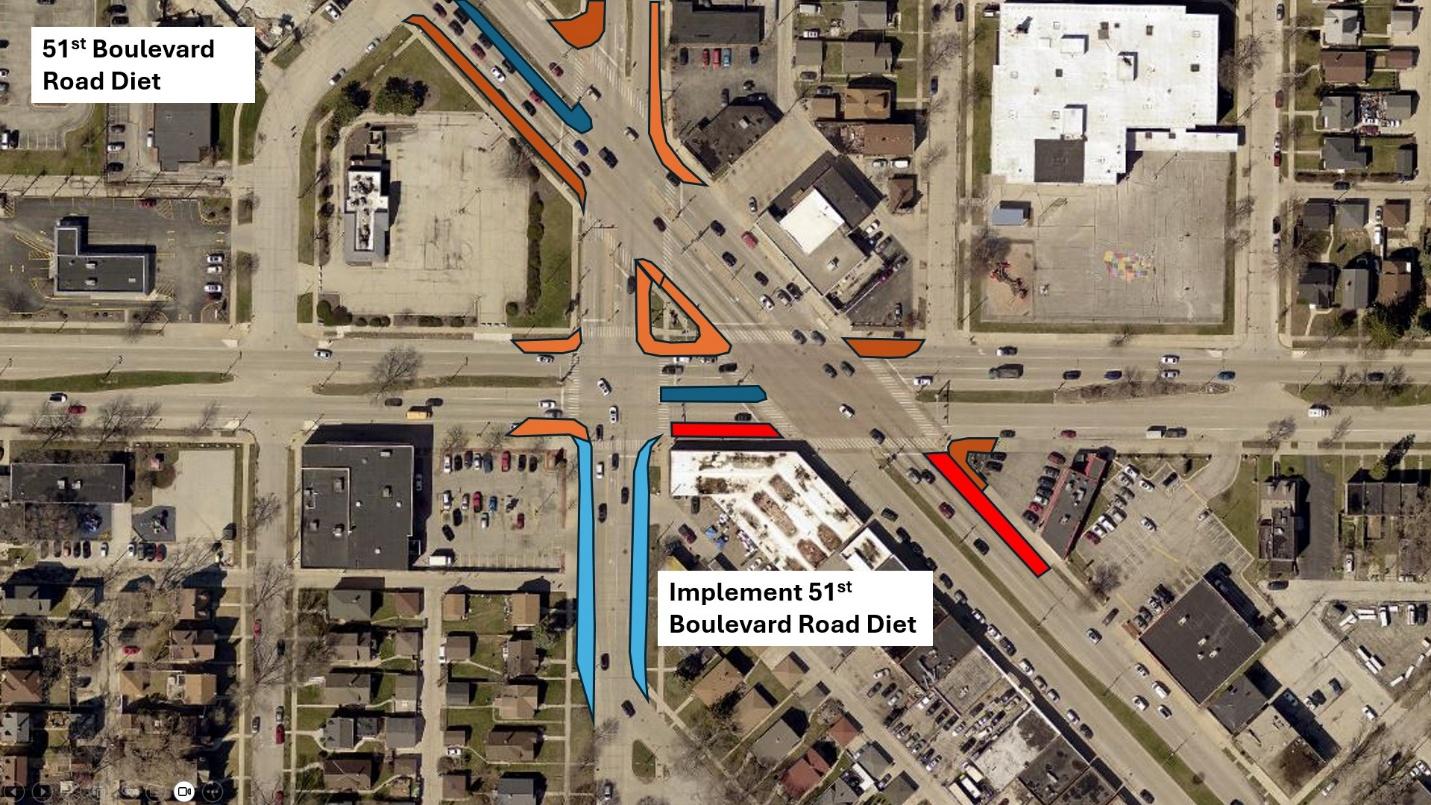
Identify the duplicative left turn lanes and repurpose them as median space
While a single bump out or eliminated turn lane may seem like a minor inconvenience to a driver, these changes taken as a whole replace a chaotic layout with a safer and more predictable one. The current intersection fails because of its excessive width, duplicative turns and irregular geometry. It’s unpleasant no matter how you approach it.
By implementing these changes, we can physically enforce the rules of the road and prevent auxiliary lanes from being used as de facto passing lanes. These structural interventions would transform a daunting, high-crash environment into a much safer, staged crossing for all users.
Photos
If you think stories like this are important, become a member of Urban Milwaukee and help support real, independent journalism. Plus you get some cool added benefits.


Intersection
-
The Port of Milwaukee Interchange Is an Overbuilt Mess
 Nov 16th, 2025 by John O’Neill
-
6 Changes Needed on Commerce & North
 Aug 25th, 2017 by John O’Neill
-
Farwell and Brady Need Changes
 Mar 30th, 2017 by John O’Neill
Transportation
-
Bus Fare Evasion Declining
 Mar 15th, 2026 by Graham Kilmer
-
Committee Approves Towing Reckless Drivers, With Objections
 Mar 12th, 2026 by Graham Kilmer
-
$14.1 Million Plan Targets Safer Streets In Walker’s Point, Valley, Westown
 Mar 12th, 2026 by Jeramey Jannene















Something must be done and these suggested changes make sense to me for consideration.
The one thing all 3 of those dangerous intersections is Fond Du Lac Ave and they are all where 3 pretty busy streets cross. I like your solutions and think they can apply to all 3 of those intersections.
Why doesn’t the state’s zeal for roundabouts not get applied here?
Surely some Fox Valley roads that are roundabout heavy have similar volumes.
They don’t have as many adjacent driveways though…
I don’t know if the author has traffic engineering credentials, or if he is a hobbyist (some info in the byline would be great), but these suggestions seem excellent. I hope decision makers listen.
David Coles —
Milwaukee native and Fordham University graduate John O’Neill is a Land Use and Environmental Planner employed by the New York City Department of Transportation.
He lives, works, dreams — and draws — the built environment.
That he is a municipal employee there says something as well, since New York City has without question the most complex and interrelated infrastructure and transportation system in the nation.
His columns are always insightful. We are fortunate that John O’Neill keeps the Cream City in mind from his vantage point in the Big Apple.
Wow, this is great. My son has a duplex nearby and I try to avoid this corner. John O’Neill has put a lot of thought into this and this solution should be implemented!