

Losing Temporary Protected Status Has Big Impact on State’s Haitian Immigrants
For some, leaving Wisconsin and returning to Haiti might be a death sentence.
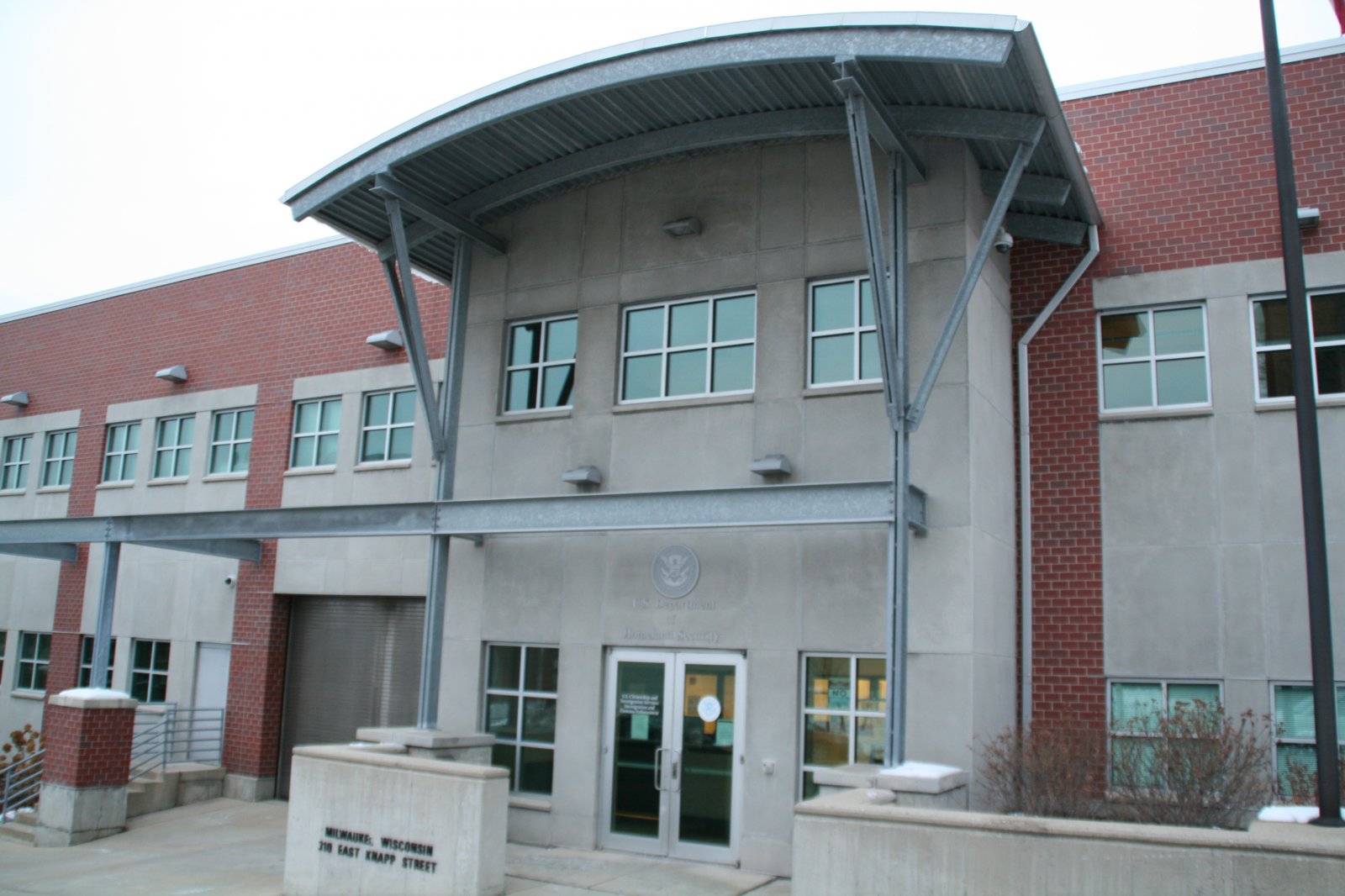
U.S. Customs and Immigration Services building at 310 E. Knapp St. Photo taken Jan, 8, 2021 by Jeramey Jannene.
Earlier this week, the Trump Administration announced that temporary protection and work authorization had ended for many Haitians and Syrians living in the U.S.
Temporary Protected Status, or TPS, applies to people from countries that have been designated by the U.S. government as too dangerous to return to because of war, natural disaster, or other circumstances. It allows people living here to stay and work until their country is deemed safe to return.
TPS for Haitians began after the devastating 2010 earthquake in Haiti. That status was repeatedly extended due to rampant gang violence and massive humanitarian need. Last month, the Supreme Court ruled the Trump administration has the right to terminate that protected status without challenge from other courts. Wisconsin’s U.S. district courts have not yet acted on that ruling.
Somewhere between 400 and 700 Haitian immigrants lived in Wisconsin, as of 2024.
In a statement to WPR, the Department of Homeland Security emphasized that the status was always meant to be temporary.
“For too long, TPS has been allowed to function as a de facto amnesty program despite Congress never intending it to be permanent,” a spokesperson wrote.
They also encouraged those Haitians affected by the end of TPS to take up the standing DHS offer for $2,600 and a free flight back to Haiti.
Marc Christopher is an immigration attorney and a New London resident representing some of the hundreds of Haitian immigrants in his community who might be affected by the end of their Temporary Protected Status. He said that while the status is temporary, Haiti is still too dangerous for people to return.
“In the past, there has to have been some type of show from our government that the conditions in the home country have improved,” Christopher told WPR’s “Wisconsin Today.” “Every objective measure about Haiti indicates that the conditions have worsened.”
Many congregants at Living Water Church in Appleton are Haitian immigrants who were under Temporary Protected Status.
“I have people who owned businesses when they were in Haiti, that were thriving with their family, and they had to run,” said church pastor Maxo Maceno. “It’s been looted and it’s occupied by gangs, and they have no place to go.”
Maceno said that many of his congregants are here because they have to be, not because they want to.
“I have people who feel that they got stuck here,” he said. “They were hoping it was going to be temporary and now they know they can’t go back.”
For some, returning to Haiti might be a death sentence. Maceno recently had a friend killed in Haiti after he tried to visit his mother in the capital city of Port-au-Prince, which is largely controlled by gangs.
“It’s almost (like) sending people to the butcher,” Maceno said.
Most Haitian immigrants under TPS must qualify for asylum to stay
If a person with revoked Temporary Protected Status has a relative that’s a U.S. citizen — like a spouse or a child over the age of 21 — they may be able to obtain an immigrant visa. Otherwise, Christopher says, their only viable option is to apply for asylum.
However, they must prove that they will be uniquely targeted for their race, religion, nationality, political views or membership in a group.
“Many people are certainly scared of the violence and going back to their home country, but it’s hard to show why they would be individualized or set aside for targeting by these groups,” Christopher said.
Maceno said that much of his congregation has applied for asylum. They’re also helping educate people and come up with plans for their children who are U.S. citizens. Christopher said his clients are having to do the same.
“You have to make the terrible decision: Am I going to go back to this country with these conditions with my child, or am I going to have my child remain here with a friend and be separated from my child?” Christopher said.
‘Part of the fabric of these small communities’
Christopher told WPR that the Trump administration not only revoked work permits for people with Temporary Protected Status from Haiti, but they also sent notices to employers that they should no longer hire workers with that work authorization.
He said that it’s affecting individuals, but also local businesses, like the Tyson plant in New London.
“If you’re running a large plant or if you’re running a business, imagine just out of the blue having a significant portion of your employment force being taken away,” Christopher said.
Christopher said the people from Haiti living in his community make an impact, socially and economically.
“They become part of the fabric of these small communities, of these businesses. Their kids are going to school. Many of their children are U.S. citizens,” Christopher said.
Christopher said the sudden need for assistance — legal and otherwise — that came with the end of TPS for Haitian immigrants is overwhelming community volunteers who want to help.
“Most of the help is from community organizations and small groups. For example, in my hometown of New London, a number of people are donating items. We’re trying to do some free legal clinics, at least to provide some guidance,” Christopher said.
“But really, people are mostly on their own.”
How the loss of Temporary Protected Status is being felt by Haitian immigrants in Wisconsin was originally published by Wisconsin Public Radio.
If you think stories like this are important, become a member of Urban Milwaukee and help support real, independent journalism. Plus you get some cool added benefits.
















The national nightmare continues.
Remember how Anne Frank was protected from Nazis by a kind family in Amsterdam in the 1940s?
Yes, what is going on in this country mirrors what was going on in Nazi Germany.