
How to Reduce the Environmental Impact of Parking Lots
All the city news you can use.
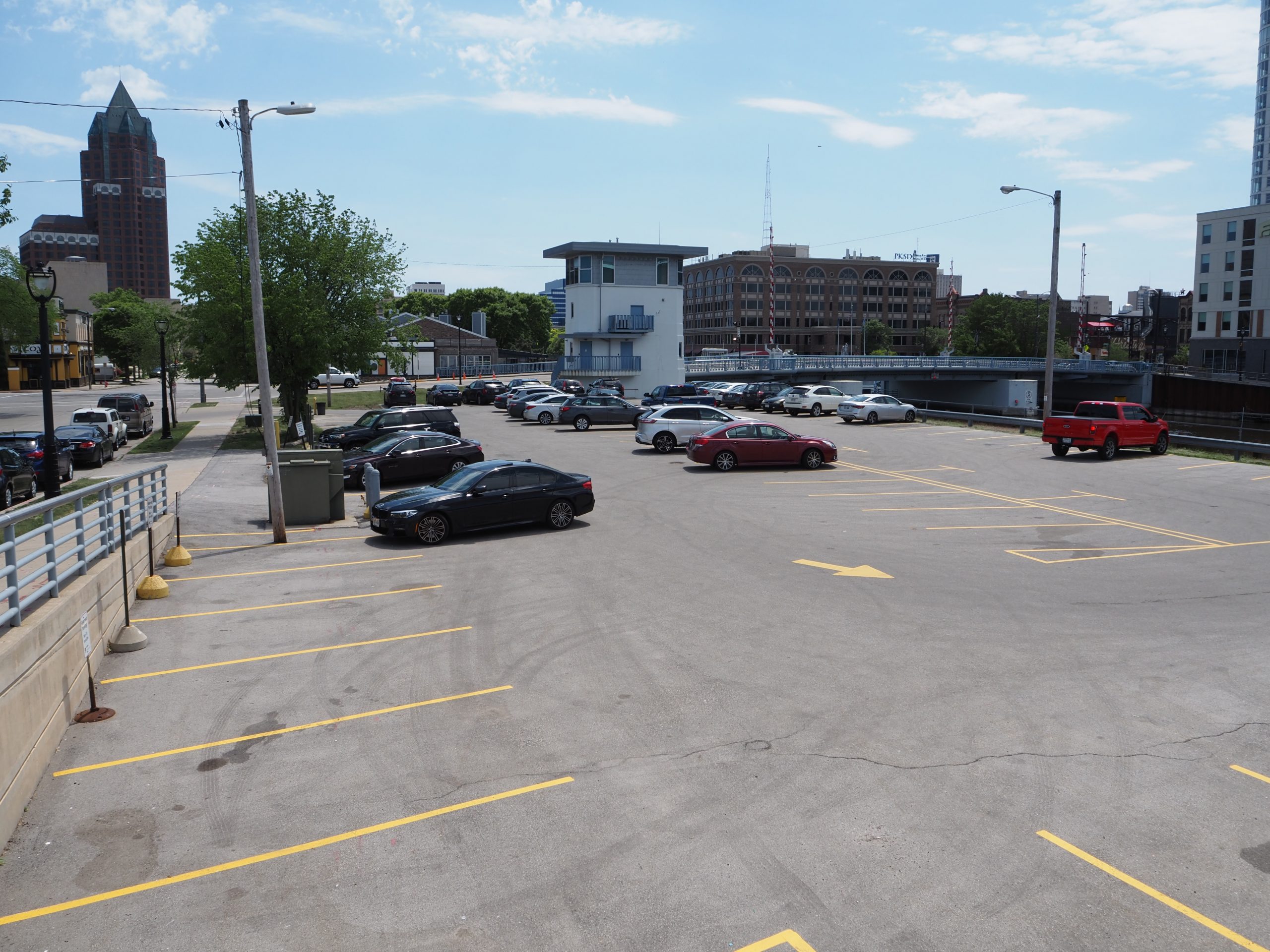
Parking lot at 1201 N. Edison St.. Photo by Jeramey Jannene.
Every day at The Overhead Wire we sort through over 1,500 news items about cities and share the best ones with our email list. Each week, we take some of the most popular stories and share them with Urban Milwaukee readers. They are national (or international) links, sometimes entertaining and sometimes absurd, but hopefully useful.
Wildfire smoke and urban violence: New research suggests that wildfire smoke is contributing to a rise in violence on the days that the air is full of particulates. Taking EPA data from Seattle which has had its fair share of wildfires and from Seattle Police Department, Lion Kircheis, from the University of Konstanz, found that an increase of 7 micrograms per cubic meter in particulates led to 3.6% more assaults. (Jheni Osman | BBC Science Focus)
Bay Area transit campaign moves forward: A campaign to collect signatures for a ballot measure that would fund bay area transit through a sales tax has turned in over 300,000, the largest effort in Bay Area history. The measure needed 186,000 to get on the ballot. The sales tax if passed by voters would enact a 14 year sales tax in bay area counties to fund transit service. (Azul Dahlstrom-Eckman | KQED)
Solving the problems of parking lots: Parking lots of concrete and asphalt cause a lot of environmental problems including adding to urban heat islands and generating excess stormwater. Some cities are looking into ways to mitigate these impacts including reduced parking requirements, pervious pavements, and lighter colored materials to reflect sunlight. (Aya Diab and Alexa St. John | Associated Press)
Courtyard blocks a way forward: Courtyard blocks are a lost architectural art in the United States but seen in most of Europe. The building design in which a continuous building wall encircles a whole block while containing interior green space could be a way to create more social connectedness and reduce growing loneliness in communities argue Alicia Pederson and Kat Vellos. Creating both strong public and private spaces make it a perfect design for fostering connection. (Alicia Pederson, Kat Vellos | Common Edge)
Rise of build-to-rent: Build to rent single family housing has been a growing market in the United States, making up just 2% of housing starts in the 1990s to more than 7% today in part because of the reordering of the housing market in the wake of the 2008 financial crisis. The business structure has been getting more attention after the Senate version of the ROAD to Housing Act required investors to sell seven years after construction. (Brian Potter | Construction Physics)
Quote of the Week
At the end of the day, the average, everyday person — they don’t care about what the board makeup is. All they care about is being able to get from Point A to Point B effectively and safely. I think this bill is a step in the right direction to doing that and being able to better serve our communities.
-Colorado State Rep. Jamie Jackson in Colorado Newsline discussing a new law passed to restructure the board of the Denver region’s transit agency.
This week on the Talking Headways podcast, we’re joined by Cardozo Law professor Michael Pollack to talk about his new book Sidewalk Nation: The Life and Law of America’s Most Overlooked Resource.
Want more links to read? Visit The Overhead Wire and signup.
If you think stories like this are important, become a member of Urban Milwaukee and help support real, independent journalism. Plus you get some cool added benefits.


Urban Reads
-
We Could Fix Our Roads, Instead We Expand and Expand
 May 16th, 2026 by Jeff Wood
-
What Parts of the US Sprawl the Most?
![Sprawl. Photo by David Shankbone (David Shankbone) [GFDL (http://www.gnu.org/copyleft/fdl.html) or CC-BY-SA-3.0 (http://creativecommons.org/licenses/by-sa/3.0/)], via Wikimedia Commons [ https://commons.wikimedia.org/wiki/File%3ASuburbia_by_David_Shankbone.jpg ]](https://urbanmilwaukee.com/wp-content/uploads/2017/10/1024px-Suburbia_by_David_Shankbone-185x122.jpg) May 9th, 2026 by Jeff Wood
May 9th, 2026 by Jeff Wood
-
Why Are States Passing Laws to Reduce Driving?
 May 3rd, 2026 by Jeff Wood