Democratic Candidates For Governor Discuss Each Other
At a forum in Madison, Barnes, Hong and Roys are asked what they've learned from each other.
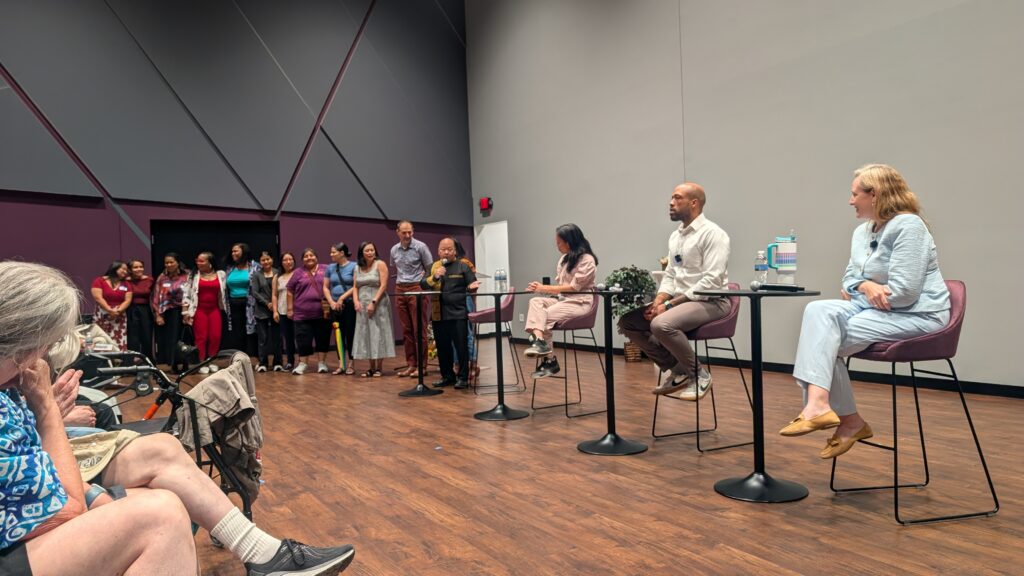
Candidates alongside representatives of Kaleidoscope Wisconsin, a coalition of organizations that are “rooted” in marginalized communities in the state, at the Center for Black Excellence in Madison. (Photo by Baylor Spears/Wisconsin Examiner)
Three Democratic candidates for governor told a citizens’ group that communities most affected by state policy decisions should have a greater role in shaping them during a Monday night forum in Madison focused on affordability.
The forum was hosted by Kaleidoscope Wisconsin, a coalition of organizations that are “rooted” in marginalized communities in the state, at the Center for Black Excellence in Madison. Angela Russell, founder of the Undercurrent, a consulting and advisory practice for organizations that care about social impact, moderated the event. It took place with just three weeks to go before the primary election and following a massive shakeup in the race last week, when Lt. Gov. Sara Rodriguez dropped out because of a financial scandal and Milwaukee County Executive David Crowley, who had previously dropped out, got back into the race with the endorsement of Gov. Tony Evers.
State Rep. Francesca Hong, state Sen. Kelda Roys and former Lt. Gov. Mandela Barnes participated. Crowley and Joel Brennan, former head of the Department of Administration, did not attend.
Throughout the evening, the candidates stated that Wisconsin’s affordability challenges stem from systemic failures in housing, healthcare, education and taxation, and agreed on the need for more progressive taxation and greater investment in public services.
Roys said she wants to end the state’s private school voucher program, restore collective bargaining rights for public employees and open the state employee health insurance plan to more residents. She criticized state subsidies for data center developers.
Barnes talked about reforming the manufacturing and agriculture tax credit, expanding BadgerCare through a public option and increasing taxes on wealthy individuals and corporations.
Hong highlighted her plans to tax millionaires and billionaires, expand Medicaid, increase shared revenue for local governments, raise the minimum wage and establish guaranteed paid leave.
While candidates articulated their policy ideas, they also repeatedly turned to a broader question: Who has influence over state government and whose voices are included in decision-making?
Hong said people in local communities know what they need and don’t need to be told what they need. She said politicians should be public servants who ensure people have access to programs, adding that she doesn’t see food, housing, education and healthcare as benefits but instead sees them as rights and “things that are needed in order to build economic security and freedom.”
Hong said an effective governor must listen to communities and that “the people” should be the ones government answers to, rather than “lobbyists” or those with the most access to the governor’s office.
“We need not only a new type of politics, but somebody right now who isn’t answering to industry and who isn’t being pressured by the status quo,” Hong said.
Barnes said he still sees himself as the community organizer he once was, adding that elected officials need to remain connected to the communities they represent and that it can be easy for politicians to “get into office and lose touch.”
“It’s impossible to lose touch if you’re still going home to the same place every night,” Barnes said, adding that he learned as lieutenant governor how important it was for him to “bring people who are representative of communities that have been left behind” as well as “people who challenge me” into his circle.
Roys said the solutions to the problem facing Wisconsin are not unknown, but that the “political will” to make change has not been there. She said that Republicans have broken the “positive feedback loop” that should exist between people and lawmakers. She described a cycle in which voters give power to policymakers, who then are expected to deliver results and return to communities to understand what more needs to be done.
“It is up to us to demand change,” Roys said, adding that people should hold her accountable as well.
The candidates were asked what they have learned from each other.
Hong said she was inspired by remarks Barnes made over the weekend about the dramatic twists and turns in the governor’s race. She recalled a speech he gave in which he commented on Evers’ decision to endorse Crowley, and his reversal of his decision to drop out of the race, saying it showed why “so many people are frustrated and want nothing to do with the Democratic establishment.” Some supporters of Barnes and Hong have complained that Crowley is being elevated by “establishment” Democrats to stop more progressive Democrats from getting through the primary.
“There’s been a lot of news in the governor’s race,” Hong said. “It’s been a little bit chaotic…I think Mandela gave his strongest remarks at a forum that I’d heard in a while.”
Hong called it “very empowering.”
“He was speaking to a community that I think still feels very much like the elections are just being decided for them,” Hong said. “And to use the time that you’re supposed to talk about yourself, to share remarks with the community… this election belongs to the voters. It should always be about the voters.”
Hong also said she has learned how to explain policy in clearer ways from Roys.
Roys said she has learned how to be more active and authentic on social media from Hong, and agreed with Hong about Barnes’ comments over the weekend, saying he “really distilled out what this is about.”
Barnes, who noted that the candidates have known each other for a long time, said Hong has brought “newness” to the forefront.
“If you want to build a real democracy, it is about not just working with the basic folks that you’ve known forever, of course, that’s the foundation of the work, but we’re in the business of addition,” Barnes said. “For so long, people hadn’t wanted to be a part of our politics… Over the last week, the people are fired up. People are ready for change, and I think it would be unwise for some people to seek to dismiss that.”
Barnes said he appreciated that Roys has sharp “elbows” and is willing to be critical and fight, including with members of her own party. He noted the primary has been very long, but said that it is good for democracy.
“These long primaries suck,” Barnes said, but he added, “it is good for people to be able to push each other, to challenge each other, to be able to generate ideas from one another, to have a moment to see what works, what doesn’t work, and ultimately to give people a choice. The more that choice is taken away the more we do to undo all the good work that has happened.”
All three Democratic candidates, along with Brennan and Crowley, are competing for a spot on the November ballot to take on U.S. Rep. Tom Tiffany, the presumptive Republican nominee. In-person absentee voting starts on July 28. The primary is Aug. 11.
Democratic candidates discuss inclusive politics, bumpy primary campaign was originally published by Wisconsin Examiner.
Political Contributions Tracker
Displaying political contributions between people mentioned in this story. Learn more.