

Wisconsin Plays Role in National Redistricting Battle
Will state Supreme Court's liberal majority require a new map of congressional districts?
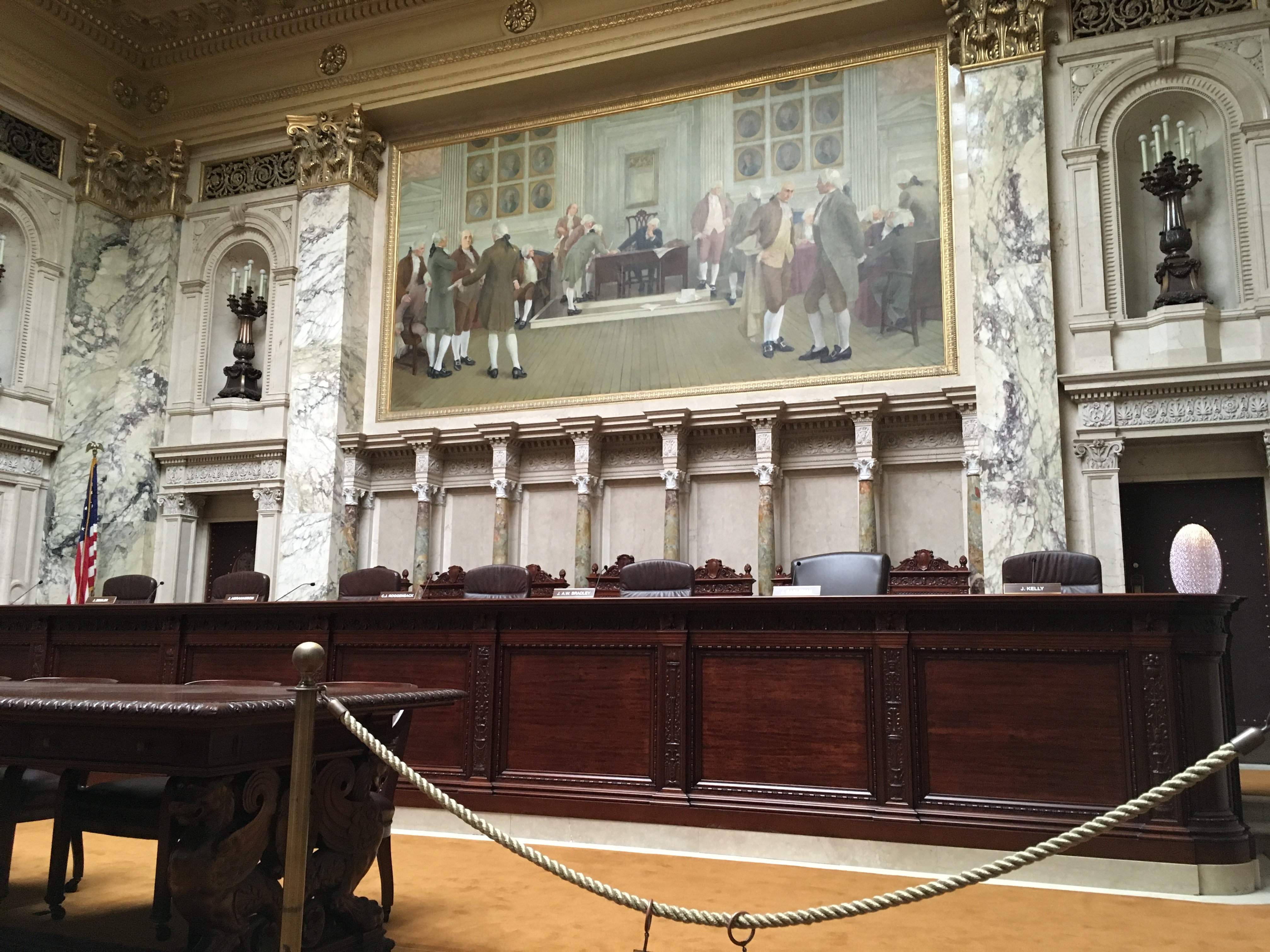
Wisconsin Supreme Court. Photo by Mariiana Tzotcheva.
Wisconsin’s court fight over redrawing the state’s eight U.S. House districts gained new importance after the U.S. Supreme Court ruled that state lawmakers cannot draw congressional districts based on race.
If groups supporting Democrats and their allies convince Wisconsin Supreme Court justices that the eight districts must be redrawn before the 2028 elections, those new districts could help decide which party controls the 435-member U.S. House, since control may again be decided by the outcomes in only a few districts nationally.
On April 29, a 6-3 majority of the U.S. Supreme Court struck down the second majority-Black House district created by Louisiana lawmakers. Writing for the court, Justice Samuel Alito said, “The Constitution almost never permits the federal government or a state to discriminate on the basis of race.”
Citing that ruling, Louisiana and other southern states have already started redrawing House districts for the Nov. 4 election.
The fight in Wisconsin is not over race-based districts. Instead, lawyers for Wisconsin Business Leaders for Democracy and voters in each district said that the current House districts, drawn by Republicans who have controlled the Legislature since 2011, illegally guarantee GOP control of a majority of those eight districts. Republicans held five of those eight districts until the 2022 election, when they added a sixth.
But, so far, groups who filed two lawsuits challenging the eight House districts have lost in court.
In an unprecedented move, the Wisconsin Supreme Court created two three-judge panels of circuit court judges to rule on those challenges. Both panels unanimously dismissed them, prompting lawyers for the challengers to appeal those dismissals to the Supreme Court.
What each panel said in their orders dismissing the challenges is important.
On April 28, the panel made up of circuit court Judges David Conway, of Dane County; Michael Moran, of Marathon County, and Patricia Baker, of Portage County, offered this explanation:
“This panel does not write on a blank check when it comes to the use of partisan considerations in redistricting. The Wisconsin Supreme Court explored the topic in significant detail when it imposed the existing congressional map in 2022.
“At that time, the court held that the partisan composition of electoral districts raises a nonjusticiable political question, and that the state constitutional provisions at issue in this case say nothing about redistricting. Those holdings are dispositive … and this panel, as an inferior court, is obligated to obey them.
“Until the Court says otherwise, [legal challenges] are non-justiciable…”
On March 31, circuit court Judges Julie Genovese, of Dane County; Emily Lonergan, of Outagamie County, and Mark Sanders, of Milwaukee County, cited decades of conflicting rulings on the issue of partisan gerrymandering by state and federal judges. Their final conclusion:
“This panel must stay within its lane as a ‘circuit court.’ The Wisconsin Supreme Court addressed the same assertion that [challengers] set forth here — whether there is a right to partisan fairness in the Wisconsin Constitution — and a majority of our Supreme Court held that there is no such right.
Lawyers for Republican legislators, the six incumbent GOP House members and conservative legal groups cheered those decisions.
“The three-judge panel got it right,” Lucas Vebber, deputy counsel of the Wisconsin Institute for Law and Liberty, said after the April ruling. “This is a victory for the rule of law in our state. WILL is proud to have represented our clients in this case and will continue to work to uphold our constitutional separation of powers.”
The legal fight is far from over, however.
“This is the first anti-competitive gerrymandering case ever filed in Wisconsin courts,” said Doug Poland, director of litigation for the progressive law firm Law Forward. “We will therefore appeal the case to our state Supreme Court and look forward to the opportunity to prove that the state’s congressional maps must be redrawn to ensure that Wisconsin voters are given a real choice in voting for congressional district candidates.”
A major factor in the controversy is how the Wisconsin Supreme Court’s makeup has changed since its 2022 ruling upholding the current House districts. Since then, three of the seven justices — Pat Roggensack, Ann Walsh Bradley and Rebecca Grassl Bradley — have been replaced by Janet Protasiewicz, Susan Crawford and, in August, Chris Taylor. That shift gives the court a 5-2 liberal majority next term, compared to the 4-3 conservative majority of 2022.
Steven Walters started covering the Capitol in 1988. Contact him at stevenscotwalters@gmail.com
If you think stories like this are important, become a member of Urban Milwaukee and help support real, independent journalism. Plus you get some cool added benefits.


The State of Politics
-
Was Dan Bice Wisconsin’s Most Important Journalist?
 May 4th, 2026 by Steven Walters
-
Will Supreme Court Liberals Adopt Recusal Rules?
 Apr 27th, 2026 by Steven Walters
-
Why UW President Candidates May Hesitate
![Van Hise Hall in the background. Photo by James Steakley (Own work) [CC BY-SA 3.0 (https://creativecommons.org/licenses/by-sa/3.0) or GFDL (http://www.gnu.org/copyleft/fdl.html)], via Wikimedia Commons](https://urbanmilwaukee.com/wp-content/uploads/2017/10/1017px-Ingraham_Van_Hise_carillon-185x122.jpg) Apr 20th, 2026 by Steven Walters
Apr 20th, 2026 by Steven Walters