Rising Fuel Prices Hit County Budget
Spiking gas prices could force departments to cut back on services in 2026.
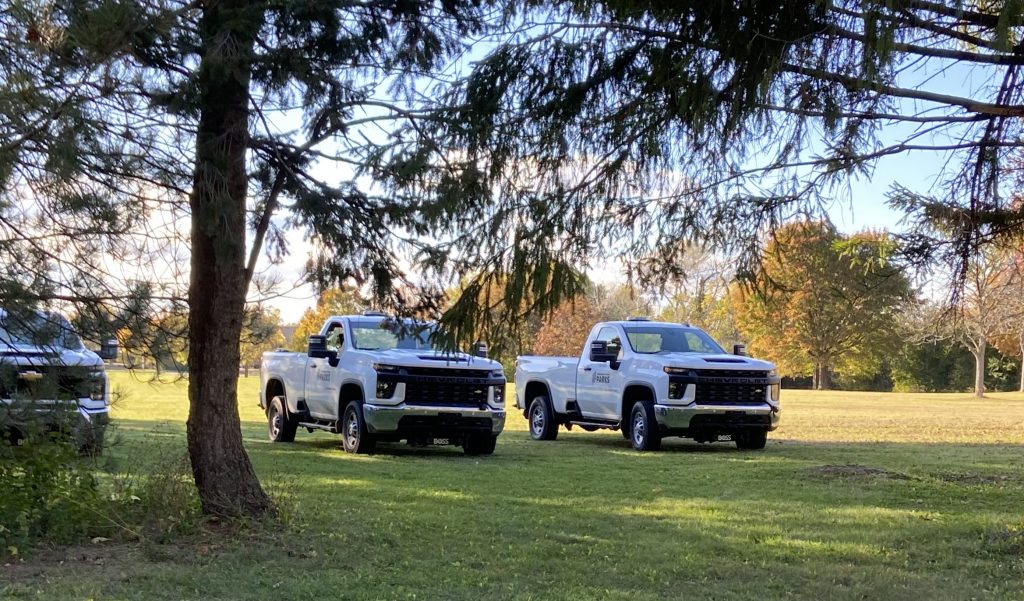
Milwaukee County Parks vehicles in Popuch Park. Photo taken October 30, 2025, by Graham Kilmer.
Spiking fuel prices are beginning to take a toll on Milwaukee County government and could lead to budget cuts if the trend continues.
More than two months after President Donald Trump launched a war against Iran, leading to a spike in global oil prices, the average price at the pump in Wisconsin is now well above $4 a gallon, according to a gas price tracker by the American Automobile Association.
Large organizations like county government buy their fuel in bulk from tankers and pay a lower price. But supply shocks have driven the price of fuel up above $3 for large purchasers like the county, leaving officials to consider how to balance budgets and maintain existing service levels.
“We’re seeing significant increases in fuel, and it likely will have impacts on county services,” Joe Lamers, Milwaukee County Department of Transportation director (MCDOT), told Urban Milwaukee. “Because departments are expected to manage within their budget, and when they see increased costs in one area, they’re going to have to find savings somewhere else.”
The biggest fuel consumers, outside of the Milwaukee County Transit System (MCTS), are the county’s highway maintenance department, the Milwaukee County Sheriff’s Office, Milwaukee County Parks and Milwaukee Mitchell International Airport. MCTS, which burns through approximately 3 million gallons of diesel a year, purchases fuel through hedge contracts that guarantee a stable price for several years, Lamers said. The latest contract runs through 2028.
These departments will likely see some impact on services as a result of rising fuel prices, Lamers said. For example, the highway department performs maintenance work on state highways in the county. It is reimbursed at a fixed rate by the state. Rising fuel prices will make the work more expensive, but the funding available for it will stay the same, Lamers said. “It could impact our ability to perform work that needs to be done on the highways.”
The parks department also has a large fleet of vehicles and machinery. Most of the department’s revenue is generated during the summer, so it will be difficult to assess whether it is able to generate enough to cover spiking fuel prices until the season is over.
“Wisconsin taxpayers should not be forced to bear the burden of decisions being made in Washington,” County Executive David Crowley said in a statement. “My administration is working to reduce fuel use wherever we can without impacting service delivery, but that alone is not enough. President Trump must take this crisis seriously and address rising gas prices before working families and the governments that serve them are left holding the bill.”
If prices stabilize where they are now, the county will likely finish the year more than $800,000 over budget for fuel. But if they increase even a little bit, the county is anticipating $1 million or more in higher fuel costs.
The county has to estimate each year, based on fuel price projections, what to budget for fuel costs, said John Blonien, MCDOT fleet director. The county is paying more per gallon than budgeted already, but it is still below $4 a gallon, he said. If the current rate of growth continues, the county will likely be paying more than $4 a gallon in the short term.
The county has weathered shocks to the fuel market before. In 2022, gas prices rose because of pandemic-related inflation and Russia’s invasion of Ukraine.
“We weren’t seeing this kind of magnitude at all, nothing really rising even close to this level,” said Lamers, who was then the county’s budget director.
The county functions most exposed to rising fuel prices will also be difficult to transition to alternative forms of fuel in the future. Currently, MCDOT estimates that only 10% to 15% of the county’s vehicle fleet is a candidate for electrification. Replacing these vehicles with electric alternatives is currently challenged by the county’s lack of electric vehicle infrastructure, Blonien said. Expanding electrical infrastructure is expensive, and the county has a limited pool of funding each year for infrastructure projects massively outstripped by available resources. But spiking fuel prices may change the economics of those projects, making them more worthwhile, Blonien suggested.
Along with infrastructure challenges, there aren’t currently any alternatives for heavy, diesel-burning machinery used in highway maintenance work. The sheriff’s office has piloted use of an electric squad car, but found that a battery only lasted three to four hours during a shift in the winter, Blonien said. MCTS has struggled with its own electrification efforts, running into maintenance and reliability challenges with the system’s 14 Nova Bus LFSe+ battery-electric buses.
For now, MCDOT is working with county departments to reduce fuel use wherever possible with anti-idling policies and by asking departments to pool vehicles when possible, even looking at routes staff use to do their work, Lamers said. But “as costs continue to rise,” he warned, “this situation will just become more and more challenging to address.”
If you think stories like this are important, become a member of Urban Milwaukee and help support real, independent journalism. Plus you get some cool added benefits.
Political Contributions Tracker
Displaying political contributions between people mentioned in this story. Learn more.


MKE County
-
Florida Educator Would Take Over Historic Trimborn Farm
 May 6th, 2026 by Graham Kilmer
-
County Running Out of Budget Fixes, Comptroller Warns
 May 5th, 2026 by Graham Kilmer
-
Dugan Seeks Acquittal Ahead of Sentencing
 Apr 29th, 2026 by Graham Kilmer