

MMSD Operator Causing Larger Sewage Overflow, More Pollution, Coalition Charges
Veolia is alleged to be putting off maintenance and running the system under capacity, raising risk of overflows.
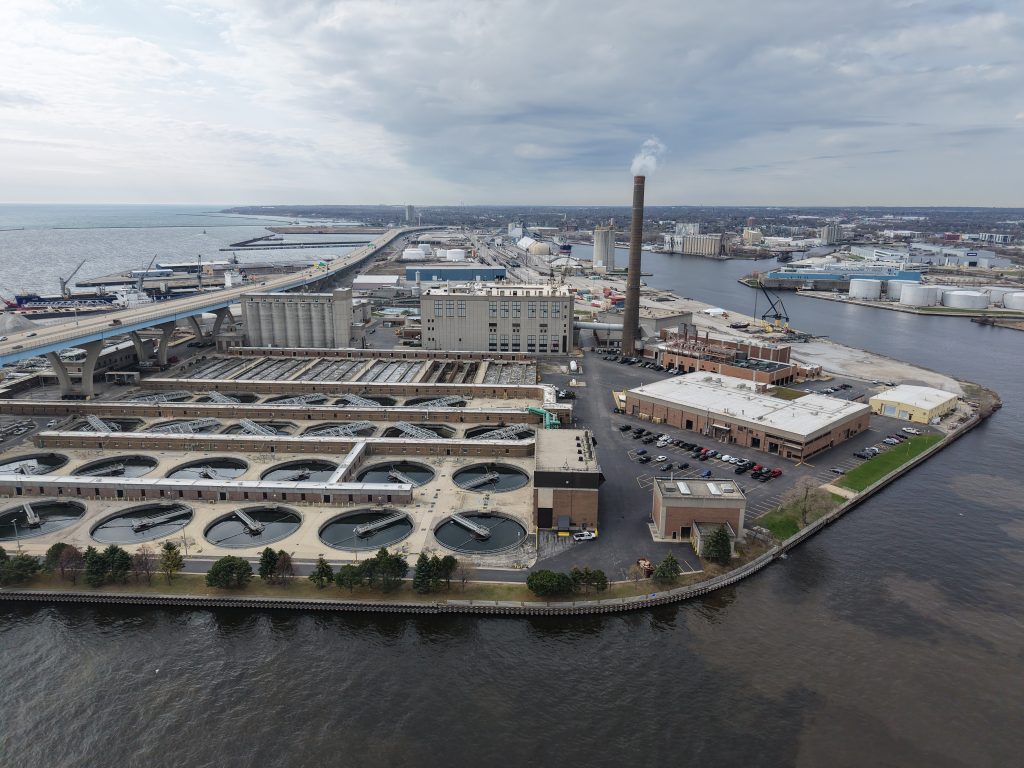
Jones Island Reclamation Facility. Photo by Urban Milwaukee staff.
The private company running the Milwaukee Metropolitan Sewerage District‘s (MMSD) wastewater treatment facilities is allegedly cutting costs and poorly operating critical sewage systems, creating greater risk of sewer overflows and basement backups, and increasing pollutants dumped into Lake Michigan.
The charges come from Common Ground Southeastern Wisconsin, a coalition of more than 46 community organizations, including area schools, nonprofit neighborhood groups and businesses.
The coalition is working with a whistleblower from MMSD and calling for a third-party audit of the operator, Veolia, before a new contract is awarded later this year.
Along with the whistleblower, Common Ground reports it has interviewed more than a dozen former MMSD employees and obtained internal documents through open records requests.
Veolia, a French transnational water services corporation, has held the contract to operate and maintain MMSD’s two wastewater treatment facilities since 2008.
Common Ground alleges Veolia is purposely running wastewater systems below capacity during rain events, increasing the risk of sewer overflows into Lake Michigan and backups into basements across the region. The coalition alleges the company has forgone maintenance to save money, instead allowing equipment to run to a point of failure and be replaced by MMSD.
Veolia is one of the largest private operators of water services in the world, with more than 200,000 employees and annual revenue of approximately $40 billion. The current 10-year contract with MMSD is valued at more than $500 million. The next 10-year contract, beginning in 2028 and valued at approximately $700 million, is up for approval in September. Veolia is competing for the contract with Jacobs Solutions, a Dallas-based engineering services company.
MMSD was created in 1982 by the Wisconsin Legislature, with the authority to levy property tax to fund infrastructure and maintenance. It is led today by Executive Director Kevin Shafer, an engineer who joined the organization in the 1990s.
is governed by an 11-member board of commissioners. The mayor of the city of Milwaukee appoints seven commissioners; the other four are appointed by the Intergovernmental Cooperation Council of Milwaukee County. Commissioners are paid $10,000 annually for their service, which is uncommon for public boards.
The whistleblower who alerted Common Ground to the alleged problems with Veolia’s performance is Steve Jacquart, who retired from MMSD in 2023 after 19 years as the sewerage district’s intergovernmental relations coordinator. He previously served as former Mayor John Norquist’s chief of staff and policy director, and as deputy commissioner of the Department of City Development.
“Some people there may prefer that these problems be kept quiet and not shared with the public,” Jacquart said in a statement released by Common Ground. “But I keep thinking about the safety of the many thousands of people who enjoy our beaches and waterways. I think about how we get our drinking water from Lake Michigan.”
In 2016, MMSD’s wastewater treatment facilities — Jones Island and South Shore — began suffering a “massive breakdown” in the processing of organic materials derived from the treatment of sewage sludge, according to Jacquart. The material, called biosolids, is used to create the fertilizer Milorganite. As removal and disposal of the biosolids broke down, wastewater treatment capacity was reduced, leading to a greater risk of sewer overflows and basement backups.
Common Ground and Jacquart also say wastewater treatment began to decline in 2017 after Veolia switched to cheaper chemicals.
“In layman’s terms, this means that the treated wastewater MMSD discharges into Lake Michigan every day contains higher levels of bacteria,” Jacquart said. “This has been happening since sometime around 2016 when this massive biosolids management problem began.”
A 2022 report by the nonpartisan Wisconsin Policy Forum (WPF) stated the chemicals were a point of disagreement for MMSD and Veolia, which eventually led to a contract amendment making MMSD responsible for purchasing the more expensive but more effective treatment chemicals for the South Shore treatment plant. As the effluent quality has worsened, MMSD has also had to pay greater fines to the Wisconsin Department of Natural Resources (DNR) for environmental performance, the WPF report found.
“These problems need to be brought out and addressed in public before MMSD Commissioners select which private company will operate our regional sewage system under the next operating contract,” Jacquart said.
MMSD will hold a public meeting on the new operations and maintenance contract on June 11, according to a timeline released by MMSD. The commission will vote on a final contract on Sept. 28.
Veolia Responds
Veolia Senior Vice President Adam Lisberg responded to Common Ground’s claims after publication telling Urban Milwaukee, “Common Ground’s campaign against Veolia is a bad faith attempt by a third party to damage Veolia’s reputation and influence the outcome of MMSD’s ongoing public procurement process.”
Veolia has a 99.95% permit compliance rate for effluent quality and has outperformed standards set by the state and MMSD, Lisberg said. “While Common Ground pushes misinformation, Veolia is busy fulfilling the duties of its contract in partnership with MMSD, protecting public health and providing environmental security to more than 1 million people each year,” Lisberg said.
Regarding the whistleblower, Jacquart, Lisberg said he is not an engineer and that he has a “fundamental lack of understanding of wastewater treatment,” and that his claims rely on assumptions that are “fundamentally false.”
Lisberg did not say whether Veolia would cooperate with a third-party audit of its performance.
Campaign Begins
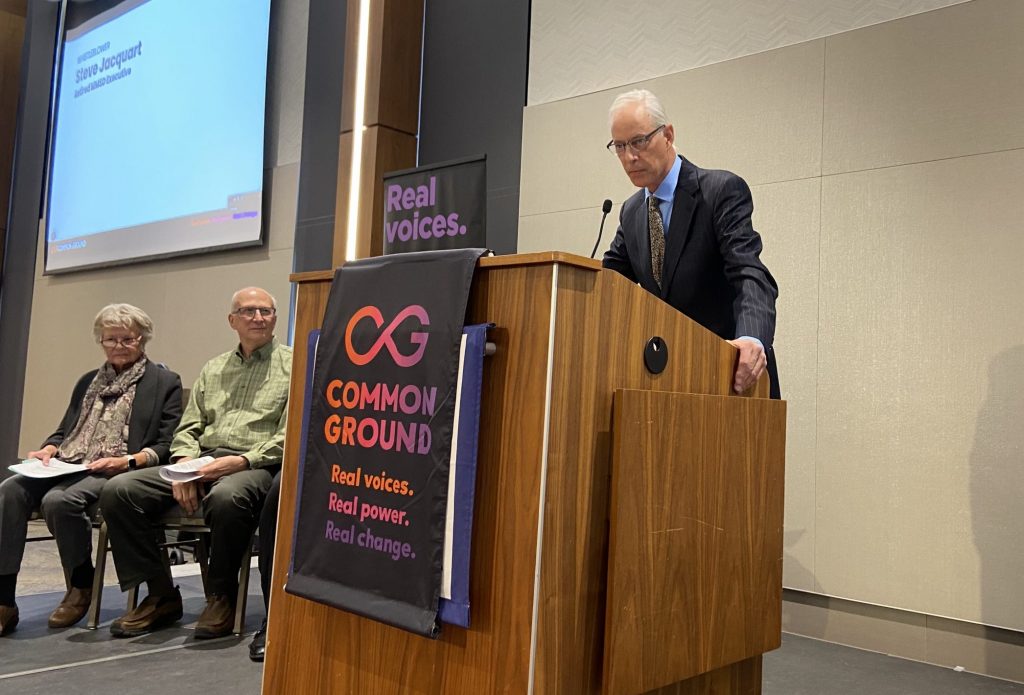
MMSD whistleblower Steve Jacquert. Photo taken April 30, 2026 by Graham Kilmer.
Common Ground held a meeting with members Thursday night at the War Memorial Center, 750 N. Lincoln Memorial Dr., and began collecting signatures for a letter to MMSD’s commission calling for an audit. The organization also put out an open call to any potential whistleblowers who may know about alleged problems with Veolia’s management of the water treatment system.
Common Ground is not taking sides in the procurement process for the next 10-year contract, Bob Connolly, founder of Common Ground, told Urban Milwaukee.
“If Veolia is doing a great job, they should welcome a performance audit,” Connolly said. “Plain and simple, we harbor no ill will towards Veolia. If they’re doing a great job, fine, but you’ve got to go talk to the people that run the plant every day, like we did… but they won’t talk to somebody they don’t trust. It needs to be somebody that cannot hurt them if they tell the truth.”
Jacquert told Urban Milwaukee he was involved in senior meetings at MMSD for years, during which time issues of capacity at the plants and trouble meeting effluent standards frequently came up. He came forward as a whistleblower not to hurt Veolia or MMSD, he said. “What this is about is trying to get this information out to the public, and particularly in front of the MMSD commissioners.”
“16 whistleblowers, 16 people, have all said the same thing, those allegations need to be taken seriously,” said Kevin Solomon, senior associate organizer with Common Ground.
Connolly told Urban Milwaukee Common Ground has previously met with members of the MMSD commission and provided them with the information they released to the public Thursday.
“What they want is they want specific problems that they can think they can go solve,” Connolly said. “So we’re not going to give them individual stories… This is about a serious problem with the whole operation.”
After Common Ground’s meeting, Veolia’s Lisberg released another statement: “Common Ground’s event this evening featured a mix of false, unsubstantiated and overstated claims about Veolia, which Common Ground admitted during the event they could not verify. Veolia has treated hundreds of billions of gallons of wastewater in Milwaukee since 2008, maintaining a 99.95% permit compliance rate for effluent quality while consistently outperforming state mandates and stricter MMSD contract standards.”
Connolly did tell Common Ground members, “Now be clear, we can’t verify everything we heard tonight, but there is a way to determine the truth of what we have learned so far.” That is, to conduct an impartial third-party audit.
MMSD Responds
After Common Ground’s campaign went public Thursday, Shafer and MMSD Commission Chair Corey Zetts released statements disputing Common Ground’s assertion of knowing mismanagement of wastewater treatment facilities. Both MMSD leaders questioned why Jacquart was coming forward now, and with help from Common Ground.
“Working with Common Ground to release this information today feels suspect,” Zetts said. “The Commission is poised to vote on a new 10-year contract soon, more than two years into a very thorough public procurement process, which has resulted in two finalists.”
In his statement, Shafer disputed Jacquart’s claim that a “massive breakdown” in biosolid processing began in 2016. “In 2016 and 2017, MMSD captured and cleaned 99.8% and 99.999% of every drop of water that made it into MMSD’s regional wastewater system. In those same years, MMSD and Veolia Water’s performance was well within our permit limits,” he said.
Shafer told Urban Milwaukee MMSD is not opposed to a third-party audit and that it is always looking to improve. However, despite meeting with Common Ground representatives in January, the information he and MMSD commissioners and other staff have received from Common Ground is not specific enough to warrant ordering the audit.
“So I can’t spend taxpayer dollars to do a performance audit when I don’t know what we’re auditing,” he said.
Shafer told Urban Milwaukee that after Common Ground’s assembly Thursday, capacity at both plants is regularly impacted by the maintenance and replacement of aging equipment. He also disputed the suggestion of a widespread policy of letting machines fail to save money.
“Not to a large scale, I mean, there may be one item here or there,” Shafer said. “There’s been times where we’ve had to charge Veolia for not doing the maintenance we thought they should have.”
If you think stories like this are important, become a member of Urban Milwaukee and help support real, independent journalism. Plus you get some cool added benefits.
More about the MMSD and Veolia Wastewater Facility
- MMSD Denies Unfair Contracting Practices - Graham Kilmer - Oct 7th, 2026
- Despite Lawsuit, MMSD Picks New Private Operator - Graham Kilmer - Sep 28th, 2026
- Federal Judge Orders Pause In Issuing New Sewage Contract - Graham Kilmer - Sep 15th, 2026
- Veolia Sues MMSD, Alleges Biased Contracting Process - Graham Kilmer - Sep 11th, 2026
- Committee Recommends New Operator for Sewerage District - Graham Kilmer - Aug 18th, 2026
- DNR Investigating Allegations Against Sewerage District - Graham Kilmer - Jul 28th, 2026
- Op Ed: MMSD’s Record Shows A Clear Path For Milwaukee’s Water Future - Michael Murphy - Jul 16th, 2026
- Clogged Sewer Pipe May Have Worsened Bay View Flooding - Graham Kilmer - Jul 16th, 2026
- CG Backs City Investigation as New Evidence Validates Whistleblowers: Milwaukee Needs Accountability and Transparency. - Common Ground Southeastern Wisconsin - Jul 15th, 2026
- More Whistleblowers Go Public With Allegations Against Veolia - Graham Kilmer - Jun 12th, 2026
Read more about MMSD and Veolia Wastewater Facility here





















Letting a private for profit corporation to run a public utility was and is stupid. All they care is about profit.
Are the MMSD top people getting kickbacks from Veolia.