
Will Lawsuits Demanding New Congressional Maps Succeed?
The arguments for and against and where things stand.
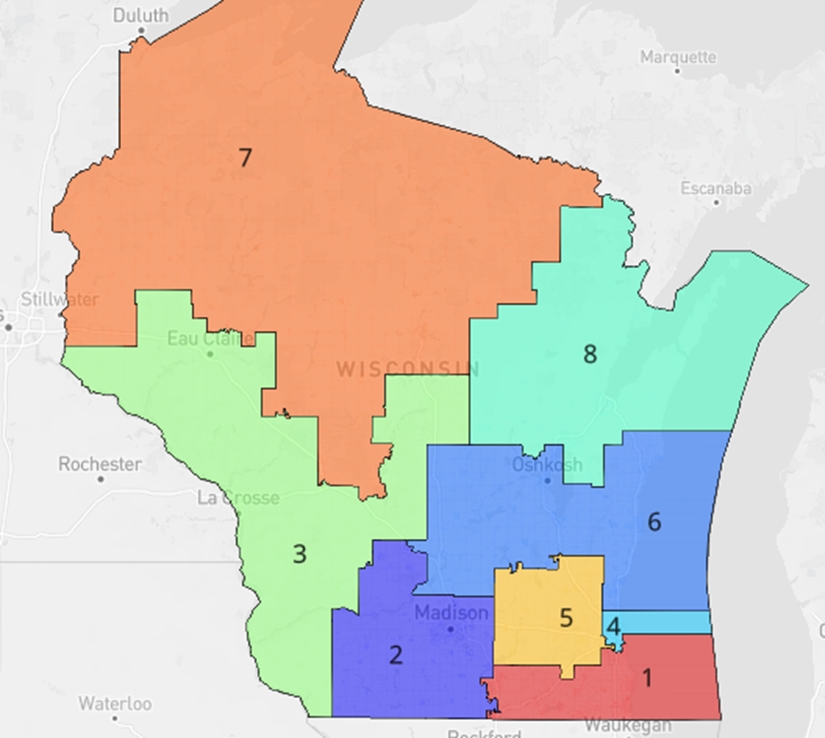
Wisconsin’s Congressional Districts.
Two lawsuits currently underway challenge the makeup of Wisconsin’s eight congressional districts. Despite Wisconsin’s status as one of the most competitive — if not the most competitive — states politically, Wisconsin’s congressional delegation is wildly skewed toward Republicans. Six of its eight districts are currently held by Republicans, four of whom represent districts that are overwhelmingly Republican. Only two Wisconsin representatives are Democrats.
In 2011, Republicans in the Wisconsin Legislature passed and Gov. Scott Walker signed Act 39. In light of recent events, it is ironic that all Democrats voted against Act 39.
Among Act 39 provisions were two that affected challenges to apportionment of congressional or state legislative districts:
751.035 Assignment to a judicial panel; appeals. (1) Upon receiving notice under s. 801.50 (4m), the supreme court shall appoint a panel consisting of 3 circuit court judges to hear the matter. The supreme court shall choose one judge from each of 3 circuits and shall assign one of the circuits as the venue for all hearings and filings in the matter.
(2) Notwithstanding s. 801.58, no party may move for substitution of any circuit court judge assigned under this section.
(3) An appeal from any order or decision issued by the panel assigned pursuant to sub. (1) may be heard by the supreme court and may not be heard by a court of appeals for any district.
Act 39 also created another new section:
801.50 (4m) Venue of an action to challenge the apportionment of any congressional or state legislative district shall be as provided in s. 751.035. Not more than 5 days after an action to challenge the apportionment of a congressional or state legislative district is filed, the clerk of courts for the county where the action is filed shall notify the clerk of the supreme court of the filing.
In essence, these two additions to state statutes created a new mechanism to challenge the apportionment of a congressional or state legislative district. Normally, proposed litigation starts in a district court, is appealed to the Court of Appeals, and may finally end up in the Supreme Court. Act 39 set up a different route, in which a three-judge panel replaced both the single district judge and the Court of Appeals. Any appeal of the action of the three-judge panel would go directly to the Wisconsin Supreme Court. In essence, the role of the district and appeals courts would be combined and given to the three-judge panel.
Currently, two three-judge panels have been formed to adjudicate two lawsuits challenging Wisconsin’s congressional districts. As is normal practice in such cases, the Wisconsin Elections Commission is listed as the defendant in these cases. As is also normal practice, the commission withdraws from an active role in adjudicating these challenges, simply stating that it is committed to administering whatever the outcome is.As a result, the job of defending the present district maps falls on other interested groups, called “intervenor-defendants.” In the present case, there are three intervenor-defendant groups:
- The Wisconsin Legislature
- The Republican members of Wisconsin’s congressional delegation (called the “Grothman group” for short, a reference to Republican U.S. Rep. Glenn Grothman)
- A group of Republican voters (called the “Johnson” group)
Two challenges to the present apportionment of Wisconsin’s congressional delegation have each been referred to separate three-judge panels.
The first challenge was brought by a group called Wisconsin Business Leaders for Democracy. It argued that the congressional map incorporated into Act 44 in 2011 suffered from a deficiency that was not challenged at the time:
It imposed districts that were deliberately uncompetitive. In other words, the map enacted in Act 44 was intentionally designed to create districts that protected the incumbent members of Wisconsin’s delegation in the U.S. House of Representatives.
The brief goes on to argue that the map was successful at protecting incumbents. In the 15 years since, no incumbent lost reelection. No district changed party. The median margin of victory is more than 25% — “a blowout by any measure.” There was only one election where the margin was less than 10 percentage points. The brief distinguishes partisan gerrymanders, aimed at boosting the number of seats for one party, from anti-competitive gerrymanders, aimed at protecting incumbents.
The amended complaint was released on Jan. 8, 2026, and responses from the Legislature, Grothman and Johnson came a week later.
The second challenge to the current congressional map comes in a case called Elizabeth Bothfeld v. Wisconsin Election Commission II. Plaintiffs’ motion for judgment on the pleadings was released on Sept. 5, 2025, and motions from the defendants on Jan. 12, 2026.
This brief centers its challenge to the map on the Supreme Court’s use of the “least change” criterion. It argues that Wisconsin’s courts are expected to be politically neutral and independent. In choosing to perpetuate the very partisan map in Act 44, the Supreme Court violated this expectation, the brief says. The brief argues that the least change criterion violates the separation of powers because it required the judiciary to cede its authority to the political branches.Opponents offer a number of arguments in opposition. First, that the process would make the three-judge panel superior to the Supreme Court; second, that laches — the doctrine that unreasonable delay can invalidate cases — applies; and third, that the Wisconsin Constitution contains “no plausible grant of authority to adjudicate plaintiffs’ claims.”
By the middle of last month, both plaintiffs had submitted their briefs, as had all three intervenor-defendants. It would appear that the stage is set for the two trials. When that is likely to happen, the courts don’t say.
If you think stories like this are important, become a member of Urban Milwaukee and help support real, independent journalism. Plus you get some cool added benefits.


Data Wonk
-
Who Do You Trust to Conduct Elections Fairly?
 Apr 6th, 2026 by Bruce Thompson
-
Is Non-Citizen Voting a Real Threat to Elections in Wisconsin?
Mar 18th, 2026 by Bruce Thompson
-
How Global Climate Change Affects Milwaukee
 Mar 11th, 2026 by Bruce Thompson