

Milwaukee To Install Malcolm X Marker At Site Of Former Home
Plaque will overlook I-43 on-ramp that replaced civil rights leader’s childhood home.
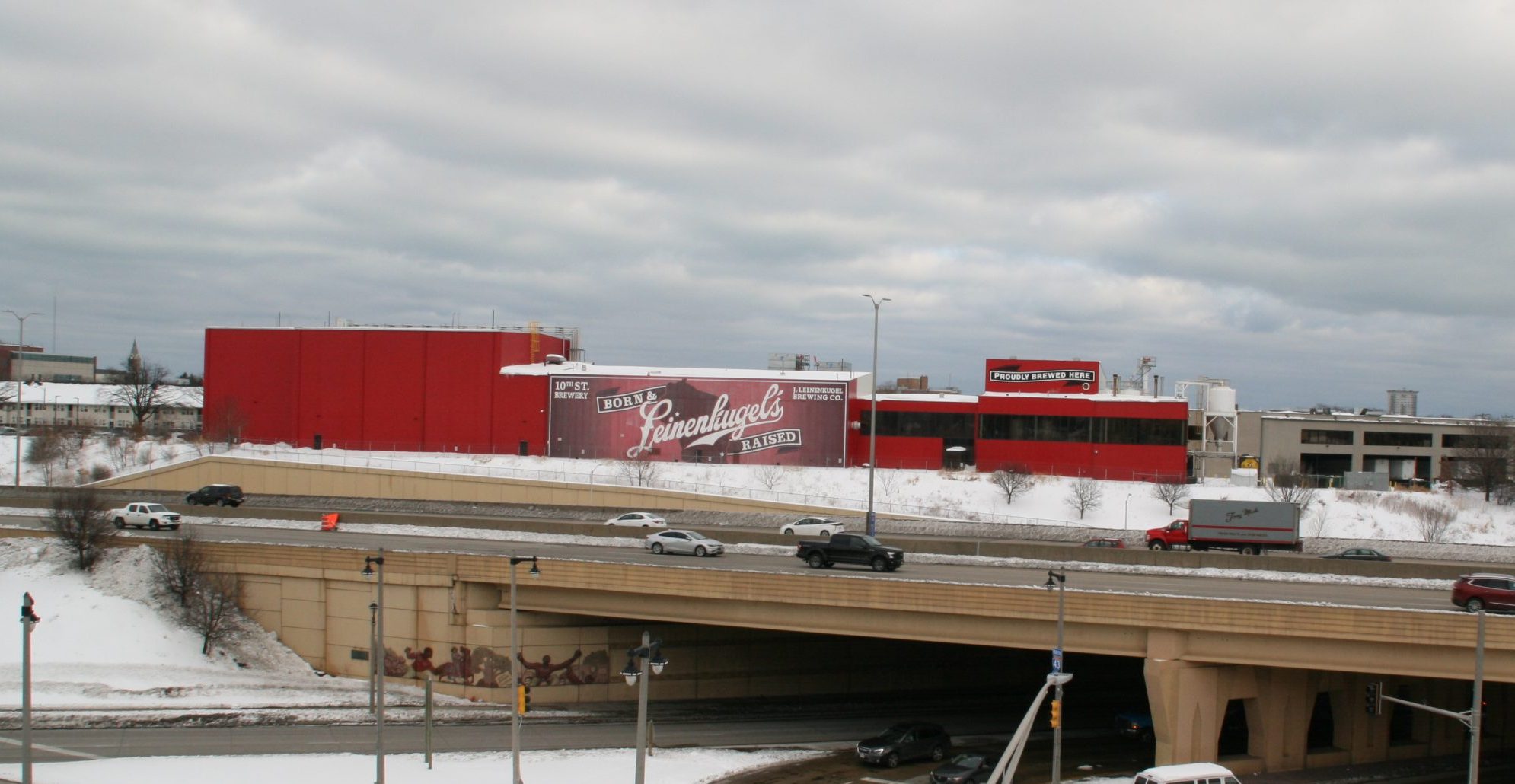
Fond du Lac Avenue ramp to Interstate 43 located in background near brewery. Photo by Jeramey Jannene.
Milwaukee will honor a prominent civil rights leader with a historic marker near the site of his childhood home.
Malcolm X lived in Milwaukee from 1926 until 1929, but the home is long gone.
“What happened to the house? Well, the expressway happened,” said Historic Preservation Commission senior planner Tim Askin to the commission on Monday.
You can find the home’s location, 1012 W. Galena St., in the middle of the northbound W. Fond du Lac Ave. on-ramp to Interstate 43.
“The only thing that can be said in Milwaukee’s defense is that the family had been gone nearly 40 years, and I doubt anyone remembered them being here,” said Askin.
Originally known as Malcolm Little, he was born in Omaha, Nebraska, in 1925, but the Little family moved to Milwaukee in December 1926. His father, Earl Little, was a Baptist minister and organizer for Black nationalist leader Marcus Garvey’s Universal Negro Improvement Association. After a short stay in Milwaukee, the family moved to Lansing, Michigan, in 1929.
The marker, unanimously approved by the commission Monday, will be installed on the W. Walnut Street bridge overlooking the onramp.
The Wisconsin Department of Transportation has already approved the location. “We tried a couple other locations, that was the only one they agreed to,” said Askin. “You can see where the house was. It works.”
Askin said definitive historical records have not been found to determine if it was the front or rear home on the lot. Research has determined that the home would have been near the signals located at the end of the ramp.
Malcolm Little’s childhood was filled with tragedy. His father was killed in a collision with a streetcar in Lansing, and his mother was institutionalized. Malcolm was separated from his siblings and placed in foster care.
As an adult, Malcolm X became one of the most influential and controversial figures of the 20th century. While incarcerated in the 1940s for larceny, he joined the Nation of Islam, emerging after his release as a powerful minister and national spokesperson. He preached Black self-determination, racial pride and economic independence, sharply criticized white supremacy and what he viewed as the slow pace of integrationist civil rights strategies. His speeches, direct and unsparing, made him a central voice in the struggle for racial justice during the 1950s and early 1960s.
After breaking with the Nation of Islam in 1964, Malcolm traveled to Mecca, embraced Sunni Islam and began articulating a more global vision of human rights, seeking to link the African American freedom struggle to anti-colonial movements worldwide. He founded Muslim Mosque, Inc., and the Organization of Afro-American Unity before his assassination in 1965 at age 39.
At the same time Malcolm X was rising to his peak of fame, Milwaukee was in the process of demolishing more than 8,000 homes and businesses to construct the Marquette Interchange and Interstate 43.
The historic marker resolution is sponsored by Common Council members Russell W. Stamper, II and Lamont Westmoreland. A fiscal note detailing the cost is not attached to the resolution. It is expected to be approved by the council.
Milwaukee Public Schools previously honored the civil rights leader with a school, Malcolm X Academy, but the building was shuttered in 2007. It is now the site of Rufus King International Middle School.
The plaque on W. Walnut Street wouldn’t be the only historic marker at the interchange. A mural of escaped slave Joshua Glover being freed from custody is located along W. Fond du Lac Avenue as it passes under Interstate 43.
Legislation Link - Urban Milwaukee members see direct links to legislation mentioned in this article. Join today
Existing members must be signed in to see the interactive map. Sign in.
If you think stories like this are important, become a member of Urban Milwaukee and help support real, independent journalism. Plus you get some cool added benefits.
Political Contributions Tracker
Displaying political contributions between people mentioned in this story. Learn more.




















Thanks to Alders Westmoreland and Stamper. Never too late to celebrate history.
The effect of freeway land acquisition was tough all over, but arguably the Bronzeville neighborhood got the worst of it. During the most recent MU interchange project, a number of overpasses were rebuilt – including Walnut Street. The DOT designed it with some decorative homages to Bronzeville embedded in the sidewalk walls. These too have become a metaphor for the insensitivity of urban freeway construction as they are badly deteriorated without a plan and/or budget to respectfully maintain this small reminder of what was lost.
The federal interstate was located in segregated Black neighborhoods across the country.
Milwaukee’s Bronzeville community was a vibrant, thriving area. Black citizen’s quality of life was good.